
Grass Types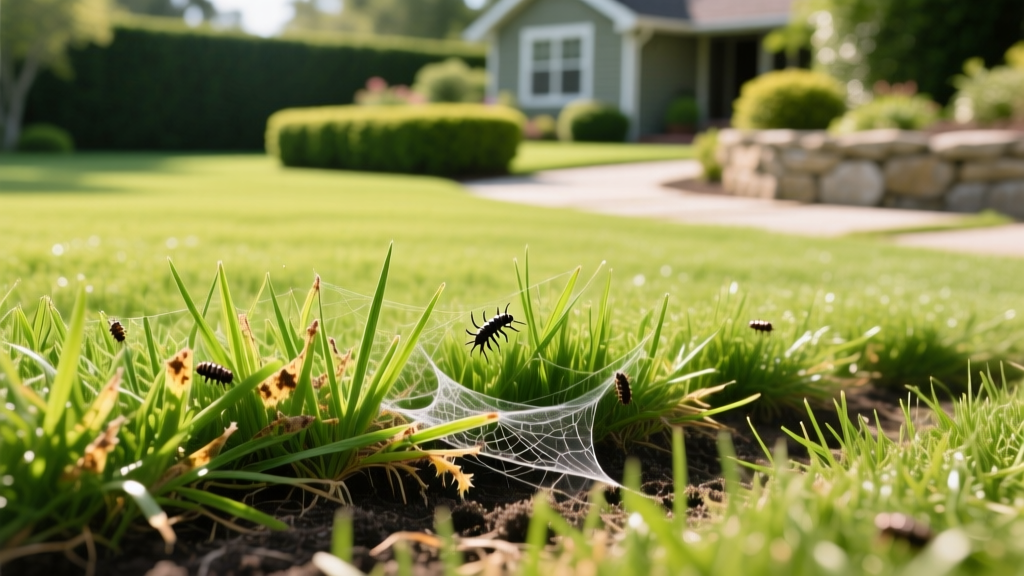
Proven Sod Webworm Control Tactics for Warm-Season Lawns
The 72-Hour Threat: Identifying Webworm Damage
Tropical sod webworms (Herpetogramma phaeopteralis) and their cooler-climate cousins (Crambus spp.) can skeletonize a St. Augustine, Bermudagrass, or Zoysia lawn in under 72 hours. Unlike grubs that attack the root system, webworm larvae chew directly through the leaf tissue, leaving behind a ragged, scorched appearance that homeowners frequently misdiagnose as drought stress or fertilizer burn. According to the University of Florida IFAS Extension, the tropical sod webworm has become a dominant pest in the Gulf Coast and Southeastern United States, capable of producing three to four overlapping generations between April and November.
Effective sod webworm control requires abandoning broad-spectrum, preventative calendar spraying in favor of targeted, instar-specific interventions. The larvae are most vulnerable during their first and second instars (when they are less than 0.25 inches long). Once they reach the fifth or sixth instar, their consumption rate increases exponentially, and their biological resistance to standard treatments spikes.
Diagnostic Matrix: Drought Stress vs. Webworm Infestation
Before purchasing any chemical controls, you must confirm the presence of the pest. Misidentifying drought stress as a webworm infestation leads to unnecessary chemical applications and further turf degradation. Use this diagnostic framework to differentiate the two:
| Symptom | Drought / Heat Stress | Sod Webworm Infestation |
|---|---|---|
| Leaf Edge Appearance | Rolled, folded, or uniformly wilted | Notched, ragged, or completely sheared off |
| Turf Color | Dull, bluish-gray tint fading to straw | Patches of brown with green, chewed stubble |
| Soil & Thatch | Dry, hydrophobic, hard to penetrate | Presence of small, green pellet-like frass (feces) |
| Root System | Stunted but intact when pulled | Roots fully intact; only leaf blades detach easily |
| Activity Time | Constant throughout the day | Damage accelerates at night; larvae hide in thatch by day |
The Soapy Flush Test: Confirming the Infestation
Visual inspection of the thatch layer is rarely sufficient because the larvae are nocturnal and highly sensitive to light and vibration. To confirm an active infestation, perform a soapy flush test. Mix 2 tablespoons of lemon-scented liquid dish soap into 1 gallon of water. Pour this solution evenly over a 1-square-yard area at the margin of the damaged turf and the healthy turf. The soap irritates the larvae's cuticle, forcing them to the surface within 3 to 5 minutes. If you see more than 3 to 5 larvae per square yard, treatment is economically justified.
Biological Eradication: Btk and Nematodes
For homeowners managing pets, children, or pollinator-sensitive landscapes, biological controls offer a highly effective, low-toxicity alternative to synthetic pyrethroids. The gold standard for biological sod webworm control is Bacillus thuringiensis var. kurstaki (Btk).
Critical Failure Mode: Btk Timing
Btk is a stomach poison that produces Cry proteins binding to the alkaline midgut receptors of caterpillars. It only works if the larvae ingest it. If you apply Btk when the webworms are in their 4th instar or larger (greater than 0.5 inches), they will simply stop feeding before ingesting a lethal dose, rendering the treatment useless. Apply Btk immediately after the soapy flush confirms the presence of small, early-stage larvae.
Recommended Btk Products & Rates:
- Monterey B.t. (Liquid): Apply at a rate of 1.5 to 2 ounces per 1,000 square feet. Mix with enough water to ensure thorough coverage of the leaf blades, as the larvae must eat the treated foliage.
- Dipel Pro DF (Dry Flowable): A professional-grade formulation containing 50% Btk. Apply at 0.25 to 0.5 ounces per 1,000 square feet. This is highly cost-effective for lawns exceeding 5,000 square feet.
For soil-dwelling pupae, beneficial nematodes (Steinernema carpocapsae) can be applied via hose-end sprayer at a rate of 1 billion nematodes per 2,000 square feet. Nematodes require immediate irrigation post-application to survive the UV exposure and migrate into the thatch layer.
Chemical Playbook: Pyrethroids and Oxadiazines
When an infestation is severe and the larvae have matured past the Btk window, synthetic insecticides are required to halt the defoliation. The NC State Extension notes that resistance to older carbamates (like Carbaryl) is rising, making modern pyrethroids and oxadiazines the superior choice for rapid knockdown.
Active Ingredient Comparison
Bifenthrin (Pyrethroid): Found in products like Talstar P and Bifen XTS. Provides rapid contact knockdown and up to 30 days of residual surface control. Cost: ~$45 for a 32 oz bottle of Talstar P (covers ~20,000 sq ft).
Chlorantraniliprole (Anthranilic Diamide): Found in Acelepryn. Slower acting (3-5 days for full control) but offers exceptional systemic movement and low toxicity to non-target organisms. Cost: ~$160 for an 8 oz commercial bottle, but requires only 0.1 oz per 1,000 sq ft, making the cost-per-application highly competitive.
Step-by-Step Application Protocol
To maximize the efficacy of your chosen chemical or biological treatment, follow this exact operational sequence:
- Mow the Turf: Mow the lawn at the lowest recommended height for your specific grass type (e.g., 1.5 inches for Bermudagrass, 2.5 inches for St. Augustine). This removes heavily damaged leaf tissue and exposes the thatch layer where the larvae hide.
- Irrigate Lightly: Apply 0.1 inches of water (about 5 minutes of standard sprinkler runtime) to encourage the larvae to move closer to the surface before the treatment.
- Apply the Treatment: Spray liquid formulations in the late afternoon or early evening. Sod webworms are nocturnal feeders; applying the chemical at dusk ensures the residue is fresh when they emerge to feed. Use a flat-fan nozzle for even distribution.
- Water-In (Chemicals Only): If using a granular product or a soil-active liquid like Acelepryn, irrigate immediately with 0.25 inches of water to wash the active ingredient off the leaf blades and into the thatch. Note: Do not water in Btk; it must remain on the foliage to be ingested.
- Delay the Next Mowing: Wait at least 48 to 72 hours before mowing again to allow the larvae to consume the treated foliage and for the chemical to fully bind to the plant tissue.
Post-Treatment Turf Recovery
Eradicating the webworms only solves half the problem; the turf must now recover from severe defoliation. Avoid applying high-nitrogen synthetic fertilizers (like 30-0-0) immediately after treatment, as this forces rapid, weak cellular growth that is highly susceptible to secondary fungal infections like Brown Patch (Rhizoctonia solani).
Instead, apply a slow-release, organic-based nitrogen source such as Milorganite (5-2-0) at a rate of 32 lbs per 2,500 square feet. The slow-release iron and nitrogen will stimulate deep root regeneration and lateral stolon spread without pushing vulnerable top-growth. Pair this with a liquid kelp extract application (e.g., Simple Grow Solutions Sea Kelp) at 2 oz per 1,000 square feet to mitigate the oxidative stress caused by the defoliation event. With proper recovery protocols, a healthy warm-season lawn will completely fill in the skeletonized patches within 14 to 21 days during the peak summer growing season.

