Grass Types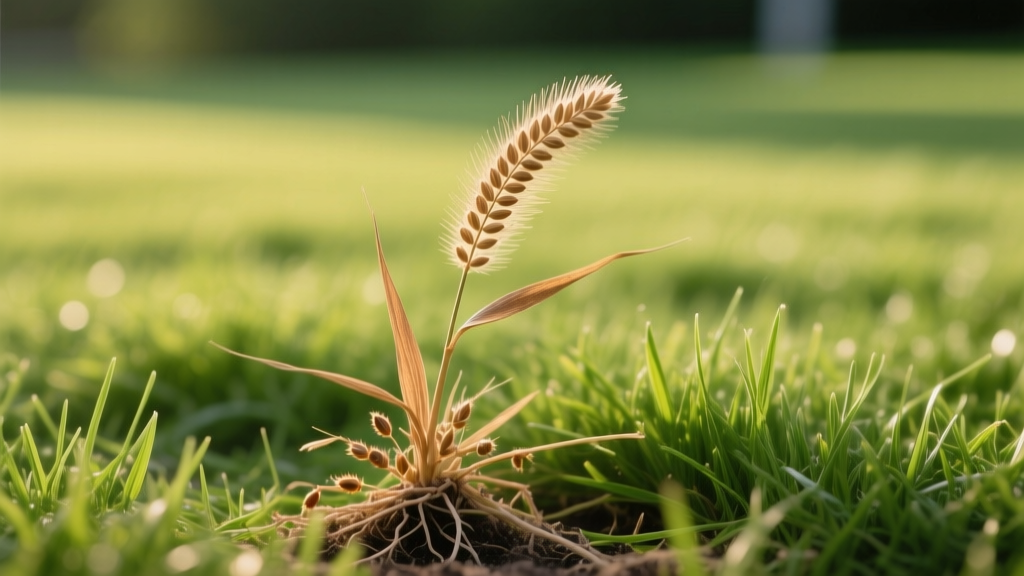
How to Spot-Treat a Mature Crabgrass Seed Head Effectively
A single mature crabgrass plant (Digitaria sanguinalis or Digitaria ischaemum) can produce up to 150,000 seeds in a single season. Once the distinctive, finger-like crabgrass seed head emerges—typically from late July through September—the plant shifts its biological priority from vegetative growth to rapid reproduction. During this phase, the plant thickens its waxy cuticle and develops deep, fibrous root systems, making it highly resistant to standard broadleaf weed killers and weak post-emergents.
Spot-treating a mature crabgrass seed head requires a fundamentally different approach than treating early-season seedlings. This guide details the exact chemical protocols, surfactant requirements, and physical removal strategies needed to neutralize seed heads before they shatter and infest your soil seed bank for the next decade.
The Seed Bank Threat: Crabgrass seeds can remain viable in the top two inches of soil for up to 30 years. Allowing even three mature seed heads to drop in a 1,000-square-foot area guarantees aggressive germination pressure the following spring, rendering standard pre-emergent applications less effective due to sheer biological volume.
The Biology of a Crabgrass Seed Head
Understanding the morphology of the seed head is critical for identifying the exact species and determining the optimal treatment window. Crabgrass seed heads are technically racemes—spike-like branches that radiate from a central stem.
Data Highlight: Species Identification
- Hairy Crabgrass (D. sanguinalis): Features 5 to 10+ racemes per seed head, often with a distinct purple tinge at the base. Leaves and sheaths are covered in fine hairs. Highly aggressive in thin, poorly maintained turf.
- Smooth Crabgrass (D. ischaemum): Features 2 to 6 racemes per seed head, lacking the purple tinge and leaf hairs. More common in dense, irrigated lawns and highly tolerant of close mowing.
When the seed heads first emerge, they are green and tightly folded. Within 7 to 14 days, they open, turn yellowish-brown, and begin to shatter (drop seeds) at the slightest mechanical disturbance, such as mowing or wind. Clemson University Extension notes that once the seeds turn yellow, chemical control is largely ineffective at preventing seed viability, necessitating immediate physical intervention.
Spot-Treatment Arsenal for Mature Seed Heads
Standard 2,4-D or Dicamba formulations will not kill crabgrass, as it is a monocot (grass), not a broadleaf weed. Furthermore, once the seed head is present, the plant's metabolic rate slows, reducing the translocation of systemic herbicides to the roots. You must use specific graminicides paired with a penetrating surfactant.
| Active Ingredient | Trade Name Examples | Efficacy on Mature Seed Heads | Surfactant Required? | Approx. Cost (Concentrate) |
|---|---|---|---|---|
| Quinclorac (18.9%) | Drive XLR8, Bayer Advanced Crabgrass Killer | High (with MSO) | Yes (Methylated Seed Oil) | $75 - $90 / 2.5 gal |
| Fenoxaprop-p-ethyl | Acclaim Extra, Bayer Grass-B-Gon | Moderate to High | No (built-in emulsifiers) | $100 - $120 / 1 gal |
| Glyphosate (41%) | Roundup Pro, Compare-N-Save | High (Non-selective) | No | $35 - $50 / 1 gal |
| MSMA (Discontinued/Banned) | N/A (Residential ban) | N/A | N/A | Illegal for residential use |
⚠️ Regulatory Warning: Do not attempt to source agricultural MSMA (Monosodium methanearsonate) for residential lawn care. The EPA phased out MSMA for residential use due to arsenic soil accumulation risks. Using agricultural formulations on home lawns is a federal violation and poses severe environmental hazards.
Step-by-Step Spot-Treatment Protocol
To effectively eradicate a mature crabgrass seed head without damaging the surrounding desirable turf (such as Fescue, Bermuda, or Zoysia), follow this precise application protocol.
Step 1: Mowing and Clipping Management
Raise your mower deck to 3.0 or 3.5 inches. Tall turf shades the soil, suppressing further crabgrass germination. However, if seed heads are already present, you must use a bagger. Mulching or side-discharging will violently shake the racemes, scattering thousands of viable seeds across your lawn. Empty the bagger directly into a sealed trash bag; never compost crabgrass seed heads, as residential compost piles rarely reach the 140°F sustained temperatures required to destroy the seeds.
Step 2: Mixing the Quinclorac Solution
Quinclorac is the gold standard for selective post-emergent crabgrass control. For mature plants with visible seed heads, mix the following in a 2-gallon pump sprayer for precise spot-treatment:
- Water: 1.5 gallons of clean water.
- Herbicide: 1.5 fluid ounces of Quinclorac (e.g., Drive XLR8). This yields a concentrated spot-treatment rate.
- Surfactant: 1.5 fluid ounces of Methylated Seed Oil (MSO). Critical: Do not use standard non-ionic surfactants (NIS) or dish soap. MSO is required to dissolve the thick, waxy cuticle of mature crabgrass leaves and stems.
- Dye: 2 drops of turf-marking blue dye to track your spray pattern and avoid overlapping, which can cause temporary yellowing in desirable turf.
Step 3: Application Technique
Spray the crabgrass clump until the leaves are uniformly wet, but not to the point of runoff. Dripping herbicide wastes product and increases soil residual, which can stunt the roots of surrounding desirable grass. Apply during the early morning when temperatures are between 65°F and 85°F. Avoid spraying if rain is forecast within 24 hours or if wind speeds exceed 5 mph.
Step 4: The 14-Day Rule and Physical Removal
Quinclorac mimics plant auxins, causing unregulated, fatal growth. Within 5 to 7 days, the crabgrass will turn purple, then brown. Wait 14 days. If the center crown is still green, apply a second, lighter dose. If the seed heads were fully yellow and dropping at the time of spraying, chemical control will kill the plant but will not sterilize the dropped seeds. In this scenario, use a weeding tool like the Fiskars Stand-Up Weeder to extract the entire root crown, then immediately apply a localized pre-emergent.
Post-Treatment: Securing the Lawn for Next Spring
Killing mature crabgrass in late summer leaves bare, circular patches in your lawn. These patches are prime real estate for winter annual weeds like Poa annua (annual bluegrass) and Henbit.
- Early Fall (Late August - September): Overseed the bare spots with a region-appropriate turfgrass. For cool-season lawns, use a Turf-Type Tall Fescue blend at a rate of 5 to 8 lbs per 1,000 sq ft. Keep the seed consistently moist for 14 days.
- Spring Pre-Emergent Timing: Because you allowed seed heads to mature this year, your soil seed bank is heavily loaded. Next spring, you must apply a pre-emergent (such as Prodiamine or Dithiopyr) exactly when soil temperatures at a 2-inch depth reach 55°F for three consecutive days. According to Purdue University Turfgrass Science, relying on calendar dates (like 'April 15th') is a common failure point; soil temperature is the only reliable metric for crabgrass germination triggers.
Frequently Asked Questions
Can I just pull the seed heads off and leave the plant?
No. Crabgrass is an annual plant, meaning its sole biological purpose is to produce seed. If you snap off the seed heads, the plant will immediately redirect stored carbohydrates from its roots to push out a secondary, smaller flush of seed heads within 7 to 10 days. You must kill or extract the entire plant.
Will a pre-emergent herbicide kill existing crabgrass seed heads?
No. Pre-emergents (like Dimension or Barricade) work by creating a chemical barrier in the top half-inch of soil that inhibits cell division in germinating seeds. They have zero post-emergent activity on mature plants or visible seed heads. Applying pre-emergent in late summer to stop current seed heads is a waste of product and will interfere with your fall overseeding plans.
Is it safe to use Quinclorac on St. Augustine grass?
Proceed with extreme caution. While Quinclorac is safe for Bermuda, Zoysia, Fescue, and Kentucky Bluegrass, it can cause severe phytotoxicity (stunting and yellowing) in St. Augustine and Centipede grass. For these sensitive warm-season turf types, spot-treating mature crabgrass with a carefully painted application of Glyphosate using a sponge brush is the safest alternative, followed by immediate sod replacement in the fall.