Grass Types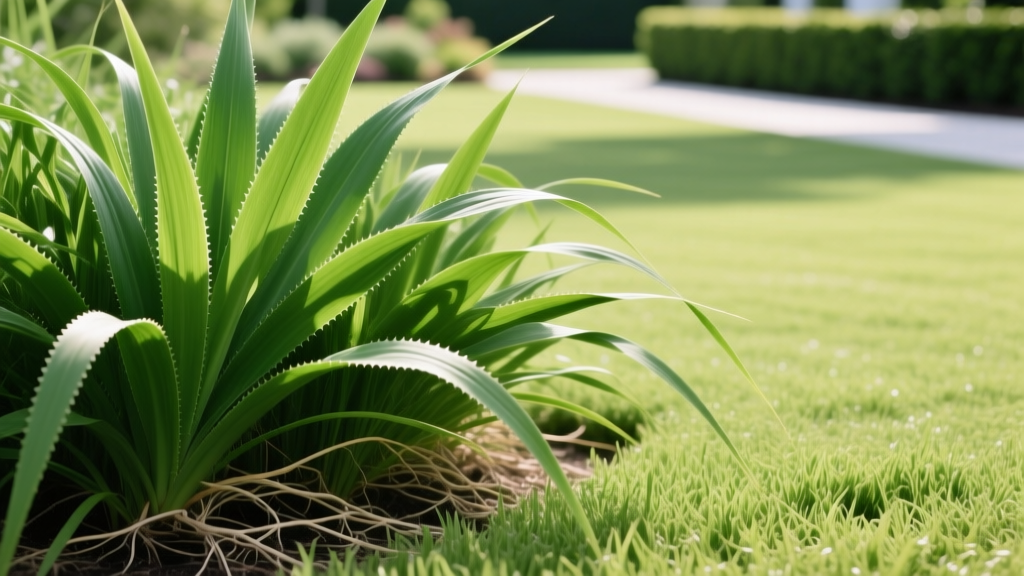
What Does St. Augustine Grass Look Like? Identification Guide
Identifying warm-season turfgrass correctly is the foundational step for proper lawn care, particularly when selecting herbicides and fertilizers. St. Augustine grass (Stenotaphrum secundatum) is the dominant turfgrass in coastal and subtropical regions of the United States, prized for its shade tolerance and salt resistance. However, homeowners frequently misidentify it as Centipede or Zoysia grass, leading to severe chemical damage from inappropriate weed control products. This guide breaks down the exact visual markers of St. Augustine grass, its specific cultivars, and how to distinguish it from common look-alikes.
Core Visual Characteristics of St. Augustine Grass
When asking what St. Augustine grass looks like, you must examine both the individual leaf blade and the overall growth habit. Unlike bunch-type grasses, St. Augustine spreads laterally, creating a dense, carpet-like mat.
Blade Architecture and Texture
The most definitive identifier of St. Augustine grass is its leaf blade. The blades are distinctly broad, typically measuring between 8mm and 10mm (roughly 0.31 to 0.39 inches) across at the base. The texture is notably coarse and somewhat spongy to the touch compared to finer turfgrasses.
- Leaf Tip: The tip is blunt, rounded, or "boat-shaped." It never tapers to a sharp point like Bermuda or Zoysia grass.
- Color: Healthy St. Augustine ranges from medium green to a deep, dark blue-green. If your lawn has a distinct lime-green or yellowish cast, it is likely Centipede grass or suffering from iron chlorosis.
- Vernation: The leaves are folded in the bud (vernation), which creates a prominent, raised midrib running down the center of the blade.
Growth Habit and Stolons
St. Augustine does not produce rhizomes (underground stems). Instead, it spreads exclusively via thick, above-ground runners known as stolons. These stolons are highly visible, often rooting at the nodes to produce new vertical shoots. In mature lawns, the stolons create a spongy, thatch-heavy layer that can exceed 0.5 inches in depth if not regularly dethatched or managed with proper mowing heights.
Quick Field Identification Test: Grab a single grass blade and run your fingers from the base to the tip. If the blade is wider than a standard wooden pencil, feels coarse, and ends in a rounded, boat-like tip attached to a thick, visible surface runner, you are looking at St. Augustine grass.
St. Augustine vs. Common Look-Alikes
Misidentifying St. Augustine grass can be costly. For instance, applying herbicides containing MSMA or high concentrations of 2,4-D—often marketed for Centipede or Bermuda grasses—will severely burn or kill St. Augustine turf. Use the comparison matrix below to verify your grass type.
| Feature | St. Augustine | Centipede | Zoysia (e.g., Emerald) | Bahia |
|---|---|---|---|---|
| Blade Width | 8 - 10 mm (Broad) | 4 - 6 mm (Moderate) | 2 - 4 mm (Fine to Moderate) | 6 - 12 mm (Very Broad) |
| Leaf Tip Shape | Blunt / Boat-shaped | Pointed but slightly rounded | Sharp / Pointed | Pointed / Folded |
| Primary Color | Dark Blue-Green | Light Apple / Yellow-Green | Medium to Dark Green | Light Green |
| Growth Habit | Above-ground Stolons | Above-ground Stolons | Stolons & Rhizomes | Short Rhizomes / Bunching |
| Texture | Coarse, Spongy | Moderate, Smooth | Wiry, Dense, Stiff | Coarse, Ribbed |
Visual Differences Among Popular Cultivars
Not all St. Augustine grass looks identical. Plant breeders have developed specific cultivars to address shade tolerance, disease resistance, and cold hardiness. When purchasing sod in 2026, expect to pay between $0.55 and $0.95 per square foot depending on the cultivar and your region. Here is how the most common varieties differ visually:
- Floratam: The industry standard since the 1970s. Floratam features the widest blades and longest internodes (the space between nodes on the stolon), giving it a slightly more open, "leggy" appearance compared to newer varieties. It requires at least 6 hours of direct sunlight.
- Palmetto: Visually distinct due to its finer texture and shorter internodes, creating a denser, tighter carpet. The color is a slightly lighter, vibrant green. It is highly favored for its superior shade tolerance.
- Seville: A dwarf cultivar with noticeably shorter, narrower leaf blades. Seville maintains a lower growth habit, meaning it requires less frequent mowing, and presents a very dense, manicured appearance.
- CitraBlue: A newer release from the University of Florida. CitraBlue features a striking, deep blue-green hue that is noticeably darker than Floratam. Its blades are slightly folded along the midrib, giving the lawn a textured, rippled look from a distance.
Seasonal Appearance Shifts
Understanding what St. Augustine grass looks like requires recognizing its seasonal dormancy cycles. As a warm-season grass, its visual profile changes drastically with temperature fluctuations.
Winter Dormancy
When soil temperatures consistently drop below 55°F, St. Augustine enters dormancy. The blades will lose their chlorophyll, turning a uniform straw-brown or tan color. Crucial distinction: Dormant St. Augustine will have firm, white-to-cream-colored roots and crowns. If the grass pulls up effortlessly with black, rotting roots, the brown appearance is caused by Take-All Root Rot (TARR) or winter kill, not natural dormancy.
Spring Green-Up
During the transition in early spring, the lawn often exhibits a "mottled" appearance, featuring a mix of green shoots emerging from a base of brown, dormant blades. This is normal. Applying high-nitrogen fertilizers before the grass is 100% green can force premature growth that is highly susceptible to late-spring frost damage.
Identifying Visual Stress and Pathogens
St. Augustine grass is prone to specific pests and diseases that alter its visual profile. Accurate identification of these symptoms is critical for targeted treatment.
Warning: Chinch Bug Damage vs. Drought Stress
Chinch bugs (Blissus insularis) inject a toxin that causes the grass to yellow and die. Visually, this mimics drought stress. However, drought stress occurs uniformly across dry areas, while chinch bug damage appears as irregular, expanding yellow halos that quickly turn brown, usually starting near heat-radiating surfaces like concrete driveways or sidewalks. Part the grass at the border of the brown patch; if you see tiny black insects with white hourglass markings scurrying at the soil line, you have chinch bugs.
Chinch bugs (Blissus insularis) inject a toxin that causes the grass to yellow and die. Visually, this mimics drought stress. However, drought stress occurs uniformly across dry areas, while chinch bug damage appears as irregular, expanding yellow halos that quickly turn brown, usually starting near heat-radiating surfaces like concrete driveways or sidewalks. Part the grass at the border of the brown patch; if you see tiny black insects with white hourglass markings scurrying at the soil line, you have chinch bugs.
Other visual indicators include:
- Brown Patch (Large Patch): Caused by Rhizoctonia solani, this fungus presents as circular, expanding patches of brown, blighted grass. A distinct "smoke ring" of dark, water-soaked margins may be visible at the edge of the patch in the early morning.
- Gray Leaf Spot: Appears as small, oval, brown lesions with gray, fuzzy centers on the leaf blades. It is most prevalent during periods of high humidity and frequent evening irrigation.
- Iron Chlorosis: New growth emerges pale yellow or almost white, while the leaf veins remain green. This is an iron deficiency common in high-pH soils, easily corrected with chelated iron applications.
"The most common mistake homeowners make with St. Augustine is treating it like Centipede grass based on a superficial glance. Centipede has a distinct apple-green color and a much narrower blade. Applying a standard Centipede weed-and-feed containing atrazine at high rates to St. Augustine during high heat will cause severe phytotoxicity. Always verify the boat-shaped leaf tip before selecting your herbicide."
— Turfgrass Management Guidelines, University of Florida IFAS Extension
For comprehensive regional data on turfgrass pathology and cultivar performance, homeowners should consult the NC State University TurfFiles database, which provides updated visual diagnostic tools and management frameworks for warm-season grasses.
By closely examining the blade width, tip shape, stolon structure, and overall color, you can confidently identify St. Augustine grass and tailor your mowing, watering, and chemical applications to keep it thriving.