
Grass Types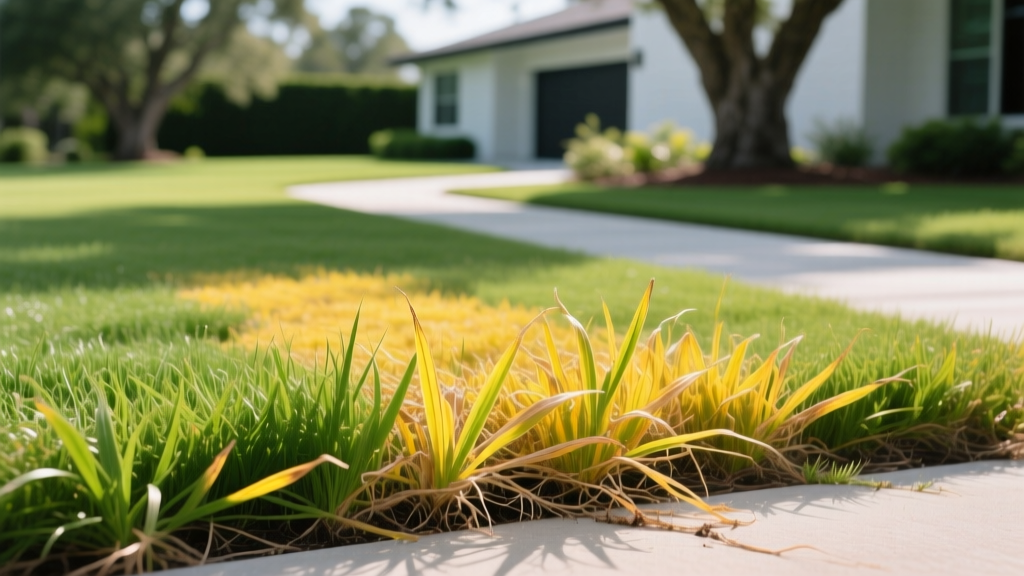
St. Augustine Grass Turning Yellow: Diagnosis and Rescue Fixes
When St. Augustine grass (Stenotaphrum secundatum) begins turning yellow, it is signaling a specific physiological distress. Unlike cool-season grasses that may yellow uniformly from winter dormancy, St. Augustine is a warm-season species that demands precise soil chemistry, moisture levels, and pest management to maintain its deep blue-green hue. Broad-spectrum fertilizers often fail to correct the issue because the underlying trigger—whether it is high-pH iron lockout, Take-All Root Rot, or chinch bug feeding—requires a targeted intervention.
This diagnostic guide bypasses generic advice to provide exact measurements, product formulations, and a 14-day rescue protocol to restore your lawn.
The Triage Protocol: Identifying the Yellowing Pattern
Before purchasing any amendments, map the visual symptoms. The pattern of yellowing dictates the treatment. Use this decision matrix to isolate the primary suspect.
| Visual Symptom Pattern | Root / Soil Condition | Primary Suspect | Immediate Diagnostic Action |
|---|---|---|---|
| Yellow leaves with distinct green veins (interveinal chlorosis) | Roots healthy; soil pH likely > 7.0 | Iron Chlorosis | Test soil pH; apply Fe-EDDHA chelated iron |
| Uniform pale green to yellow across entire lawn | Roots healthy; no distinct lesions | Nitrogen Deficiency | Apply fast-release nitrogen (Urea) at 0.5 lb N/1000 sq ft |
| Yellowing patches that pull up easily; black, rotted roots | Roots blackened, sloughing off; thatch > 0.5 inches | Take-All Root Rot (TARR) | Apply Azoxystrobin fungicide; top-dress with peat moss |
| Yellowing at the base of runners; localized dead spots | Roots intact; tiny black/white insects at soil line | Southern Chinch Bugs | Perform coffee can flush test |
Nutrient Lockout: Iron Chlorosis vs. Nitrogen Deficiency
The most common reason for St. Augustine grass turning yellow in the Sun Belt is iron chlorosis, frequently misdiagnosed as a simple nitrogen deficiency. St. Augustine thrives in a soil pH between 6.0 and 6.5. When soil pH creeps above 7.0 (common in areas with alkaline municipal water or limestone-heavy soils), iron becomes chemically locked in the soil and unavailable to the roots.
The Iron Chlorosis Fix (High pH Soils)
If your soil test confirms a pH above 7.0, applying standard iron sulfate will not work; it will oxidize and become useless before the grass can absorb it. You must use a specific chelated iron formulation.
Expert Formulation Rule: For soil pH between 6.5 and 7.0, Fe-EDTA chelated iron is sufficient. For soil pH above 7.0, you must use Fe-EDDHA chelated iron (often labeled as 'red iron' due to its dark red liquid color). Products like Southern Ag Chelated Liquid Iron or LawnStar Chelated Liquid Iron ($20–$28 per 32 oz bottle) contain the correct EDDHA chelate.
Application Rate: Mix 3 ounces of Fe-EDDHA liquid iron per 1,000 square feet with 1 gallon of water. Spray in the late evening to prevent leaf burn. You will see the grass green up within 48 to 72 hours. Note that this is a foliar rescue, not a permanent soil fix. To permanently lower soil pH, apply elemental sulfur at a rate of 1 to 2 lbs per 1,000 square feet in the fall.
The Nitrogen Deficiency Fix
If the yellowing is uniform and the soil pH is optimal (6.0–6.5), the lawn is likely nitrogen-starved. Avoid 'weed and feed' combinations during a stress period. Instead, apply a dedicated nitrogen source.
- Quick Rescue: Apply Urea (46-0-0) at a rate of 1 lb of product per 1,000 square feet (yielding 0.46 lbs of actual N). Water in immediately with 0.25 inches of irrigation.
- Sustained Recovery: Follow up 14 days later with a slow-release organic nitrogen like Milorganite (6-4-0) at 16 lbs per 1,000 square feet to provide steady feeding without forcing rapid, disease-susceptible growth.
Pathogen Attack: Take-All Root Rot (TARR)
Take-All Root Rot, caused by the fungus Gaeumannomyces graminis var. graminis, is a devastating disease for St. Augustine lawns, particularly in Texas and the Gulf Coast. According to Texas A&M AgriLife Extension, TARR thrives in soils with a pH between 6.0 and 7.0 and is exacerbated by excessive thatch and shade.
Confirming TARR
Grab a handful of the yellowing grass and pull upward. If the stolons (runners) detach easily from the soil and the roots look black, short, and rotted rather than white and fibrous, you are dealing with TARR. The leaves may also exhibit a yellow mottling before turning brown.
The Dual-Action Rescue Protocol
Curing TARR requires altering the soil surface environment while suppressing the pathogen.
- Fungicide Application: Apply a preventative/curative fungicide containing Azoxystrobin (e.g., Scotts DiseaseEX granular at $25 for a 10lb bag, or Syngenta Heritage SC liquid). Apply at the curative rate of 4 oz per 1,000 square feet (liquid equivalent) and water in with 0.25 inches of water to move the active ingredient into the root zone.
- Peat Moss Top-Dressing: Apply a 1-inch layer of Canadian Sphagnum peat moss (which has a highly acidic pH of 3.5–4.5) over the affected areas. Research shows this localized acidification severely restricts TARR fungal growth. Use roughly 1 bale per 1,000 square feet of affected turf.
Pest Vectors: The Chinch Bug Coffee Can Test
Southern chinch bugs (Blissus insularis) pierce the grass blades and inject a salivary toxin that blocks water transport, causing the grass to yellow and die rapidly in hot, sunny patches. Because they hide in the thatch, they are easily missed.
Executing the Coffee Can Test
Remove both ends of a standard metal coffee can. Push the can 2 inches into the soil at the margin where the yellowing grass meets the green grass. Fill the can with water and wait 5 minutes. Count the bugs that float to the surface. According to the University of Florida IFAS, if you count more than 4 to 5 chinch bugs per can, treatment is required.
Rescue Treatment: Apply a liquid insecticide containing Bifenthrin or Imidacloprid (such as Ortho BugClear Lawn Insect Killer). Liquid formulations penetrate the thatch layer far better than granular options for immediate knockdown. Apply in the early morning when bugs are near the surface, using 2 gallons of mixed solution per 1,000 square feet to ensure deep thatch penetration.
Environmental Stress: Correcting the Irrigation Cycle
St. Augustine requires 1 to 1.25 inches of water per week during peak summer. However, daily shallow watering (e.g., 10 minutes every morning) promotes shallow root systems and creates the high-humidity thatch environment where fungal pathogens thrive. If your grass is yellowing and the soil is constantly damp, you are suffocating the roots.
Warning: Never water St. Augustine grass at night. Watering between 8 PM and 4 AM extends the leaf wetness period beyond 12 hours, virtually guaranteeing a Gray Leaf Spot or Brown Patch outbreak.
The Cycle and Soak Method: For compacted clay soils common in the South, program your irrigation controller to water in three cycles of 10 minutes each, spaced 30 minutes apart, twice a week. This delivers the required volume without causing surface runoff, forcing roots to grow deeper to chase the moisture.
Step-by-Step 14-Day Rescue Plan
If your lawn is suffering from a combination of stressors, follow this sequential timeline to avoid chemical burn and product antagonism.
- Day 1: Perform soil pH test and coffee can pest test. Mow the lawn to 3.5 inches, removing no more than 1/3 of the blade. Bag the clippings to remove potential fungal spores and thatch buildup.
- Day 2: Apply Azoxystrobin fungicide if TARR is suspected. Water in with 0.25 inches of irrigation.
- Day 5: Apply Fe-EDDHA chelated iron (if pH > 7.0) OR Urea nitrogen (if pH is optimal). Do not mix iron and fungicides in the same tank.
- Day 8: Apply Bifenthrin insecticide if the coffee can test yielded > 5 chinch bugs.
- Day 14: Apply slow-release nitrogen (Milorganite) and top-dress TARR-affected zones with Sphagnum peat moss.
Frequently Asked Questions
Will yellow St. Augustine grass turn green again?
Yes, if the crown and stolons (runners) are still firm and white inside. If the yellowing is caused by nutrient deficiency, chinch bugs, or environmental stress, the existing tissue will recover its green pigmentation within 7 to 14 days of the correct treatment. However, if the grass has progressed to brown and the stolons are brittle or black (indicating TARR or severe drought desiccation), that specific tissue is dead and will require replugging or sodding.
Should I mow my lawn while it is yellowing?
Reduce your mowing frequency and raise your mower deck to 3.5 or 4 inches. St. Augustine relies on its broad leaf surface area for photosynthesis. Scalping a stressed, yellowing lawn removes its remaining energy-producing tissue and exposes the vulnerable soil surface to weed invasion and moisture loss. As noted by the Clemson University Home & Garden Information Center, maintaining a higher canopy is critical for shade-tolerant St. Augustine varieties like 'Palmetto' or 'Seville' to outcompete weeds and retain soil moisture during recovery.

