
Grass Types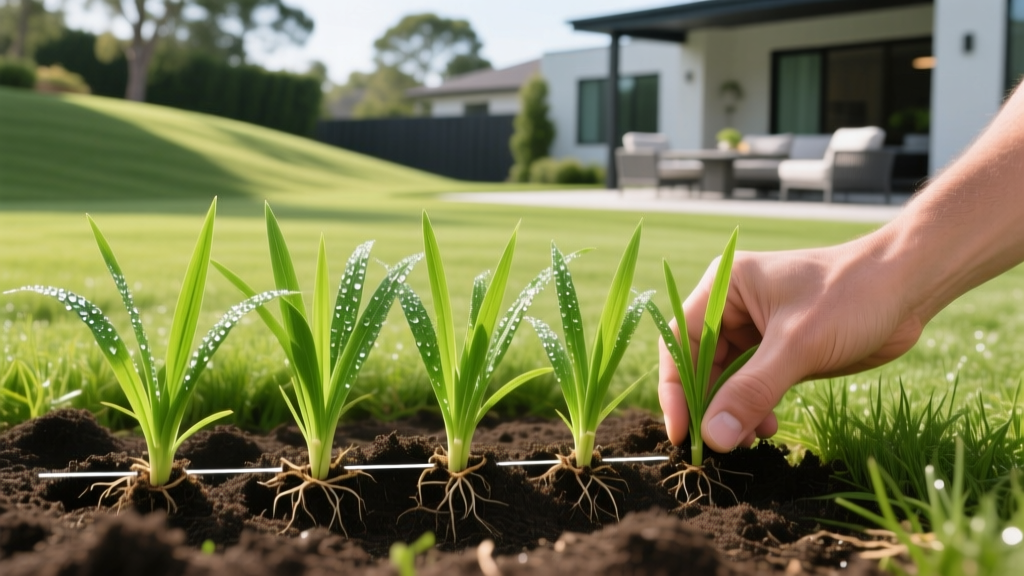
Planting St Augustine Plugs: Spacing, Timing, and Care Guide
Why Vegetative Propagation is Mandatory for St. Augustine
Unlike Bermuda or Zoysia, St. Augustine grass (Stenotaphrum secundatum) produces very little viable seed. Commercial seed varieties simply do not exist, meaning homeowners must rely entirely on vegetative propagation—sod, sprigs, or plugs. For budget-conscious lawn renovations or patching thin areas, planting St Augustine plugs offers the highest return on investment. While sod costs between $0.45 and $0.85 per square foot (totaling $450–$850 for a 1,000 sq ft yard), plugs cost roughly $0.65 to $1.10 each. By utilizing a 12-inch spacing grid, you can establish a 1,000 sq ft lawn for under $700, trading capital for a 3-to-5-month establishment timeline.
Cultivar Selection Matters: Do not just buy generic "St. Augustine." Look for CitraBlue (excellent shade tolerance and resistance to gray leaf spot), Floratam (the industry standard for chinch bug resistance), or Palmetto (superior cold tolerance for transitional zones).
The Ideal Timing Window and Regulatory Constraints
St. Augustine is a warm-season grass that requires soil temperatures consistently above 70°F to initiate stolon (runner) growth. The optimal planting window is late spring to early summer. However, you must factor in local environmental regulations before planning your soil prep.
Navigating Summer Fertilizer Blackouts
Many coastal and southern states, notably Florida, enforce strict fertilizer blackouts from June 1 through September 30 to prevent nitrogen and phosphorus runoff into waterways. Because newly planted plugs require a phosphorus-rich starter fertilizer (like a 10-18-10 NPK ratio) to develop roots, planting in May is highly recommended. If you must plant in July, you will need to source specialized slow-release, blackout-exempt organic fertilizers, which can delay initial root establishment by 2 to 3 weeks.
Calculating Your Plug Count and Spacing Grid
The speed at which your lawn fills in is directly dictated by your spacing grid. St. Augustine spreads aggressively via above-ground stolons, but wider spacing leaves bare soil vulnerable to weed invasion during the establishment phase.
| Spacing Grid | Plugs per 1,000 sq ft | Estimated Cost (at $0.85/plug) | Time to Full Coverage | Weed Pressure Risk |
|---|---|---|---|---|
| 6" x 6" | 4,000 | $3,400 | 2 - 3 Months | Low |
| 9" x 9" | 1,770 | $1,504 | 3 - 4 Months | Moderate |
| 12" x 12" | 1,000 | $850 | 4 - 6 Months | High |
| 15" x 15" | 640 | $544 | 6 - 9 Months | Severe |
Note: According to the University of Florida IFAS, a 12-inch spacing is the standard recommendation for residential lawns, provided you commit to an aggressive pre-emergent and post-emergent weed control strategy during the fill-in period.
Step-by-Step Soil Preparation and Planting Technique
The most common failure mode when planting St Augustine plugs is improper soil-to-root contact and burying the crown. Follow this exact sequence to ensure survival.
- Eradicate Existing Vegetation: Apply a glyphosate-based herbicide to the target area 14 days prior to planting. Do not till living weeds into the soil, as this will redistribute tubers and rhizomes of perennial weeds like nutsedge.
- Till and Amend: Rototill the top 4 to 6 inches of soil. St. Augustine prefers a pH between 6.0 and 7.5. Incorporate 1 inch of screened compost to improve moisture retention in sandy soils.
- Extract Soil Cores: Use a specialized 3-inch plugger (such as the Yard Butler STEP-1) to remove soil cores. Pro Tip: Keep a bucket of water nearby to dip the plugger into; this prevents soil from sticking inside the cylinder.
- Insert the Plugs: Place the plug into the hole. The top of the plug's soil line must be perfectly flush with the surrounding ground. If you bury the base of the grass blades (the crown), the plug will rot. If the root ball sits above the soil line, it will desiccate.
- Compact and Water: Step firmly on the soil immediately surrounding the plug to eliminate air pockets, then water the entire area within 30 minutes of planting.
The Critical First 30 Days: Watering and Fertilization
Newly planted plugs lack the deep root structure required to pull moisture from the subsoil. Your watering schedule must keep the top 2 inches of soil consistently moist without creating anaerobic, waterlogged conditions.
Overwatering Warning: St. Augustine is highly susceptible to Pythium root rot and brown patch fungus. Watering deeply in the late evening leaves the grass blades wet overnight, creating an ideal environment for fungal pathogens. Always water between 4:00 AM and 8:00 AM.
30-Day Watering Schedule
- Days 1–14: Water for 5–10 minutes daily (applying roughly 1/8 to 1/4 inch of water) to keep the root zone moist.
- Days 15–21: Transition to watering every other day, increasing the duration to apply 1/2 inch of water per session. This encourages roots to stretch downward.
- Days 22–30: Reduce to twice a week, applying 3/4 inch of water per session. Check for establishment by gently tugging on a plug; if you feel resistance, the roots have anchored.
For fertilization, apply a starter fertilizer at the time of planting. The Texas A&M AgriLife Extension recommends avoiding high-nitrogen synthetic fertilizers until the plugs have visibly begun to send out lateral stolons (usually around week 4). Once runners appear, switch to a balanced 3-1-2 ratio slow-release granular fertilizer.
Troubleshooting Common Plug Failure Modes
If your plugs are struggling, diagnose the issue using this symptom matrix before the plant tissue dies completely.
| Symptom | Probable Cause | Corrective Action |
|---|---|---|
| Leaves turning pale yellow with green veins | Iron chlorosis (common in high-pH soils) | Apply liquid chelated iron spray; avoid raising soil pH further. |
| Plugs shrinking and pulling away from soil | Desiccation / poor soil contact | Hand-press soil around edges; increase daily watering frequency. |
| Dark brown, water-soaked lesions on blades | Brown patch fungus (Rhizoctonia solani) | Halt evening watering; apply Azoxystrobin-based fungicide. |
| Stolons snapping easily at the nodes | Chinch bug infestation | Part the grass at the soil line to spot tiny black/red insects; treat with Bifenthrin. |
Successful establishment of St. Augustine requires patience and strict adherence to moisture management. By calculating your spacing accurately, respecting local fertilizer regulations, and ensuring the crown remains flush with the soil grade, your plug investment will yield a dense, weed-resistant carpet of grass by the end of the growing season.

