
Grass Types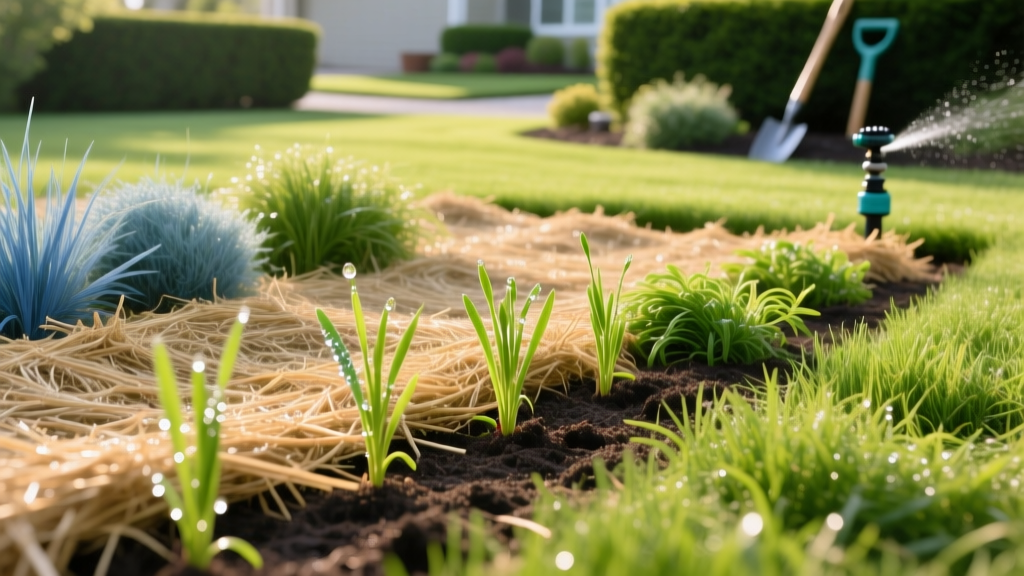
Straw Blanket for Grass Seed: Germination and Setup Guide
The Mechanics of Straw Blankets in Seed Establishment
Establishing a new lawn from seed requires maintaining a precise microclimate at the soil surface. Grass seed needs consistent moisture, soil contact, and protection from wind and avian predators to germinate successfully. A straw blanket for grass seed acts as a permeable, biodegradable shield that regulates soil temperature, reduces evaporation rates by up to 50%, and physically anchors the seedbed against water runoff. According to the University of Minnesota Extension, using erosion control blankets on slopes or exposed topsoil significantly increases germination uniformity compared to bare-seed broadcasting.
Expert Insight: Never use hay bales as a substitute for manufactured straw blankets. Hay contains viable weed seeds (like crabgrass and foxtail) that will germinate alongside your turfgrass. Agricultural straw (wheat or barley) is threshed to remove seeds, and commercial blankets are woven to provide uniform coverage without introducing weed pressure.
Material Matrix: Straw Blankets vs. Alternatives
Not all erosion control blankets (ECBs) are engineered for the same slope gradients or degradation timelines. Selecting the wrong material can lead to premature washouts or synthetic netting that tangles in your mower blades months later. Below is a performance and cost comparison for residential lawn establishment.
| Material Type | Avg. Cost (per 4x112 ft roll) | Max Slope Rating | Degradation Timeline | Best Application |
|---|---|---|---|---|
| Single-Net Straw | $35 - $45 | 3:1 (Moderate) | 90 - 120 Days | Flat yards, gentle swales |
| Double-Net Straw | $55 - $75 | 2:1 (Steep) | 180 - 365 Days | Steep hillsides, heavy rain zones |
| Coconut Coir (Coir) | $90 - $130 | 1:1 (Severe) | 2 - 3 Years | Riverbanks, extreme erosion zones |
| Hydromulch (Spray) | $0.15 - $0.30 / sq ft | 4:1 (Mild) | 60 - 90 Days | Large flat areas, commercial lots |
For standard residential overseeding or new lawn installations on slopes less than 33%, a single-net straw blanket with a biodegradable jute netting is the most cost-effective choice. Ensure the product packaging explicitly states '100% biodegradable netting'—some budget brands use extruded plastic polypropylene netting that will persist in your soil and damage mower reels.
Step-by-Step Installation Protocol
Proper installation is critical. A poorly anchored blanket will 'tent' (lift away from the soil), allowing wind to get underneath and tear the matting away, taking your grass seed with it. Follow these precise measurements for a secure installation.
- Grade and Rake the Soil: Remove all debris, rocks larger than 1 inch, and existing weeds. The soil surface must be smooth. Clods of dirt will prevent the blanket from making flush contact with the seedbed.
- Sow Seed and Fertilizer: Apply your grass seed and starter fertilizer (high in phosphorus, such as a 10-18-10 NPK ratio) directly to the bare soil. Do not seed on top of the blanket; the seed must have direct soil contact to develop root structures.
- Unroll and Overlap: Unroll the straw blanket horizontally across the slope (perpendicular to water flow). Overlap adjacent rolls by a minimum of 3 inches. If laying blankets up a slope, overlap the uphill roll over the downhill roll like shingles on a roof to prevent water from diving under the seams.
- Anchor with Landscape Staples: Use 18-inch galvanized U-pins (landscape staples). Place staples every 3 feet along the seams and every 5 feet in the center of the blanket. On slopes steeper than 4:1, increase staple density to one every 2 square feet.
- Trench the Edges: Dig a 4-inch deep trench at the top and bottom edges of the blanket. Bury the leading edge of the blanket in the trench and backfill with soil. This 'anchor trench' prevents water from bypassing the blanket at the perimeter.
Troubleshooting Common Germination Failures
Even with a straw blanket for grass seed, environmental variables can disrupt establishment. Use this diagnostic matrix to identify and correct issues during the 14-to-28-day germination window.
Symptom: Seed Washout or Bare Patches
- Cause: Inadequate stapling density, or water channeling under overlapping seams.
- Fix: Add additional 18-inch staples at 1-foot intervals in the bare areas. Apply a thin layer of topsoil over the exposed seed and patch with a scrap piece of blanket.
Symptom: Yellowing Seedlings or 'Damping Off' Fungus
- Cause: Overwatering combined with poor air circulation. While straw is breathable, keeping the blanket saturated 24/7 invites Pythium blight.
- Fix: Reduce watering frequency. Water deeply but allow the top layer of the straw to dry slightly between sessions. Ensure you are not using a plastic-backed weed barrier beneath the straw.
Symptom: Grass Blades Tangling in Netting
- Cause: The blanket utilized synthetic polypropylene netting instead of biodegradable jute or cotton.
- Fix: You must manually cut the synthetic netting away with scissors before mowing. Do not attempt to mow over synthetic netting, as it will wrap around the mower blade spindle and destroy the deck bearings.
Post-Germination Maintenance and Mowing
A frequent question among homeowners is when to remove the straw blanket. The answer is almost never. According to erosion control guidelines cited by Penn State Extension, biodegradable blankets are designed to decompose into organic matter, feeding the soil microbiome as the turf establishes.
- First Mow: Wait until the grass reaches 3.5 to 4 inches in height. Set your mower deck to 3 inches. The mower wheels will roll over the blanket, and the blades will cleanly snip the grass emerging through the netting.
- Fertilization: Apply a secondary round of nitrogen-heavy fertilizer (e.g., 24-0-6) roughly 6 weeks after germination. The decomposing straw will temporarily tie up soil nitrogen, so supplemental feeding is required to prevent the grass from chlorosis (yellowing).
- Weed Control: Avoid pre-emergent herbicides for the first 60 days. Post-emergent broadleaf weed killers can be applied once the new grass has been mowed at least three times.
Warning on Herbicides: Never apply herbicides containing Quinclorac or Dithiopyr over a newly installed straw blanket. These chemicals can bind to the organic straw fibers and slowly leach into the soil over several weeks, stunting the root development of your newly germinated turfgrass.
Frequently Asked Questions
Can I use a straw blanket over existing grass for overseeding?
It is not recommended. Straw blankets require flush soil contact to anchor properly. Existing turf will create air gaps (tenting), preventing the new seed from reaching the soil. For overseeding, rely on core aeration, topdressing with compost, and frequent light watering instead of blankets.
How much water passes through a straw blanket?
High-quality single-net straw blankets have a water permeability rate of over 10 gallons per minute per square foot. However, during heavy downpours, the straw fibers absorb water and swell, which slows the flow velocity and prevents soil scouring. Always water gently with a fine mist sprinkler head to avoid displacing the seed beneath the mat.
Will the straw blow away in high winds?
Loose straw mulch will blow away in winds exceeding 15 mph. Manufactured straw blankets, however, are stitched into a netting matrix and anchored with steel staples. As long as the perimeter is trenched and the staple density meets the 1 per 9 sq ft minimum, the blanket will withstand winds up to 45 mph without structural failure.

