
Grass Types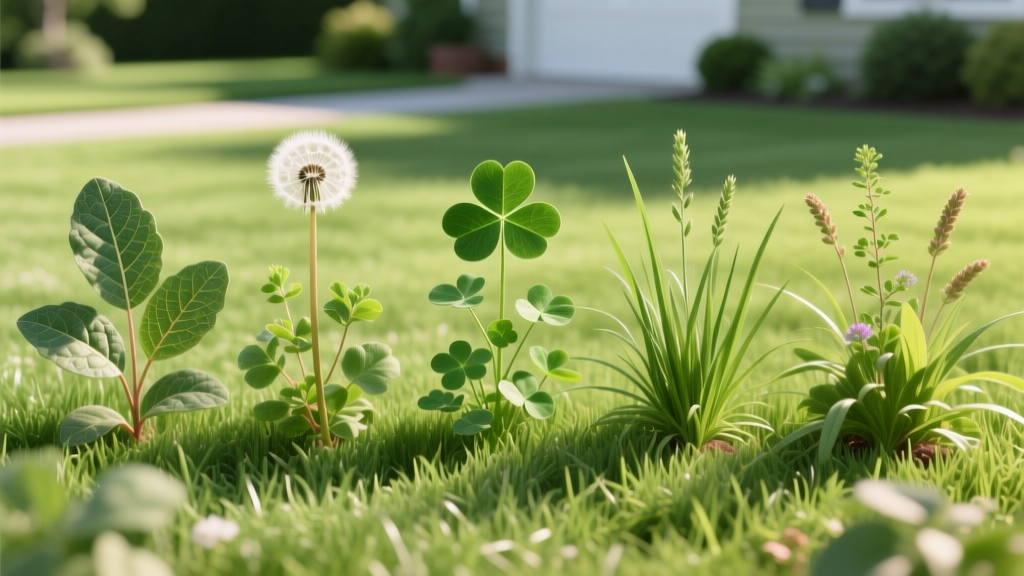
Turf Weeds Identification and Spot-Treatment Guide for Home Lawns
The Diagnostic Framework for Turf Weeds Identification
Broadcast herbicide applications are a blunt instrument that wastes money, increases chemical load on your soil, and risks damaging non-target ornamentals. Spot-treatment is the precision approach, but it hinges entirely on accurate turf weeds identification. Misidentifying a weed leads to applying the wrong active ingredient, resulting in a dead patch of turf and a thriving weed. Before mixing any chemicals, you must categorize the invader into one of three botanical families: broadleaf, grassy, or sedge.
The 3-Step Visual Diagnostic Test
- Step 1: Leaf Venation. Broadleaf weeds feature net-like (reticulate) veins. Grassy weeds and sedges display parallel veins running from the base to the tip of the leaf.
- Step 2: Stem Cross-Section. Roll the stem between your thumb and forefinger. A round stem indicates a true grassy weed. A square stem belongs to the mint family (a broadleaf sub-category like creeping Charlie). A distinctly triangular stem is the universal hallmark of a sedge.
- Step 3: Ligule and Auricle Check. True grasses have a ligule (a membrane or fringe of hairs at the leaf collar) and sometimes auricles (claw-like appendages). Sedges and broadleaves lack these structures entirely.
According to the University of Minnesota Extension, accurate identification at the seedling stage cuts herbicide volume by up to 60% compared to treating mature, established weeds. Young weeds have thinner cuticles, allowing systemic chemicals to translocate to the root zone rapidly.
Broadleaf Invaders: Targeted Spot-Treatment Protocols
Broadleaf weeds are generally the easiest to control post-emergence because their biology is vastly different from your turfgrass, allowing for highly selective herbicides. The most common culprits include dandelion (Taraxacum officinale), white clover (Trifolium repens), and broadleaf plantain (Plantago major).
The Chemistry of Broadleaf Control
For spot-treating broadleaves in cool-season lawns (Fescue, Kentucky Bluegrass, Ryegrass), a three-way ester or amine formulation is the gold standard. Products containing a blend of 2,4-D, MCPP, and Dicamba (such as Trimec Classic or SpeedZone) disrupt plant growth hormones, causing the weed to literally grow itself to death.
- Mixing Rate: 1.5 fluid ounces per 1,000 square feet. For a standard 2-gallon pump sprayer used for spot treatments, mix 0.75 fl oz of product in 1 gallon of water.
- Surfactant Requirement: Most commercial 3-way products include a built-in surfactant. If using a generic concentrate, add a non-ionic surfactant (NIS) at 0.25% v/v (approximately 1/2 teaspoon per gallon) to break the surface tension of waxy leaves like plantain.
- Cost: Approximately $4 to $6 per 1,000 sq. ft. when buying commercial-grade concentrates.
⚠️ Warm-Season Grass Warning: Never use standard 2,4-D formulations on St. Augustine or Centipedegrass. The 2,4-D will severely stunt or kill these warm-season species. Instead, use Atrazine (for St. Augustine) or Celsius WG (thiencarbazone + iodosulfuron + diclofop), which is specifically engineered for warm-season safety and costs roughly $85 for a 2 oz bottle that treats thousands of square feet via spot applications.
Grassy Weeds: The Selective Control Challenge
Grassy weeds like crabgrass (Digitaria sanguinalis), goosegrass (Eleusine indica), and dallisgrass (Paspalum dilatatum) share a similar biology with your desired turf. This makes turf weeds identification critical, as selective post-emergent control is chemically difficult and highly dependent on the weed's maturity.
The primary active ingredient for post-emergent crabgrass and goosegrass control is Quinclorac (found in products like Drive XLR8). Quinclorac mimics auxin in broadleaves but causes severe phytotoxicity and ethylene buildup in susceptible grassy weeds.
Application Nuances for Quinclorac
Quinclorac is highly effective on crabgrass, but it struggles with mature goosegrass and dallisgrass. For those, you need Fenoxaprop-p-ethyl (Acclaim Extra) or Fluazifop (Fusilade II), but these are strictly limited to specific cool-season grasses and will destroy bermudagrass.
- Timing: Quinclorac works best on crabgrass at the 1-tiller to 2-tiller stage. Once crabgrass reaches maturity (4+ tillers and seed head production), spot-treatment efficacy drops below 40%, and multiple applications spaced 14 days apart are required.
- Adjuvant: Quinclorac requires a methylated seed oil (MSO) or high-quality NIS to penetrate the thick, hairy leaf sheaths of crabgrass. Do not skip this step.
Sedges: The "Sneaky" Third Category
Sedges thrive in compacted, poorly drained soils where traditional turfgrass struggles. Yellow nutsedge (Cyperus esculentus) and purple nutsedge (Cyperus rotundus) reproduce via underground tubers (nutlets). Pulling them by hand usually snaps the stem, leaving the tubers intact to sprout three new plants. Purdue University Turfgrass Extension notes that a single yellow nutsedge plant can produce over 1,500 seeds and hundreds of tubers in a single season.
The undisputed standard for sedge spot-treatment is Halosulfuron-methyl (SedgeHammer). It is an ALS-inhibitor that stops amino acid synthesis in the sedge without harming surrounding turf.
- Rate: One 0.9 oz packet of SedgeHammer is pre-measured to treat up to 1,000 square feet of spot applications when mixed with 1 to 2 gallons of water.
- Patience Required: Halosulfuron-methyl is slow-acting. The sedge will stop growing immediately, but visible yellowing and necrosis take 10 to 14 days. Do not reapply prematurely.
- Cost: ~$25 per 0.9 oz packet, making it highly economical for isolated spot treatments.
Spot-Treatment Comparison Matrix
| Weed Category | Primary ID Trait | Recommended Active Ingredient | Safe For | Est. Cost / 1k sq ft |
|---|---|---|---|---|
| Broadleaf (Clover/Dandelion) | Net-like veins, taproot | 2,4-D + MCPP + Dicamba | Cool-season grasses, Bermudagrass, Zoysia | $4 - $6 |
| Grassy (Crabgrass) | Parallel veins, hairy ligule | Quinclorac | Most cool-season, Bermuda, Zoysia (Not St. Aug) | $8 - $12 |
| Sedge (Nutsedge) | Triangular stem, shiny leaf | Halosulfuron-methyl | Virtually all turfgrass species | $20 - $25 |
| Warm-Season Broadleaf | Net-like veins in St. Aug/Centipede | Thiencarbazone + Iodosulfuron | St. Augustine, Centipede, Zoysia, Bermuda | $15 - $18 |
Application Mechanics and Environmental Variables
Even with perfect turf weeds identification, poor application mechanics will result in failure. Spot-treating requires a different physical approach than blanket spraying.
Nozzle Selection and Pressure
Use a flat fan nozzle (e.g., TeeJet 8002 or 11002) rather than a cone nozzle. A fan nozzle provides even distribution across the weed canopy. Keep your pump spranger pressurized between 30 and 40 PSI. Pressures above 50 PSI create fine mist droplets that are highly susceptible to wind drift, potentially landing on and damaging nearby ornamental shrubs or desirable turf.
The Temperature and Mowing Window
Systemic herbicides require active plant growth to translocate from the leaf surface down to the root system.
- Temperature: Do not apply 2,4-D or Quinclorac when daytime temperatures exceed 85°F (29°C). High heat causes the turf to close its stomata to conserve water, halting herbicide uptake, and increases the risk of chemical volatilization (vapor drift).
- Mowing: Wait at least 48 hours after mowing before spot-treating. This ensures maximum leaf surface area is available to intercept the chemical. Wait another 48 hours after application before mowing again to allow full translocation.
"The most common mistake homeowners make with spot treatments is spraying until the weed is dripping wet. Herbicides are measured in active ingredient per acre, not by how soaked the plant gets. Spray the weed until the leaves are uniformly damp. If it's dripping off the leaf tip onto the soil, you are wasting product and increasing soil residual risks." — Turfgrass Agronomist Field Notes
Troubleshooting Decision Tree: Why Did My Spot-Treatment Fail?
Symptom: The weed turned white/bleached but didn't die.
Cause: You likely used Mesotrione (Tenacity) on a warm-season grass, or the weed is a mature grassy species resistant to the chemical. Tenacity causes temporary bleaching in some species but won't kill mature dallisgrass.
Fix: Switch to a non-selective spot treatment using a shielded applicator, or use Fluazifop if targeting grassy weeds in fescue.
Symptom: The weed wilted in 2 hours but bounced back a week later.
Cause: You used a contact-only herbicide (like Carfentrazone) on a perennial weed with deep taproots or tubers (like dandelion or nutsedge). Contact herbicides only burn the top growth.
Fix: Switch to a systemic active ingredient (Halosulfuron-methyl for sedges, 2,4-D for broadleaves) that travels to the root.
Symptom: The chemical sat on the leaf and washed off with the first rain.
Cause: Failure to use a surfactant on a waxy-leafed weed (plantain, mature broadleaf), or rain occurred before the "rainfast" window closed.
Fix: Check the label for rainfast timing (SedgeHammer is 2 hours; Quinclorac is 4-6 hours). Always include NIS or MSO for waxy cuticles.
Accurate turf weeds identification transforms lawn care from a guessing game into a precise science. By categorizing the weed, selecting the exact active ingredient, and respecting the environmental variables of application, you can eradicate invaders efficiently while preserving the health and density of your desired turfgrass canopy.

