
Grass Types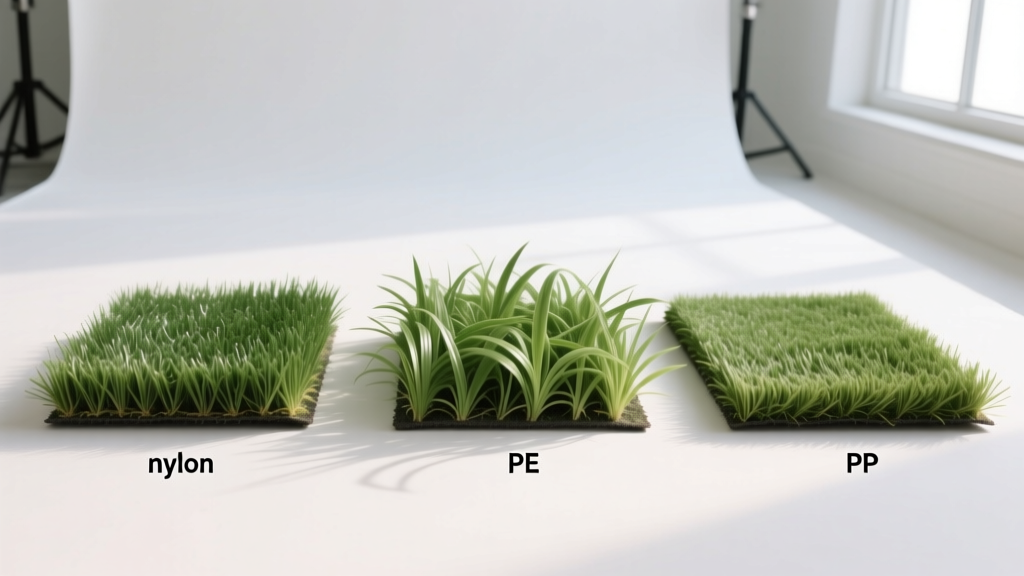
Types of Artificial Turf: Nylon, PE, and PP Grass Explained
Choosing the right synthetic lawn requires looking past the initial color and texture. The performance, longevity, and heat retention of your installation are dictated by the specific polymer used to extrude the grass blades. While marketing materials often use vague terms like 'premium synthetic grass,' the industry relies on three distinct plastics: Nylon (Polyamide 6,6), Polyethylene (PE), and Polypropylene (PP). Understanding the chemical and structural differences between these materials is the only way to ensure your investment survives heavy foot traffic, pet claws, and extreme UV exposure without matting or fading.
The Big Three: Synthetic Turf Materials
1. Nylon (Polyamide 6,6): The Heavy-Duty Standard
Nylon is the most robust synthetic fiber used in artificial turf. Its molecular structure provides exceptional memory retention, meaning the blades will spring back to their original upright position even after being crushed by heavy patio furniture or intense athletic cleats. Nylon boasts the highest melting point of the three materials (exceeding 480°F), making it highly resistant to the heat radiating from nearby windows or reflective surfaces.
However, nylon is inherently stiff. To counteract this, manufacturers often use it as a hidden 'thatch' layer beneath softer face fibers, or they texturize the yarn to soften the feel. Pure nylon turf is primarily reserved for high-traffic commercial zones, golf tee boxes, and areas requiring maximum structural integrity. Expect to pay between $3.50 and $5.50 per square foot for the material alone.
2. Polyethylene (PE): The Aesthetic Choice
Polyethylene is the undisputed king of residential landscaping. It offers the most realistic look and the softest feel, closely mimicking the cellular structure of natural grass blades. PE fibers are easily extruded into various shapes—such as C-shape, W-shape, and flat-blade with a central spine—allowing manufacturers to engineer specific light refraction and structural support properties.
The primary drawback of PE is its lower melting point (around 230°F to 270°F). While it handles standard sun exposure perfectly well, concentrated heat from reflected window glare can melt the fibers. Furthermore, PE lacks the aggressive memory retention of nylon, meaning it requires a robust infill system to remain upright in high-traffic zones. Material costs typically range from $2.00 to $4.00 per square foot.
3. Polypropylene (PP): The Budget and Putting Green Option
Polypropylene is a thin, cost-effective plastic that degrades quickly under heavy UV exposure and physical friction. It is rarely used for standard landscaping lawns. Instead, its primary application is in synthetic putting greens. Because PP can be extruded into very fine, thin ribbons that lay flat and smooth, it perfectly replicates the fast roll of a manicured bentgrass green. It is also common in indoor, low-budget decorative turf. PP melts at roughly 212°F and costs between $1.00 and $2.50 per square foot.
Material Comparison Matrix
| Feature | Nylon (PA 6,6) | Polyethylene (PE) | Polypropylene (PP) |
|---|---|---|---|
| Primary Use | Heavy traffic, commercial, thatch layer | Residential lawns, landscaping, pets | Putting greens, indoor decor |
| Softness / Realism | Low (Stiff) | High (Very soft and realistic) | Medium (Thin, plasticky feel) |
| Durability & Memory | Exceptional (Springs back instantly) | Good (Requires infill support) | Poor (Mats down quickly) |
| UV & Heat Resistance | Excellent (Melts >480°F) | Good (Melts ~230-270°F) | Poor (Melts ~212°F) |
| Avg. Material Cost | $3.50 - $5.50 / sq ft | $2.00 - $4.00 / sq ft | $1.00 - $2.50 / sq ft |
Beyond Material: Face Weight and Pile Height
Identifying the polymer is only half the battle. The physical density of the turf, measured in face weight and pile height, dictates how the material performs in the real world.
- Face Weight (oz/sq yd): This measures the weight of the yarn used in one square yard of turf, excluding the backing. A standard residential lawn requires a minimum of 50 oz to 60 oz. For homes with large dogs or heavy foot traffic, specify a face weight between 70 oz and 85 oz. Anything exceeding 90 oz is generally reserved for commercial applications or specific aesthetic preferences, as it can impede proper drainage if the infill isn't calibrated correctly.
- Pile Height: The length of the blade from the backing to the tip. For standard landscaping, a 1.5-inch to 1.75-inch pile height offers the best balance of lush appearance and structural stability. Taller grass (over 2 inches) requires significantly more infill to prevent the blades from bending over and matting flat.
- Stitch Rate: Look for a stitch rate of 16 to 20 stitches per 10 cm. A higher stitch rate means more blades per square inch, contributing to a denser, more durable surface.
Infill Systems: The Unsung Hero of Turf Longevity
Without infill, even the highest-grade polyethylene turf will flatten within months. Infill weighs down the backing, keeps the blades upright, and provides cushioning. According to guidelines from the Synthetic Turf Council, selecting the correct infill is critical for safety, drainage, and temperature regulation.
Modern Infill Options
- Silica Sand: The baseline, budget-friendly option ($0.10 - $0.20/lb). It provides ballast but retains heat and offers no odor control for pet waste.
- Zeolite (Clinoptilolite): A naturally occurring, highly porous mineral that is the gold standard for pet turf. Zeolite can absorb up to 80% of its weight in liquid and traps ammonia gases, neutralizing pet urine odors. It also stays significantly cooler than silica sand under direct sunlight.
- Acrylic-Coated Sand (e.g., Envirofill): Silica sand coated with an acrylic resin and infused with Microban antimicrobial protection. It prevents the growth of mold, mildew, and bacteria, making it ideal for playgrounds and pet areas. It costs roughly $0.50 to $0.70 per pound.
- Crumb Rubber: Made from recycled tires, this was once the standard for sports fields. However, due to ongoing environmental and health discussions regarding microplastics and VOC off-gassing, the EPA continues to monitor its safety profile. Most modern residential installations have shifted away from crumb rubber toward organic or coated mineral alternatives.
Decision Framework: Matching Turf to Your Use Case
Scenario A: The Active Family & Pet Lawn
Recommendation: Polyethylene (PE) with a W-shape or C-shape blade profile.
Specs: 70 oz face weight, 1.5-inch pile height, dual-tone thatch layer.
Infill: 100% Zeolite (minimum 2 lbs per sq ft) for maximum odor control and cooling.
Why: PE provides the softest surface for children and pets, while the high face weight ensures the blades survive digging and running. Zeolite neutralizes urine ammonia instantly.
Scenario B: The Backyard Putting Green
Recommendation: Polypropylene (PP) or heavily texturized Nylon.
Specs: 45 oz to 50 oz face weight, 0.5-inch to 0.75-inch pile height (no thatch).
Infill: Fine, round-grain silica sand (10 to 15 lbs per sq ft) to lock the short blades upright and provide a true ball roll.
Why: Short PP fibers mimic the dense, manicured surface of bentgrass, allowing the golf ball to roll smoothly without bouncing or plowing through the turf.
Scenario C: High-Traffic Commercial or Roof Deck
Recommendation: Nylon (PA 6,6) or a PE/Nylon hybrid blend.
Specs: 60 oz to 80 oz face weight, 1.25-inch pile height.
Infill: Acrylic-coated antimicrobial sand or TPE (Thermoplastic Elastomer) organic infill.
Why: Nylon's high melting point prevents damage from reflected window glare (common in commercial plazas), and its superior memory retention keeps the grass upright despite constant foot traffic from hundreds of visitors.
Frequently Asked Questions
Does artificial turf get too hot to walk on?
Yes, synthetic turf can reach surface temperatures of 140°F to 170°F in direct, mid-day summer sun. However, you can mitigate this by selecting turf with specialized cooling technology (such as UV-reflective pigments) and using light-colored infills like Zeolite or specially coated TPE. Installing a subsurface irrigation system or simply hosing the turf down for 60 seconds can drop the surface temperature by up to 30°F instantly.
How long does polyethylene turf actually last?
A high-quality PE turf (60 oz+ face weight) installed with proper base preparation and adequate infill will last 15 to 20 years in a residential setting. The primary failure point is rarely the plastic degrading; rather, it is the UV stabilizers breaking down, leading to color fading, or the infill compacting and washing away, which causes the blades to mat permanently.
Can I install artificial turf directly over existing natural grass?
No. Installing directly over dirt or existing grass guarantees failure. The organic matter will decompose, causing severe settling, uneven surfaces, and drainage pooling. You must excavate 3 to 4 inches of topsoil and install a compacted base of Class II Road Base or decomposed granite (DG) to ensure structural stability and proper permeability.

