
Grass Types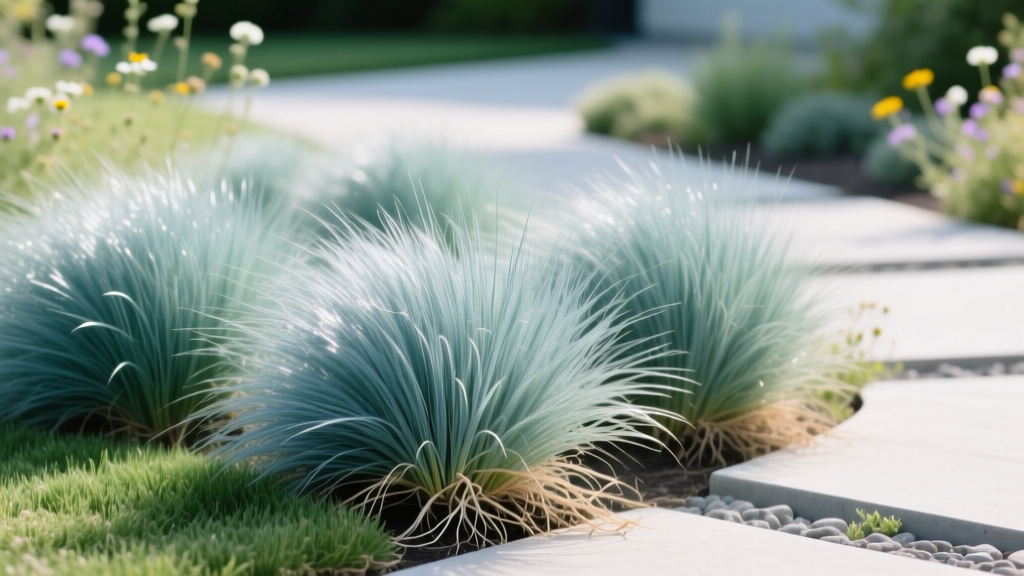
What Does Buffalo Grass Look Like? Identification Guide
The Anatomy of Buffalo Grass: Core Visual Traits
Identifying Bouteloua dactyloides, commonly known as buffalo grass, requires looking beyond the standard emerald-green expectations of traditional turf. As a native prairie grass adapted to the harsh conditions of the North American Great Plains, its visual profile is defined by drought tolerance, low growth, and a distinct color palette. According to the USDA Plants Database, this warm-season perennial exhibits specific morphological traits that separate it from imported turfgrasses.
The leaf blades of buffalo grass are remarkably fine and soft to the touch. They typically measure between 1/16 and 1/8 of an inch in width and grow to a length of 3 to 6 inches if left unmowed. Unlike the stiff, upright blades of Zoysia or the coarse texture of common Bermudagrass, buffalo grass blades tend to arch gracefully, creating a soft, carpet-like canopy. A definitive identification marker is the presence of fine, sparse hairs along the leaf margins and at the collar (where the leaf meets the stem), which are visible under close inspection.
Quick Visual ID Checklist
- Color: Gray-green to blue-green (never deep emerald).
- Blade Width: 1/16 to 1/8 inch (very fine texture).
- Growth Habit: Low-growing, spreading via above-ground stolons.
- Rooting: Roots only at the nodes of creeping stolons; lacks underground rhizomes.
- Canopy Height: Naturally caps between 4 to 8 inches uncut.
The Dioecious Divide: Spotting Male vs. Female Plants
One of the most critical—and frequently overlooked—visual aspects of buffalo grass is its reproductive structure. Unlike most turfgrasses, buffalo grass is primarily dioecious, meaning male and female flowers grow on entirely separate plants. This biological quirk drastically alters what the lawn looks like during its active seeding phase in mid-to-late summer.
Male plants produce distinct, flag-like seedheads (spikes) featuring two to four slender awns that rise 4 to 6 inches above the leaf canopy. These give an unmowed male lawn a somewhat unkempt, tufted appearance. Female plants, conversely, produce their seedheads hidden deep within the lower leaf sheaths, near the base of the plant. Visually, a female-dominant lawn looks much cleaner and more uniform, which is why modern vegetative cultivars (sold as plugs or sod) are predominantly cloned from female plants to eliminate the need for frequent mowing to remove seed stalks.
| Feature | Male Buffalo Grass | Female Buffalo Grass |
|---|---|---|
| Seedhead Visibility | Highly visible, flag-like spikes | Hidden near the soil line |
| Canopy Uniformity | Tufted, uneven during seeding | Smooth, carpet-like |
| Mowing Requirement | Frequent (to remove flags) | Minimal (mostly aesthetic) |
| Common Propagation | Seed | Vegetative plugs/sod |
Seasonal Shifts: Color Changes Throughout the Year
Buffalo grass is a warm-season species, meaning its visual appearance is heavily dictated by soil temperature and seasonal dormancy. Understanding these shifts prevents homeowners from mistakenly assuming their lawn is dead or diseased.
In early spring, buffalo grass is one of the last turfgrasses to break dormancy. It will remain straw-brown or pale tan until soil temperatures consistently reach 60°F to 65°F at a 2-inch depth, which in many transition zones does not occur until late May or early June. Once active, the grass transitions to its signature soft blue-green hue. As autumn approaches and the first hard frost hits, the grass rapidly cures, turning a distinctive pale blonde or light brown. This dormant winter color is highly prized in xeriscaping for its natural, prairie-like aesthetic, and it remains in this state until the following late spring.
Buffalo Grass vs. Common Lookalikes
Because it spreads via stolons and thrives in heat, buffalo grass is frequently confused with other warm-season grasses. However, close inspection reveals distinct structural differences. Texas A&M AgriLife Extension notes that while Bermudagrass and buffalo grass share a stoloniferous growth habit, Bermudagrass also aggressively spreads via underground rhizomes, making it much harder to eradicate from flower beds. Zoysia, another lookalike, has much stiffer leaf blades that will visibly fold in half along the midrib when the plant experiences drought stress, a trait buffalo grass does not exhibit.
Visual Comparison Matrix
- Buffalo Grass: Fine, soft blades; gray-green color; stolons only; distinct male seedheads.
- Bermudagrass: Coarser texture; aggressive deep green; stolons and rhizomes; prominent ligule (hairy membrane at the collar).
- Zoysia Grass: Stiff, prickly blades; dark emerald green; folds during drought; very slow lateral spread.
- St. Augustine: Broad, flat blades (1/4 to 1/2 inch wide); coarse texture; thick, spongy stolons.
Visual Nuances of Top Commercial Cultivars
If you are purchasing buffalo grass for establishment in 2026, you will likely encounter improved vegetative cultivars rather than generic seed. These cultivars have been selectively bred for specific visual and performance traits:
- 'UC Verde': Developed by the University of California, this all-female clone features an exceptionally fine texture and a brighter, more vibrant green color than native strains. It also holds its green color 3 to 4 weeks longer into the fall.
- 'Prestige': A University of Nebraska release known for its dark green hue and extremely low growth habit. It rarely exceeds 4 inches in height, making it a popular choice for 'no-mow' lawn aesthetics.
- 'Bowie': A seeded variety with a medium-fine texture and excellent cold tolerance. It exhibits a slightly lighter, more traditional gray-green prairie color.
- 'Cody': Another seeded option, prized for its dense, uniform canopy and rapid germination, though it requires more frequent mowing to control male seedheads.
Diagnosing Visual Stress Signals
Because buffalo grass is evolved for low-input environments, it visually reacts poorly to over-care. The most common visual anomaly is interveinal chlorosis, where the leaf blades turn yellow but the central veins remain green. This is a classic sign of iron deficiency, typically triggered when the grass is planted in highly alkaline soils (pH above 7.5) where iron becomes chemically locked up. The solution is a foliar application of chelated iron (Fe-EDDHA) rather than soil-applied iron sulfate.
Another frequent visual error is leggy, pale growth. This occurs when homeowners water buffalo grass like a traditional Kentucky bluegrass lawn. Overwatering causes the stolons to stretch excessively, the blades to lose their rigid structure, and the canopy to thin out, inviting aggressive weed invasion like crabgrass and spurge.
Expert Watering Rule: Buffalo grass requires only 1 to 1.5 inches of water per month during peak summer heat to maintain its blue-green color. If the lawn begins to take on a dull, grayish cast and footprints remain visible after walking, it is signaling drought stress and requires a deep, infrequent soaking. According to Colorado State University Extension, watering more than once a week actively harms the root structure and visual density of the turf.
By understanding the fine textures, unique reproductive structures, and seasonal color shifts of Bouteloua dactyloides, you can accurately identify it in the wild or confidently manage its distinct aesthetic in a residential landscape.

