
Grass Types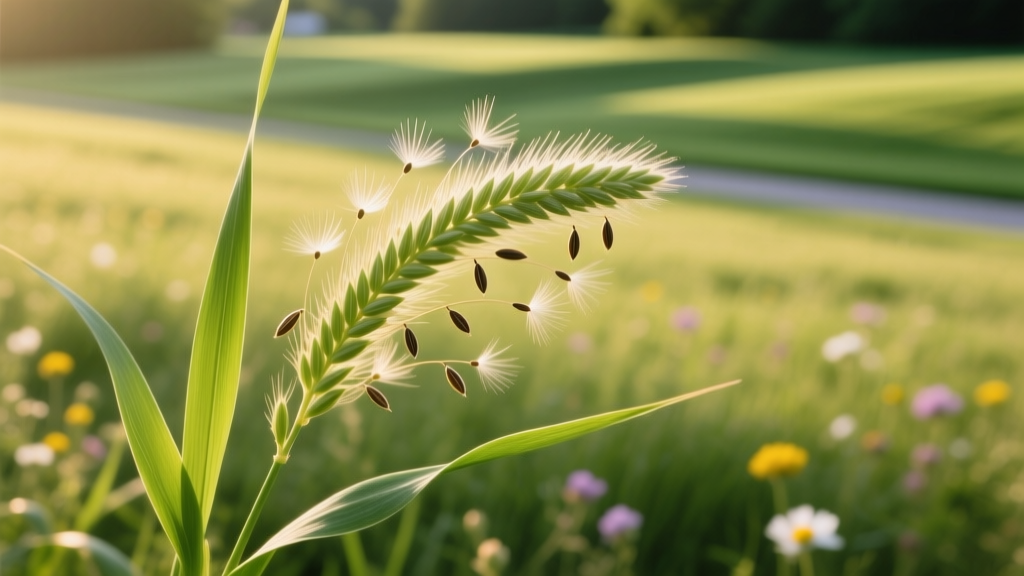
Where Does Grass Seed Come From? The Seed Production Journey
Grass seed comes from the mature inflorescence (seed head) of cultivated turfgrass plants, primarily grown on specialized commercial farms. While wild grasses drop seed naturally to propagate, the commercial turf industry relies on highly controlled agricultural environments. Over 70% of the cool-season grass seed sold in the United States—including Kentucky bluegrass, perennial ryegrass, and tall fescue—originates from a single geographic hub: Oregon’s Willamette Valley. Understanding the journey from botanical anatomy to the coated seed in your spreader reveals why premium turf cultivars command higher prices and how to select the best genetics for your lawn.
The Botanical Origin: Anatomy of a Grass Seed
To understand where grass seed comes from, you must look at the plant's reproductive structures. Turfgrasses are angiosperms (flowering plants) that reproduce via wind pollination. The seed head, or inflorescence, takes three primary forms depending on the species: panicles (Kentucky bluegrass), spikes (perennial ryegrass), or racemes.
The Caryopsis Structure
What homeowners refer to as a 'seed' is botanically a caryopsis—a dry, one-seeded fruit where the ovary wall is completely fused with the seed coat. Inside this protective outer layer (the pericarp) lies the endosperm, which stores the carbohydrates and proteins required for germination, and the embryo, which contains the radicle (first root) and coleoptile (first shoot).
Expert Insight: The physical size of the caryopsis dictates your seeding rate. Kentucky bluegrass seeds are exceptionally small (roughly 1.5 to 2 million seeds per pound), requiring only 1 to 2 lbs per 1,000 sq ft for establishment. Tall fescue seeds are much larger (approx. 225,000 seeds per pound), requiring 5 to 8 lbs per 1,000 sq ft to achieve the same seedling density.
Commercial Seed Farming: The Geographic Hubs
Commercial grass seed is not harvested from the lawns it is destined to become. It is grown as a row crop on massive agricultural tracts. The climate requirements for seed production are vastly different from the requirements for maintaining a green lawn.
- The Willamette Valley, Oregon: The undisputed capital of cool-season grass seed. The region's mild, wet winters promote vigorous vegetative growth, while its notoriously dry, hot summers are perfect for seed maturation and natural field drying, preventing fungal pathogens like ergot or head smut.
- The Transition Zone & Midwest: States like Missouri and Kansas produce significant quantities of warm-season grass seeds, such as Bermudagrass and Zoysia, which require high summer heat and specific photoperiods to trigger flowering.
- International Hubs: New Zealand and Denmark are major exporters of specialized turfgrass cultivars, particularly for fine fescues and proprietary perennial ryegrasses bred for high-salt tolerance and extreme wear resistance.
The Harvesting and Processing Pipeline
Harvesting turfgrass seed is a precision operation. Unlike wheat or corn, grass seeds shatter (drop from the plant) easily when fully mature. To prevent yield loss, farmers use a multi-step harvesting pipeline.
- Swathing (Windrowing): When seed moisture content drops to roughly 30-40%, a swather cuts the grass stalks and lays them in continuous rows (windrows). The seed continues to cure and dry in the windrow for 7 to 14 days.
- Combining: A specialized seed combine with a pickup header lifts the windrows, threshing the seed from the chaff. At this stage, the seed moisture must be at or below 12% to prevent mechanical damage to the embryo.
- Air-Screen Cleaning: The raw harvest is run through machines like the Carter Day air-screen cleaner, which uses controlled air blasts and vibrating mesh screens to remove dust, dirt, and lightweight chaff.
- Indent Cylinder Separation: This machine uses rotating cylinders with small pockets to separate seeds by exact length, removing broken seeds or weed seeds of different dimensions.
- Gravity Table Separation: The final and most critical step. Gravity tables separate seeds by density. Heavy, viable, nutrient-dense seeds roll off the top, while light, dead, or hollow seeds are discarded. This ensures the high germination rates demanded by the NC State TurfFiles and NTEP (National Turfgrass Evaluation Program) standards.
Seed Coatings and Enhancements: What You Actually Buy
Once cleaned, raw seed is often sent to coating facilities. Raw seed is highly susceptible to desiccation (drying out) and soil-borne pathogens like Pythium blight during the vulnerable 7-to-21-day germination window. Coatings alter the physical properties of the seed, but they also change the economics of your purchase.
| Seed Type | Average Retail Cost (per lb) | Coating Material | Actual Seed Content by Weight | Best Application Scenario |
|---|---|---|---|---|
| Raw / Uncoated | $4.50 - $7.00 | None | 98-99% (Purity dependent) | Large-scale commercial sod farms, agricultural overseeding |
| Standard Clay Coated | $6.00 - $8.50 | Calcium Carbonate / Limestone | 65-75% | Standard residential overseeding, basic erosion control |
| Hydroscopic / Fungicide Coated | $9.00 - $14.00 | Zeba Hydrogel + Apron Maxx (Metalaxyl) | 50-60% | Premium residential establishment, high-stress summer/fall seeding |
Buyer Beware: When purchasing heavily coated seed (e.g., 50% coating by weight), you are paying for 10 lbs of product but only putting 5 lbs of actual grass seed on your lawn. Always adjust your spreader settings and purchase volume based on the Pure Live Seed (PLS) calculation, not the gross bag weight.
Quality Control: Decoding the Seed Tag
The origin and quality of your grass seed are legally mandated to be printed on the seed tag attached to every commercial bag. According to Penn State Extension Turfgrass guidelines, understanding this tag is the only way to verify you are getting the genetics you paid for.
Calculating Pure Live Seed (PLS)
The most critical metric on the tag is the PLS, which tells you the exact percentage of the bag that contains viable, germinating seed of the desired species. The formula is:
(% Purity × % Germination) ÷ 100 = % PLS
Example: A bag of Tall Fescue lists 98.5% Purity and 90% Germination. The PLS is 88.6%. If the bag weighs 50 lbs, it contains exactly 44.3 lbs of viable tall fescue seed. The remaining weight comprises inert matter, coating, dead seed, and a legally permitted fraction of other crop seeds (which must be less than 0.5% to avoid agricultural weed contamination).
Cultivar Verification
Never buy seed labeled simply as 'Kentucky Bluegrass' or 'Tall Fescue' without a named cultivar. Generic 'VNS' (Variety Not Stated) seed is typically cheap, untested pasture grass that will succumb to brown patch and drought stress. Look for specific NTEP-rated cultivars like 'Titan Ultra' (Tall Fescue) or 'Midnight' (Kentucky Bluegrass) printed directly on the tag.
Frequently Asked Questions
Can I harvest grass seed from my own lawn?
While technically possible, it is highly impractical. Turfgrass must be allowed to grow to its full reproductive height (often 12 to 24 inches) to produce a viable seed head. Furthermore, many modern hybrid turfgrasses, particularly certain Bermudagrasses and Zoysias, are sterile triploids or are propagated vegetatively via stolons and rhizomes, meaning they will not produce viable seed at all.
Why does grass seed from Oregon grow in my East Coast lawn?
Grass seed is a dormant biological product. As long as the cultivar is genetically adapted to your USDA Hardiness Zone and photoperiod, the geographic origin of the seed farm does not affect its performance. A 'Spyder 2LS' Tall Fescue seed grown in Oregon will perform identically in Virginia as it would in California, provided the soil preparation and irrigation protocols are met.
How long does commercial grass seed remain viable?
When stored in a cool, dry environment (below 70°F and less than 50% humidity), unopened commercial grass seed retains high germination rates for 2 to 3 years. However, germination viability drops by approximately 10% to 15% for every year it remains in storage past the harvest date printed on the seed tag.

