
Grass Types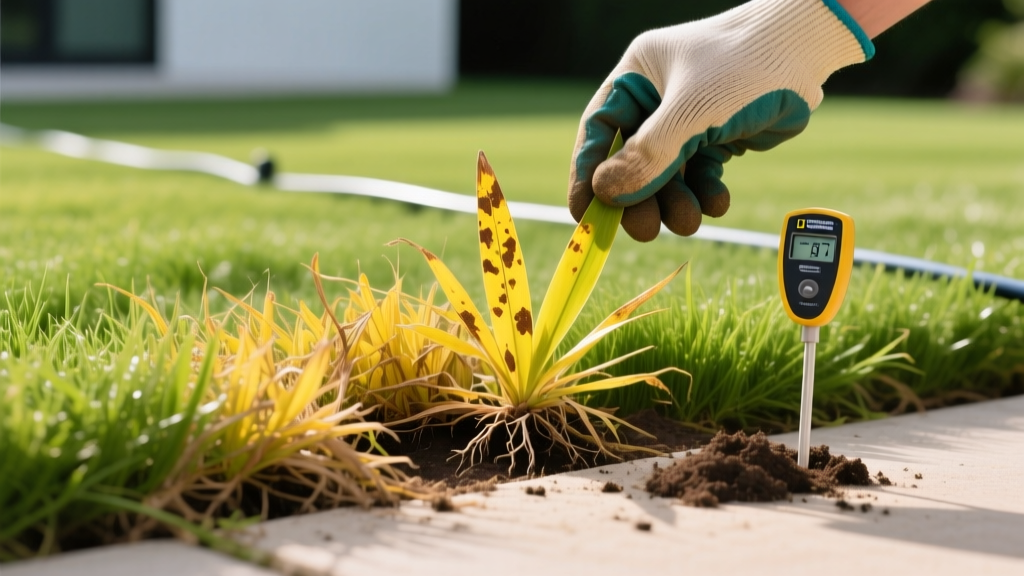
Fixing Yellow St Augustine Grass: Diagnosis and Rescue Tips
The Diagnostic Triage: Identifying the Yellowing Pattern
St. Augustine grass (Stenotaphrum secundatum) is a vigorous, shade-tolerant warm-season turf, but it is highly reactive to soil chemistry imbalances and pathogenic stress. When your lawn turns yellow, it is transmitting a specific distress signal. According to NC State University TurfFiles, misdiagnosing the root cause and applying the wrong fertilizer or chemical can accelerate turf decline. Before buying any rescue products, you must perform a visual triage to narrow down the exact failure mode.
⚠️ The 3-Step Triage Test:
- Check the Pattern: Is the yellowing uniform across the entire lawn, or is it localized in distinct patches?
- Inspect the Leaf Blade: Look closely at the veins. Are the veins green while the tissue between them is yellow (interveinal chlorosis), or is the entire blade solid yellow?
- Pull the Turf: Grab a handful of grass at the edge of a yellow patch and pull. Does it resist, or do the stolons and roots lift easily with black, necrotic lesions?
Cause 1: Iron Chlorosis from Alkaline Soil
The Science Behind the Symptom
If your triage test reveals interveinal chlorosis (yellow leaves with distinct green veins) appearing primarily on the youngest, newest growth, you are dealing with iron deficiency. St. Augustine grass requires iron for chlorophyll synthesis. However, in soils with a pH above 7.0, iron becomes chemically locked into insoluble ferric hydroxide compounds, making it entirely unavailable to the root system, regardless of how much iron is naturally present in the soil.
The Rescue Fix
Applying granular iron sulfate to alkaline soil is a waste of money; it will lock up immediately. You must bypass the soil chemistry using a foliar application of chelated iron, followed by a long-term pH correction strategy.
- Immediate Rescue: Apply Southern Ag Chelated Liquid Iron at a rate of 2 to 3 ounces per 1,000 square feet. Mix with water and spray directly onto the foliage in the late evening to prevent leaf burn. You should see re-greening within 48 to 72 hours.
- Long-Term Correction: To permanently fix the soil lockout, apply elemental sulfur at a rate of 1 to 2 pounds per 1,000 square feet in the fall or early spring. Soil microbes oxidize the sulfur into sulfuric acid, gradually dropping the pH into the optimal 6.0–6.5 range for St. Augustine.
Cause 2: Spring Nitrogen Lockout
The Science Behind the Symptom
If the yellowing is uniform and solid (no green veins) and affects the older, lower leaves first, the grass is nitrogen-starved. In early spring, soil temperatures often hover between 55°F and 65°F. At these temperatures, the soil microbiome is largely dormant and cannot mineralize organic nitrogen into the nitrate form that St. Augustine roots can absorb. Applying a standard granular fertilizer during this window will not green up the lawn.
The Rescue Fix
You must bypass the cold soil microbiome by feeding the grass directly through its leaves using a liquid, urea-based nitrogen source.
- Application: Use a liquid foliar fertilizer like Simple Lawn Solutions 16-4-8 or a generic liquid urea solution. Apply at a rate of 6 ounces per 1,000 square feet.
- Timing: Spray when soil temperatures consistently reach 65°F at a 2-inch depth. Avoid applying heavy granular nitrogen until the lawn has fully broken dormancy and you are mowing weekly, as excessive early nitrogen promotes large patch fungus (Rhizoctonia solani).
Cause 3: Take-All Root Rot (TARR)
The Science Behind the Symptom
If your lawn features irregular yellowing patches that do not respond to iron or nitrogen applications, and the grass pulls up easily with black, rotted roots, you are likely facing Take-All Root Rot. Caused by the soil-borne fungus Gaeumannomyces graminis var. graminis, TARR is one of the most destructive diseases in St. Augustine lawns, particularly in the Gulf Coast and Texas regions. The Texas A&M AgriLife Extension notes that TARR thrives in alkaline soils and heavily compacted turf where the root system is already stressed.
The Rescue Fix
TARR requires a two-pronged approach: chemical suppression and rhizosphere acidification.
- Fungicide Application: Apply a preventative or early-curative fungicide containing Azoxystrobin (such as Heritage SC or Scotts DiseaseEx). The professional liquid rate for Heritage SC is 0.4 fluid ounces per 1,000 square feet. Apply in a carrier volume of 2 gallons of water per 1,000 square feet to ensure the active ingredient washes down into the root zone where the pathogen lives.
- The Peat Moss Protocol: Pioneered by plant pathologists at Texas A&M, topdressing the affected areas with sphagnum peat moss is highly effective. Apply a 1/2-inch layer (roughly one 3-cubic-foot bale per 1,000 square feet). As the peat breaks down, it creates a highly localized acidic environment (pH 4.0–5.0) at the stolon level, which actively suppresses the TARR fungus and encourages new, healthy root growth.
Cause 4: Southern Chinch Bug Damage
The Science Behind the Symptom
If the yellowing starts as small patches in the hottest, sunniest areas of the lawn (near driveways or sidewalks) and rapidly turns brown and crisp, suspect the Southern Chinch Bug (Blissus insularis). These 1/16-inch pests pierce the grass stolons and inject a toxin that blocks water transport, mimicking drought stress. According to UF IFAS Extension, chinch bugs have developed widespread resistance to many older pyrethroid insecticides, requiring targeted chemical rotation.
The Rescue Fix
- Verification: Part the grass at the margin of the dying patch and look closely at the soil surface. You should see tiny black bugs with white, diamond-shaped wings scurrying away from the light.
- Chemical Control: Apply Talstar P (Bifenthrin) at a rate of 1 fluid ounce per 1,000 square feet. For severe infestations or areas with known pyrethroid resistance, use a combination product like Allectus (Imidacloprid + Bifenthrin) to attack both the nymphs and the adults. Water the lawn lightly before application to draw the bugs closer to the surface, and apply the insecticide in the early morning.
Rescue Protocol & Cost Matrix
Understanding the financial and operational commitment of each rescue protocol helps prioritize your weekend lawn care schedule. Below is a breakdown of the estimated 2026 material costs and application parameters for a standard 5,000-square-foot St. Augustine lawn.
| Diagnosis | Primary Rescue Product | Application Rate (per 1,000 sq ft) | Est. Material Cost (per 1,000 sq ft) | Time to Visual Recovery |
|---|---|---|---|---|
| Iron Chlorosis | Southern Ag Chelated Liquid Iron | 2 - 3 fl oz | $1.50 - $2.00 | 48 - 72 hours |
| Nitrogen Lockout | Liquid Urea (28-0-0 or 16-4-8) | 6 fl oz | $2.50 - $3.50 | 7 - 10 days |
| Take-All Root Rot | Heritage SC (Azoxystrobin) | 0.4 fl oz | $12.00 - $16.00 | 14 - 21 days |
| Chinch Bugs | Talstar P (Bifenthrin) | 1 fl oz | $1.25 - $1.75 | 14 - 28 days (regrowth) |
💡 Expert Mowing Tip: While executing any of these rescue protocols, raise your mower deck. St. Augustine grass should be maintained at a minimum height of 3.5 to 4 inches. Scalping the lawn to 2 inches removes the photosynthetic leaf area required for the grass to metabolize the rescue treatments and recover from stress.
Preventative Soil Management for Long-Term Health
Yellowing is almost always a secondary symptom of a primary soil failure. To prevent recurring chlorosis and fungal outbreaks, implement an annual soil testing regimen. Pull 10 to 15 core samples from your lawn at a depth of 4 inches, mix them in a clean bucket, and send a composite sample to your local university extension office.
Focus specifically on the base saturation of calcium and magnesium on the soil test report. If your base saturation of calcium exceeds 70% and your pH is above 7.5, your St. Augustine will perpetually struggle with micronutrient uptake. In these scenarios, annual applications of ammonium sulfate (which provides nitrogen while simultaneously lowering soil pH) are vastly superior to standard urea or nitrate-based fertilizers. By managing the rhizosphere chemistry proactively, you eliminate the environmental triggers that cause St. Augustine grass to yellow in the first place.

