
Grass Types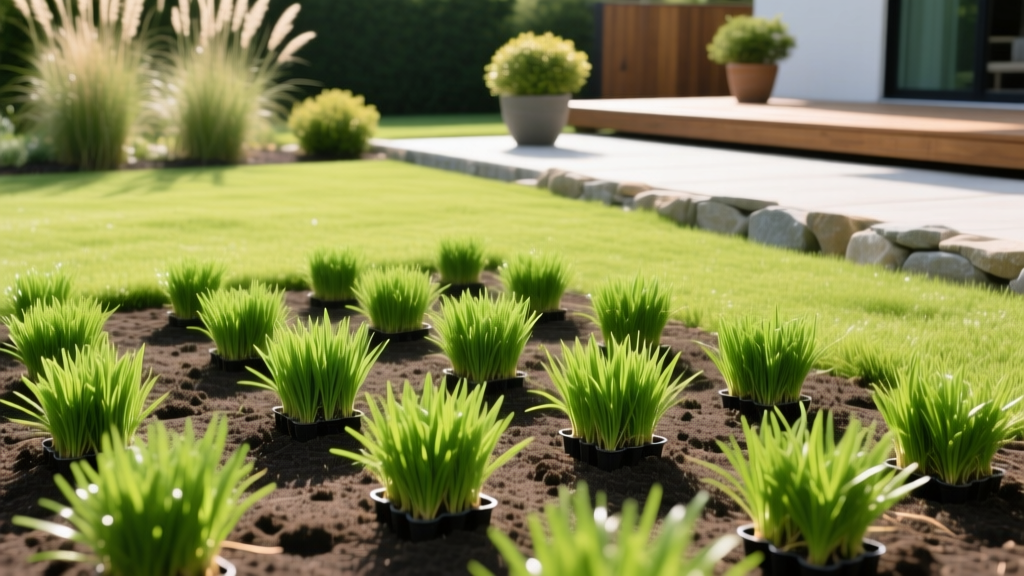
Zeon Zoysia Plugs: Planting, Spacing, and Care Guide
The Economics and Biology of Zeon Zoysia Plugs
Establishing a lawn with Zeon Zoysia (Zoysia matrella) plugs is a strategic compromise between the immediate gratification of sod and the low cost of seed. Zeon is a premium fine-bladed cultivar celebrated for its exceptional shade tolerance—thriving in up to 50% shade—and its dense, dark green carpet-like finish. However, as a Zoysia matrella, its lateral spread rate via stolons and rhizomes is notably slower than coarser Zoysia japonica varieties like Meyer or Emerald.
This biological reality dictates your entire planting strategy. While sod installation costs between $0.75 and $1.10 per square foot in 2026, Zeon Zoysia plugs retail for approximately $0.45 to $0.65 per unit. The financial savings are significant, but they demand a 12- to 18-month commitment to aggressive watering, targeted fertilization, and meticulous weed control while the plugs knit together. According to NC State TurfFiles, zoysiagrass establishment failure most commonly occurs when homeowners underestimate the time and inputs required for plug expansion.
Expert Insight: Zeon Zoysia is highly susceptible to competition during its first year. Because it spreads slowly, any broadleaf weeds or aggressive summer annuals (like crabgrass) that infiltrate the gaps between plugs will starve the zoysia stolons of sunlight and nutrients. A strict pre-emergent and post-emergent herbicide protocol is non-negotiable during the establishment phase.
Soil Preparation and pH Calibration
Zeon Zoysia demands a well-draining soil profile with a slightly acidic pH to maximize nutrient uptake and stolon expansion. Before extracting a single core, you must calibrate the soil environment.
- Target pH: 6.0 to 6.5. Test your soil using a university extension lab kit. If pH is above 7.0, apply elemental sulfur at a rate of 1 to 2 lbs per 1,000 sq ft to lower it. If below 5.5, apply pelletized lime.
- Tilling and Amendment: Rototill the top 4 to 6 inches of soil. Incorporate 1 cubic yard of screened compost per 1,000 square feet to improve moisture retention in sandy soils or drainage in heavy clays.
- Starter Fertilizer: Apply a high-phosphorus starter fertilizer (e.g., 10-18-10 or 5-10-5) at a rate of 1 lb of nitrogen per 1,000 sq ft immediately before planting to stimulate rapid root development.
Spacing Matrix: Time vs. Budget
The distance between your Zeon Zoysia plugs directly correlates to your budget and your patience. Because Zeon spreads slower than other warm-season grasses, wider spacing drastically extends the time to full coverage. Use the matrix below to calculate your material needs for a 1,000-square-foot area.
| Spacing Grid | Plugs per 1,000 sq ft | Est. Material Cost (2026) | Time to Full Coverage |
|---|---|---|---|
| 6 x 6 inches | 400 | $180 - $260 | 6 - 9 months |
| 9 x 9 inches | 177 | $80 - $115 | 10 - 14 months |
| 12 x 12 inches | 100 | $45 - $65 | 18 - 24 months |
For most residential lawns, the 9x9 inch spacing offers the optimal balance, keeping material costs under $120 while ensuring the lawn closes in before the second winter dormancy.
Precision Planting Protocol
Proper installation prevents plug desiccation and ensures soil-to-root contact. Follow this exact sequence for planting 2-inch or 3-inch diameter plugs.
- Core Extraction: Use a specialized plugger tool (like the ProPlugger 5-IN-1) or a 2-inch bulb planter to extract soil cores. Dig exactly 3 inches deep. If using a standard shovel, ensure the hole is no wider than the plug itself to prevent air pockets.
- Root Dipping: Before placing the plug, dip the root mass into a liquid mycorrhizal inoculant or a diluted seaweed extract solution. This reduces transplant shock and accelerates root hair formation.
- Seating the Plug: Drop the Zeon Zoysia plug into the hole. The crown of the grass (where the blades meet the roots) must sit exactly level with or slightly below the surrounding soil grade. Never bury the grass blades.
- Tamping: Step firmly on the plug or use a hand tamper to collapse the soil around the roots. Eliminating air pockets is critical; exposed roots will dry out and die within hours in summer heat.
- Topdressing: Apply a 1/8-inch layer of fine masonry sand or screened compost over the entire planted area. This levels the micro-topography and protects the exposed stolon nodes.
The 90-Day Establishment Watering Schedule
Zeon Zoysia plugs have a severely restricted root mass at planting. They cannot access deep soil moisture and will die if the top 2 inches of soil dry out. According to Texas A&M AgriLife Extension, frequent, shallow watering is required initially, transitioning to deep, infrequent soaking to drive roots downward.
Phase 1: Days 1 to 14 (Root Initiation)
Water 2 to 3 times daily for 10 to 15 minutes per zone. The goal is to keep the top 2 inches of soil constantly moist but not waterlogged. If the plugs wilt or turn grayish-green during midday heat, add a third watering cycle.
Phase 2: Days 15 to 30 (Stolon Emergence)
Reduce frequency to once daily for 15 to 20 minutes. The plugs should now be anchored; test this by gently tugging a blade. If you feel resistance, roots have established. Begin transitioning to deeper watering to encourage downward growth.
Phase 3: Days 31 to 90 (Deep Rooting and Spread)
Water every other day, then transition to twice a week, applying roughly 0.5 inches of water per session. By day 90, you should be delivering 1 to 1.5 inches of water per week in 2 or 3 deep soakings. This trains the Zeon Zoysia to develop the deep root system it is famous for.
Troubleshooting Common Establishment Failures
Even with meticulous care, environmental variables can stall plug expansion. Identify and correct these specific failure modes immediately.
Warning: Large Patch Disease (Rhizoctonia solani)
Zeon Zoysia is highly susceptible to Large Patch fungus during the spring and fall transition periods when soil temperatures hover between 60°F and 75°F and night-time moisture is high. If you see circular, brownish-orange rings expanding outward from the plugs, apply a preventative fungicide containing Azoxystrobin or Pyraclostrobin immediately. Do not apply high-nitrogen fertilizers during these transition windows, as this fuels the pathogen.
Zeon Zoysia is highly susceptible to Large Patch fungus during the spring and fall transition periods when soil temperatures hover between 60°F and 75°F and night-time moisture is high. If you see circular, brownish-orange rings expanding outward from the plugs, apply a preventative fungicide containing Azoxystrobin or Pyraclostrobin immediately. Do not apply high-nitrogen fertilizers during these transition windows, as this fuels the pathogen.
Failure Mode 1: Plugs Remain Green but Do Not Spread
Cause: Soil compaction or heavy clay preventing stolon penetration.
Fix: The stolons are hitting a physical barrier. Use a manual core aerator to pull 3-inch plugs directly adjacent to the Zeon plugs. Topdress the aeration holes with coarse sand to create pathways for the stolons to expand into the surrounding soil.
Failure Mode 2: Plugs Turn Yellow and Shrink
Cause: Nitrogen deficiency or high soil pH locking up iron and manganese.
Fix: Re-test soil pH. If pH is above 6.8, apply chelated iron (Fe-EDDHA) as a foliar spray for immediate greening, followed by elemental sulfur to lower the soil pH long-term. Resume a 3-1-2 ratio nitrogen fertilizer application at 0.5 lbs per 1,000 sq ft every 4 weeks during peak summer growth.
Failure Mode 3: Weeds Overtaking the Gaps
Cause: Lack of pre-emergent herbicide or delayed post-emergent application.
Fix: Apply a zoysia-safe post-emergent herbicide containing Quinclorac or Sulfentrazone to target broadleaf and grassy weeds. Avoid herbicides with 2,4-D during the high heat of summer, as it can cause temporary phytotoxicity (leaf curling and stunting) on fine-bladed Zeon Zoysia.

