Grass Types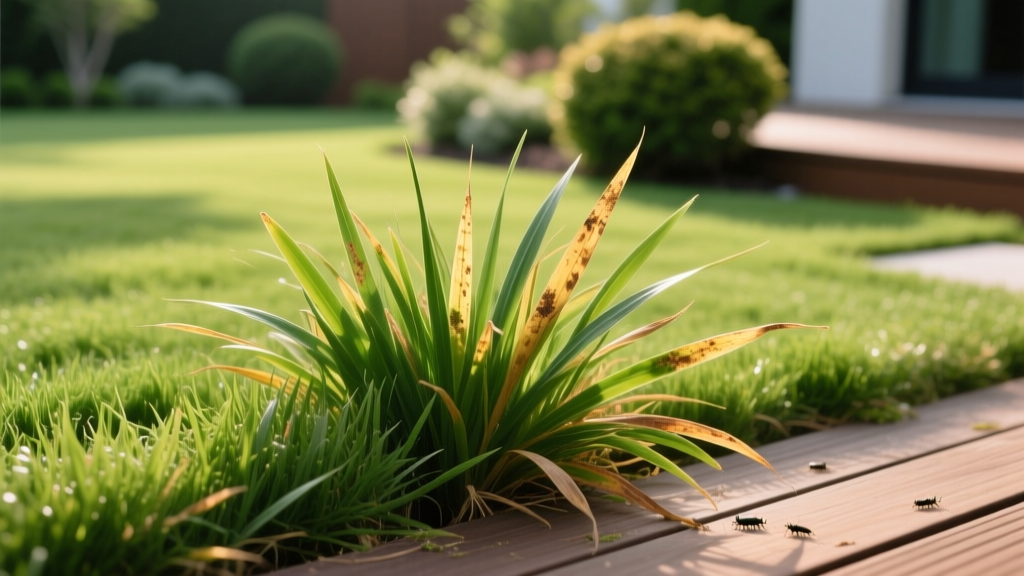
Diagnosing Zoysia Grass Problems: A Homeowner's Fix Guide
The Unique Vulnerabilities of Zoysia Turf
Zoysia grass (Zoysia spp.) is widely marketed as a drought-tolerant, low-maintenance turf, but its unique biological traits create specific failure modes when environmental conditions shift. Unlike Bermuda or Centipede grass, Zoysia produces stolons and rhizomes with exceptionally high lignin content. While this lignin provides superior wear tolerance, it also decomposes very slowly, making Zoysia highly susceptible to severe thatch accumulation. Furthermore, Zoysia's slow lateral growth rate means that once a problem causes turf loss, recovery takes significantly longer than with other warm-season species.
Understanding these biological constraints is the first step in effective warm-season grass care. Homeowners often misdiagnose Zoysia decline as general drought stress or poor soil, when the actual culprit is usually a compounding issue of thatch-induced hydrophobia, specific fungal pathogens, or crown-feeding insects. According to Texas A&M AgriLife Extension, proactive monitoring of the thatch layer and soil temperature is critical to preventing catastrophic turf loss in Zoysia lawns.
Symptom-to-Solution Diagnostic Matrix
Use the following diagnostic matrix to pinpoint the exact cause of your turf decline based on visual symptoms and physical verification. Do not apply broad-spectrum treatments without confirming the specific pathogen or pest.
| Visual Symptom | Probable Cause | Verification Method | Targeted Treatment |
|---|---|---|---|
| Circular brown patches (2-8 ft) with dark 'smoke rings' at margins | Brown Patch (Rhizoctonia solani) | Inspect individual leaf blades for tan lesions with dark borders | Azoxystrobin or Flutolanil fungicide |
| Grass pulls up easily; sawdust-like debris at the crown | Hunting Billbug (Sphenophorus venatus) | Perform the 'tug test'; inspect stem bases for frass and hollowed crowns | Imidacloprid or Clothianidin insecticide |
| Spongy turf feel; water pools or runs off instead of absorbing | Excessive Thatch Buildup | Extract a soil core; measure the spongy organic layer above the soil | Verticutting and core aeration |
| Yellowing between leaf veins on newer growth; overall pale canopy | Iron Chlorosis (High Soil pH) | Conduct a soil test; check for pH levels above 7.0 | Fe-EDDHA chelated iron application |
Deep Dive: Thatch Accumulation and Soil Compaction
Thatch is the most pervasive of all Zoysia grass problems. A healthy Zoysia lawn should have no more than 0.5 inches of thatch. When the layer exceeds 0.75 inches, it acts as a hydrophobic barrier, preventing water, oxygen, and liquid fertilizers from reaching the root zone. This forces the grass to root into the thatch layer itself, making it highly vulnerable to drought and winter kill.
Warning: Never use a standard power rake or flail dethatcher on Zoysia. The aggressive tearing will rip out the slow-growing rhizomes, causing damage that can take an entire growing season to recover from. Always use a verticutter with rigid, solid blades.
Actionable Fix: Rent a dedicated verticutting machine (typically $85-$110 per day). Set the blade depth to penetrate exactly 1/4 to 1/2 inch into the soil surface, with blades spaced 1 inch apart. Run the machine over the lawn in two perpendicular directions. Rake out the debris immediately. For severely compacted clay soils beneath the thatch, follow up with core aeration using 3-inch deep tines spaced no more than 4 inches apart.
Fungal Pathogens: Brown Patch and Dollar Spot
Zoysia is particularly vulnerable to Brown Patch during the transition seasons when nighttime temperatures remain above 68°F and daytime humidity is high. The fungus attacks the leaf sheaths, causing them to rot and detach easily from the stolon.
Chemical Control Strategy: Curative treatment requires a systemic fungicide. Azoxystrobin (found in retail products like Scotts DiseaseEX or commercial Heritage G) is the industry standard. Apply at a rate of 2 to 4 lbs per 1,000 square feet. Because Rhizoctonia can develop resistance to strobilurin chemistries, you must rotate your active ingredients. Follow up 21 days later with a DMI fungicide like Propiconazole (e.g., Banner Maxx) at 1.1 to 2.2 oz per 1,000 square feet.
Cultural Control: Do not apply high-nitrogen fertilizers (specifically quick-release urea) in late summer. Excessive nitrogen fuels the rapid leaf growth that Brown Patch exploits. Switch to a slow-release, methylene-urea based fertilizer with a minimum of 50% water-insoluble nitrogen (WIN) if you must feed the lawn in August.
Insect Pests: Hunting Billbugs and Chinch Bugs
While Chinch Bugs occasionally plague Zoysia, the Hunting Billbug is the primary insect threat. Adult billbugs chew into the stems to lay eggs, and the resulting grubs hollow out the crown and roots. Because the damage occurs at the soil line, homeowners often mistake billbug damage for drought stress or fungal disease until the turf is completely dead.
Pro Tip: Track local degree-days. Billbug egg-laying peaks when local forsythia bushes drop their blooms and soil temperatures at a 1-inch depth consistently hit 65°F. This is your exact window for preventative insecticide application.
Actionable Fix: Apply a preventative grub and billbug insecticide containing Imidacloprid (such as Bayer Advanced Season Long Grub Control) at a rate of 0.46 oz of active ingredient per 1,000 square feet. Water the application in immediately with 1/4 inch of irrigation to move the chemical into the root zone where the larvae feed. If you discover active, mature larvae in mid-summer, Imidacloprid will be ineffective; switch to a contact pyrethroid like Bifenthrin (e.g., Talstar P) at 0.18 oz per 1,000 square feet to kill the adults and large instars.
Nutrient Deficiencies and Iron Chlorosis
Zoysia grass thrives in slightly acidic soils with a pH between 6.0 and 6.5. In alkaline soils (pH 7.0+), iron becomes chemically locked up and unavailable to the roots, resulting in Iron Chlorosis. This manifests as interveinal yellowing, where the leaf veins remain green but the tissue between them turns pale yellow or white.
Applying standard iron sulfate (ferrous sulfate) to high-pH soils is a waste of money; the iron will oxidize and bind to the soil particles within hours. Instead, use a chelated iron product containing Fe-EDDHA (such as Sequestar or Ironite Plus). The EDDHA chelate ring protects the iron molecule from soil binding up to a pH of 9.0. Apply at a rate of 2 to 3 oz per 1,000 square feet as a foliar spray mixed with a non-ionic surfactant to ensure leaf penetration. You should see visible greening within 48 to 72 hours.
Frequently Asked Questions
Why is my Zoysia grass thinning out in heavily shaded areas?
Zoysia requires a minimum of 6 to 7 hours of direct, unfiltered sunlight daily. If your turf is thinning under tree canopies, the issue is light deprivation, not a disease. Prune lower tree limbs to raise the canopy. If light levels cannot be increased, transition those specific zones to a shade-tolerant groundcover or a fine fescue blend, as no Zoysia cultivar (including 'Zeon' or 'Zorro') will survive deep, full-day shade.
How often should I water Zoysia to prevent fungal outbreaks?
Watering frequency is more critical than total volume. Zoysia needs about 1 inch of water per week, but it should be applied in one or two deep soakings rather than daily light sprinklings. Watering in the early morning (between 4:00 AM and 6:00 AM) allows the leaf blades to dry quickly once the sun rises, drastically reducing the leaf-wetness duration that Brown Patch and Dollar Spot require to infect the tissue.
Can I overseed my thinning Zoysia lawn with more Zoysia seed?
Overseeding established Zoysia with seed is highly ineffective. Zoysia seed has a low germination rate and requires bare soil and constant moisture to establish, conditions that the existing turf canopy prevents. To fill in thin spots, use a sod plugger to extract 3-inch cores from healthy, thick areas of your lawn and transplant them into the bare patches at 12-inch intervals. According to Clemson University Extension, plugging is the most reliable method for repairing localized damage in slow-growing warm-season grasses.