
Home & Garden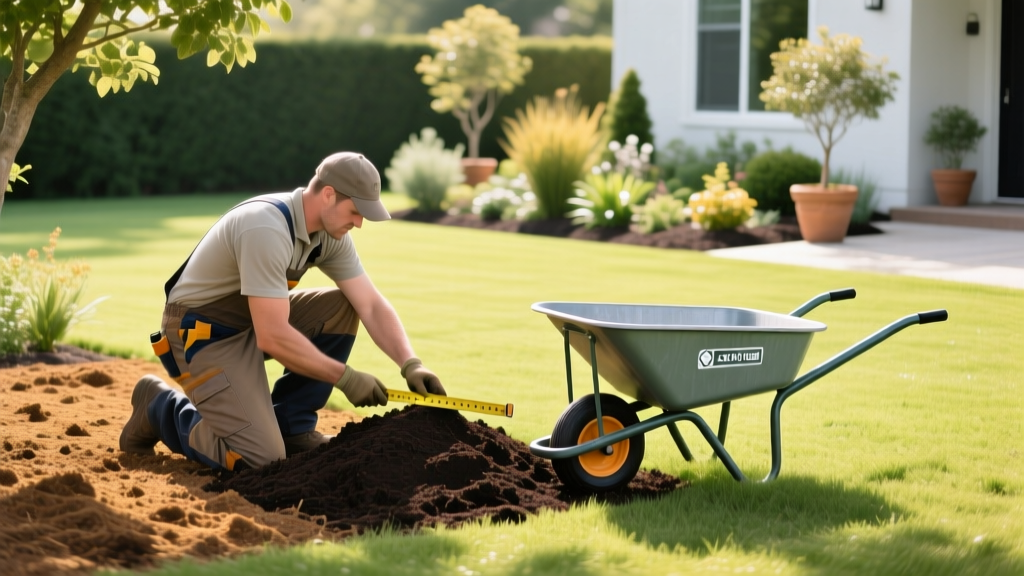
How Much is 3 Cubic Yards? Coverage, Weight, and Cost Guide
The Physical Reality of 3 Cubic Yards
When ordering bulk landscaping materials, understanding volume is critical to avoid over-ordering, under-ordering, or paying for multiple delivery trips. Three cubic yards equals exactly 81 cubic feet. To visualize this, imagine a perfect cube measuring 3 feet wide, 3 feet long, and 3 feet high. In reality, bulk materials are dumped in a conical or elongated mound, typically spanning about 4 to 5 feet across at the base and peaking around 3 feet high.
For DIYers planning a weekend project, translating this volume into physical labor and vehicle capacity is the first step in project planning. Here is what 3 cubic yards looks like in everyday terms:
- Standard Wheelbarrow (6 cu. ft. capacity): Roughly 13.5 fully loaded wheelbarrows.
- Bagged Mulch (2 cu. ft. bags): Exactly 40.5 bags. (This is why bulk delivery is vastly superior for anything over 1 yard).
- Standard Pickup Truck (6.5-foot bed): A standard half-ton truck bed holds about 1.5 to 2 cubic yards level-full. Three cubic yards will require a heavily heaped load that spills over the cab and tailgate, or two separate trips.
Coverage Area by Material and Depth
The area that 3 cubic yards will cover depends entirely on the material type and your target depth. Different materials require different depths for optimal performance. For instance, the University of Minnesota Extension recommends a 2-to-3-inch layer for organic mulches to suppress weeds without suffocating tree roots, while gravel driveways require a 4-inch base for structural integrity.
Use the coverage matrix below to determine if 3 cubic yards is the right dosage for your specific square footage.
| Target Depth | Mulch / Compost | Topsoil / Garden Mix | Gravel / Crushed Stone |
|---|---|---|---|
| 1 Inch | 972 sq. ft. | 972 sq. ft. | 972 sq. ft. |
| 2 Inches | 486 sq. ft. | 486 sq. ft. | 486 sq. ft. |
| 3 Inches | 324 sq. ft. | 324 sq. ft. | 324 sq. ft. |
| 4 Inches | 243 sq. ft. | 243 sq. ft. | 243 sq. ft. |
Pro Tip: The Settlement Factor
Organic materials like topsoil and double-shredded mulch compress by 10% to 20% after heavy rain and natural settling. If your calculation dictates you need exactly 2.5 cubic yards of topsoil to fill a raised bed to the brim, order the full 3 cubic yards to account for compaction. Gravel and crushed stone do not settle significantly and can be ordered to exact mathematical specifications.
The Payload Trap: Weight Limits and Truck Safety
The most common and expensive mistake homeowners make when picking up bulk materials is ignoring payload capacities. Volume does not equal weight. While 3 cubic yards of mulch might fit in the back of your truck, 3 cubic yards of wet topsoil or gravel will destroy your vehicle's suspension and void your warranty.
According to the Arbor Day Foundation, proper mulching requires understanding material density to protect both your landscape and your transport vehicle. Here is the real-world weight breakdown for a 3-yard load:
1. Hardwood Mulch & Compost (Safe for Half-Ton Trucks)
- Weight per yard: 600 - 800 lbs.
- Total for 3 yards: 1,800 - 2,400 lbs.
- Vehicle Compatibility: Fits within the payload capacity of most modern half-ton pickups (e.g., Ford F-150, Chevy Silverado 1500, Ram 1500), which typically max out between 1,500 and 2,200 lbs. Note: Check your specific door-jamb payload sticker; if you are near the limit, opt for delivery.
2. Topsoil & Garden Mix (Requires 3/4-Ton or Delivery)
- Weight per yard: 1,800 - 2,200 lbs (heavier if wet).
- Total for 3 yards: 5,400 - 6,600 lbs.
- Vehicle Compatibility: DO NOT put this in a half-ton truck. You need a 3/4-ton (F-250/2500) or 1-ton (F-350/3500) dually truck. For most homeowners, professional dump-truck delivery is mandatory.
3. Gravel & Crushed Stone (Delivery Only)
- Weight per yard: 2,500 - 2,800 lbs.
- Total for 3 yards: 7,500 - 8,400 lbs.
- Vehicle Compatibility: Exceeds the limits of almost all consumer pickup trucks. Must be delivered via a commercial single-axle dump truck.
Warning: Driveway Damage Liability
A fully loaded single-axle dump truck carrying 3 to 5 yards of gravel can weigh over 15,000 lbs. If you have a newer asphalt driveway that hasn't fully cured, or a concrete driveway with existing hairline cracks, the point-load of the truck's rear dual tires can cause severe cracking. Always request the driver to drop the load on the street or a reinforced concrete apron if your driveway is suspect.
Bulk vs. Bagged: The True Cost Breakdown
Is it cheaper to buy 3 cubic yards in bulk or buy 40 bags from a big-box store? The math heavily favors bulk, but you must factor in delivery fees and the value of your physical labor.
| Cost Factor | Bulk Delivery (3 Yards) | Bagged Purchase (40 Bags) |
|---|---|---|
| Material Cost | $105 - $180 ($35-$60/yard) | $160 - $240 ($4-$6/bag) |
| Delivery / Transport | $50 - $90 flat delivery fee | $0 (if you own a truck) or $50+ trailer rental |
| Total Estimated Cost | $155 - $270 | $160 - $290 |
| Labor Reality | Shoveling from a driveway pile | Slitting, emptying, and disposing of 40 plastic bags |
While the upfront costs are similar, the Environmental Protection Agency (EPA) notes that bulk organic materials are often fresher, less likely to contain anaerobic souring odors (common in sealed plastic bags), and generate zero plastic waste. Bagged mulch sits in the sun for months, degrading the plastic and sometimes baking the organic matter inside, whereas bulk mulch is usually processed and delivered within weeks.
How to Calculate Your Exact Needs
Before calling your local landscape supply yard, measure your project area to confirm that 3 cubic yards is the correct dosage. Use this standard formula:
- Measure Length and Width: Measure your garden bed in feet. (e.g., 20 feet long x 16 feet wide = 320 square feet).
- Determine Depth in Inches: Decide on your depth. (e.g., 3 inches of mulch).
- Apply the Formula: (Square Footage × Depth in Inches) ÷ 324 = Cubic Yards.
- The Math: (320 × 3) ÷ 324 = 2.96 cubic yards.
In this scenario, ordering exactly 3 cubic yards is the perfect dosage, leaving just enough extra to account for minor spreading irregularities and initial settling.
Final Delivery Logistics
When scheduling your 3-yard delivery, specify the exact drop zone. A standard single-axle dump truck requires about 25 feet of vertical clearance to raise its bed fully. Ensure there are no overhead power lines, low-hanging tree limbs, or roof eaves over the drop site. If the driver cannot safely raise the bed, they will be forced to drop the pile in the street, leaving you to wheelbarrow the material to your backyard.

