
Home & Garden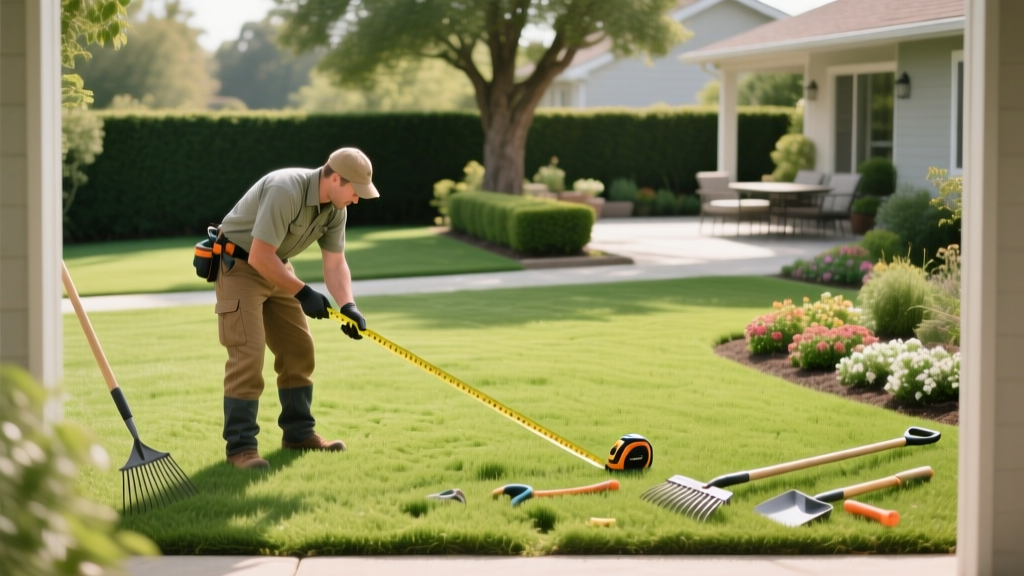
Accurate Yard Measurement: Step-by-Step Landscaping Guide
Why Guesswork Ruins Landscaping Budgets
Estimating property dimensions by eye or relying on outdated plat maps typically results in a 15% to 20% variance in material ordering. When purchasing bulk topsoil, premium sod, or custom-cut composite fencing, that variance translates directly into hundreds of dollars in wasted materials or costly project delays. Professional yard measurement requires moving beyond the standard 25-foot pocket tape measure and adopting spatial mapping techniques that account for property boundaries, curved garden beds, and topographical slopes.
This guide details the exact tools, geometric methods, and mathematical formulas required to capture precise square footage and surface area for any residential outdoor project.
Selecting the Right Yard Measurement Tools
Different landscaping scenarios demand different measurement technologies. A laser distance meter is useless for mapping a wooded one-acre perimeter, just as a GPS unit lacks the millimeter precision needed for laying a patio base. As of 2026, the following tools represent the industry standard for residential landscape contractors.
| Tool Category | Recommended Model | Avg. Cost (2026) | Best Use Case | Accuracy Margin |
|---|---|---|---|---|
| Laser Distance Meter | Bosch GLM 50 C (Bluetooth) | $135 | Hardscapes, patios, short fence runs | ± 1/16 inch |
| Handheld GPS | Garmin eTrex 10 | $110 | Large acreage, perimeter mapping | ± 10 feet |
| Measuring Wheel | Keson RoadRunner 1 | $45 | Rough lawn area, long driveway runs | ± 1 inch per 100 ft |
| Fiberglass Tape | Komelon 100ft ProTape | $28 | Curved beds, irregular lot lines | ± 1/8 inch |
For comprehensive yard measurement, a combination of the Bosch GLM 50 C for hardscape precision and the Komelon 100ft fiberglass tape for softscape curves provides the most reliable data. Fiberglass is mandatory; steel tapes kink, retain moisture, and snap under tension when dragged through dense shrubbery.
Step-by-Step: Measuring Rectangular and Irregular Zones
Most suburban lots are not perfect rectangles. They feature offset property lines, easements, and angled fence corners. To calculate the exact area of an irregular polygon, use the triangulation method.
The Triangulation Method for Irregular Corners
- Establish a Baseline: Identify the longest, straightest boundary line (e.g., the back of the house). Measure this exact distance and mark the two endpoints as Point A and Point B.
- Measure the Diagonals: From Point A, stretch your 100ft fiberglass tape to the irregular corner (Point C). Record the distance. Repeat from Point B to Point C.
- Plot the Triangle: You now have the dimensions of a triangle (A-B, A-C, B-C). Using graph paper or landscape design software like iScape, draw the baseline, then use a digital compass tool to draw arcs from A and B at the recorded radii. Where the arcs intersect is the exact location of Point C.
- Calculate Area: Divide the entire irregular yard into a series of these triangles. Calculate the area of each using Heron's formula, then sum the total.
Pro Tip: When using a laser measure outdoors, the red dot becomes invisible past 30 feet in direct sunlight. Attach a cheap digital camera viewfinder or use the Bosch MeasureOn app with a smartphone camera to zoom in on the laser target reflection on distant fences.
Mapping Curved Garden Beds with the Grid Method
Curved planting beds defy standard length-by-width calculations. To determine the exact square footage of a kidney-shaped or freeform garden bed for mulch ordering, use the grid offset method.
- Drive two wooden stakes at the furthest ends of the bed's longest axis. Stretch a mason line tightly between them. This is your X-axis.
- Every 2 feet along the mason line, use a carpenter square to measure perpendicularly to the left and right edges of the bed (the Y-axis offsets).
- Record these widths. Add all the widths together, multiply by the 2-foot interval, and you will have a highly accurate square footage calculation for the curved area.
Calculating Material Volumes from Square Footage
Accurate yard measurement is only half the equation; translating 2D area into 3D volume is where most homeowners overspend. Bulk materials like mulch, soil, and gravel are sold by the cubic yard. According to turfgrass and soil management guidelines from UC Davis Agriculture and Natural Resources, applying materials at incorrect depths leads to root suffocation or inadequate coverage.
The Universal Cubic Yard Formula
To convert your measured square footage into cubic yards, use this formula:
(Square Footage × Desired Depth in Inches) ÷ 324 = Cubic Yards
The number 324 is the constant derived from the fact that one cubic yard (27 cubic feet) covers exactly 324 square feet at a depth of one inch.
| Material | Recommended Depth | Coverage per 1 Cubic Yard | Common Application |
|---|---|---|---|
| Shredded Hardwood Mulch | 3 inches | 108 sq. ft. | Perennial beds, tree rings |
| Fine Playground Mulch | 6 to 9 inches | 36 to 54 sq. ft. | Safety zones under swing sets |
| Screened Topsoil | 2 inches | 162 sq. ft. | Lawn leveling, sod preparation |
| 3/4-inch Crushed Gravel | 2.5 inches | 130 sq. ft. | Driveways, French drain bases |
The Slope Factor: Correcting for Topographical Error
A critical mistake in yard measurement is assuming the ground is flat. If you measure a 50-foot sloped hillside with a laser measure held level, you are capturing the horizontal projection, not the actual surface area. When laying sod on a hill, you need enough material to cover the slope itself.
Warning: Slope Correction Required
If a hillside rises at a 15-degree angle, and your horizontal laser measurement reads 50 feet, the actual ground distance is 51.7 feet. To calculate the true surface area, divide your horizontal measurement by the cosine of the slope angle. For a 15-degree slope:
If a hillside rises at a 15-degree angle, and your horizontal laser measurement reads 50 feet, the actual ground distance is 51.7 feet. To calculate the true surface area, divide your horizontal measurement by the cosine of the slope angle. For a 15-degree slope:
50 ÷ cos(15°) = 51.76 feet. Ignoring this on a steep 2,000 sq. ft. hillside will leave you roughly 150 sq. ft. short of sod.
To measure the slope angle accurately without expensive surveying transit levels, use the inclinometer app built into most modern smartphones, or upgrade to a laser measure with an integrated tilt sensor, such as the Leica DISTO D2, which automatically calculates the horizontal equivalent and surface distance.
Common Yard Measurement Mistakes and Fixes
- Mistake: Measuring to the inside of fence posts.
Fix: Always measure to the outer boundary line if you are replacing the fence. Measuring inside the posts will result in panels that are too short when the old posts are removed. - Mistake: Using a steel tape measure in high heat.
Fix: Steel expands in direct summer sun, altering calibration over long distances. The National Association of Landscape Professionals recommends fiberglass or Invar tapes for precision work exceeding 50 feet in variable temperatures. - Mistake: Forgetting the 'waste factor'.
Fix: When ordering cut materials like flagstone, composite decking, or sod, always add a 7% to 10% waste factor to your final square footage to account for cutting errors, damaged pieces, and irregular edge fitting.
Finalizing Your Landscape Material Order
Once your triangulation, grid mapping, and slope corrections are complete, consolidate your data into a master spreadsheet. Cross-reference your calculated cubic yards with local bulk supplier delivery minimums. Many landscape supply yards enforce a 3-cubic-yard minimum for motorized dump truck delivery, while smaller projects may require purchasing bagged materials at a 30% premium. By executing a precise yard measurement protocol, you eliminate the guesswork, protect your project budget, and ensure your hardscape and softscape materials arrive in the exact quantities required.