
Home & Garden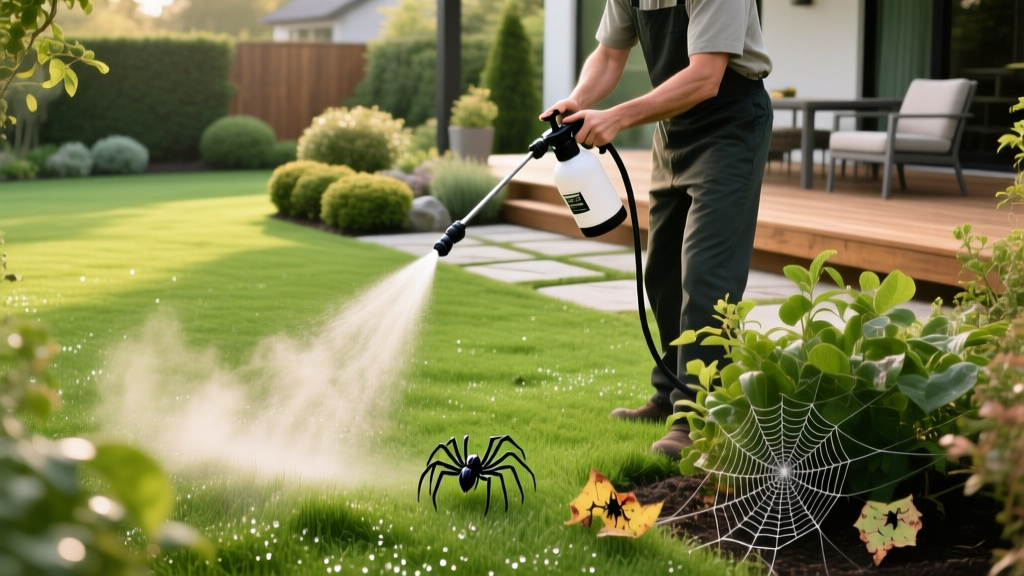
Black Widow Spray Guide: Diagnosis, Selection, and Application
Diagnosing the Threat: Identifying Black Widow Harborage
Before reaching for a black widow spray, you must accurately diagnose the infestation. Black widows (Latrodectus species, primarily the Western L. hesperus and Southern L. mactans) do not build the neat, circular orb webs associated with harmless garden spiders. Instead, they construct irregular, three-dimensional tangle webs, often referred to as 'gum-footed' webs. These webs feature sticky, tension-loaded silk lines that anchor directly to the ground or substrate to trap crawling insects.
When inspecting your yard, focus on undisturbed, dry, and shaded microclimates. Common harborages include the undersides of deck joists, inside hollow block walls, beneath HVAC condenser units, and within stacked firewood. Look for their distinctive egg sacs: smooth, spherical, papery, and roughly 0.5 inches in diameter, typically colored yellowish-white to tan. Finding multiple egg sacs indicates a breeding population that requires an aggressive, multi-phase chemical intervention rather than a simple contact spray.
⚠️ SAFETY WARNING: Never use a high-pressure pin-stream nozzle to spray an active black widow web from close range. The spider may drop or become agitated and fall onto you. Always use a wide-fan nozzle from a minimum distance of 3 feet, or apply a residual dust directly into the harbor crevice while wearing thick nitrile gloves and eye protection.
Active Ingredients: Which Black Widow Spray Actually Works?
The term 'black widow spray' encompasses a wide range of chemical formulations, but not all are effective for outdoor perimeter control. Spiders are arachnids, not insects, and their physiology—specifically their elevated bodies and long legs—means they often walk over treated surfaces without absorbing a lethal dose of standard insecticides. To achieve a high kill rate, you need micro-encapsulated or wettable powder formulations that cling to the spider's tarsi (feet) and abdominal hairs.
| Active Ingredient | Product Example | Knockdown Speed | Residual Life | Best Use Case |
|---|---|---|---|---|
| Bifenthrin (7.9%) | Talstar P, Bifen IT | Moderate (24-48 hrs) | 60-90 Days | General perimeter, soil, mulch beds |
| Cypermethrin | Demon WP | Fast (12-24 hrs) | 60 Days | Porous surfaces (brick, stucco, wood) |
| Deltamethrin | Suspend SC | Very Fast (1-4 hrs) | 60-90 Days | Cracks, crevices, immediate knockdown |
| Pyrethrins (Natural) | ExciteR, EcoPCO | Instant (Seconds) | None (0 Days) | Contact kill only, indoor-safe flush |
As of 2026, micro-encapsulated formulations like Suspend PolyZone or wettable powders like Demon WP remain the industry standard for outdoor spider control. According to the University of California Agriculture and Natural Resources, wettable powders are particularly effective on porous surfaces like stucco and unpainted wood because the active ingredient crystals remain on the surface rather than soaking into the substrate, ensuring the spider picks up a lethal dose.
Step-by-Step Application Protocol for Maximum Kill Rate
Proper mixing and application technique are just as critical as the chemical itself. A standard ready-to-use hardware store spray lacks the concentration and surfactant properties required to penetrate a black widow's dense webbing.
- Don Proper PPE: Wear chemical-resistant nitrile gloves, long sleeves, closed-toe shoes, and safety goggles. Black widows are defensive when their web is disturbed.
- Calculate and Mix: For a standard Bifenthrin concentrate (like Talstar P), mix 1 fluid ounce of chemical per 1 gallon of water. This yields a 0.06% active ingredient solution, which is optimal for spiders. Add a non-ionic surfactant (like Dyne-Amic) at a rate of 1 teaspoon per gallon to break the surface tension of the webbing.
- Select the Right Nozzle: Adjust your pump sprayer to a wide, 40-degree fan pattern for broad foundation spraying. Switch to a pin-stream nozzle only when injecting the solution deep into weep holes, cracks in masonry, or gaps under siding.
- Target the Retreat, Not Just the Web: Black widows are nocturnal. During the day, they hide in a funnel-like retreat at the top corner of their web or inside a nearby crack. Direct the bulk of your spray into these dark crevices, not just the silk threads.
- Establish a Perimeter Barrier: Spray a continuous 3-foot wide band on the soil/mulch around the foundation, and a 3-foot high band up the exterior walls. Pay special attention to areas where utility lines enter the home.
💡 PRO TIP: If you are dealing with a severe infestation in a woodpile or stone wall, liquid sprays may run off. Instead, use a bulb duster to apply Drione Dust (silica aerogel + pyrethrins) or Delta Dust directly into the voids. Dusts cling to the spider's exoskeleton and cause rapid dehydration, providing a residual kill for up to 8 months in dry, protected voids.
Edge Cases and Failure Modes: Why Your Spray Might Fail
Homeowners frequently report that their black widow spray 'didn't work.' In 90% of these cases, the failure is due to one of three specific biological or environmental edge cases:
- UV Degradation: Standard liquid concentrates break down rapidly under direct ultraviolet light. If you spray a south-facing, sun-baked concrete wall with a basic emulsifiable concentrate, the residual will degrade in less than 14 days. Solution: Use micro-encapsulated products (like Onslaught FastCap or Suspend PolyZone) which encase the active ingredient in a polymer shell, shielding it from UV rays.
- The Web Shield Effect: Black widow silk is incredibly dense and water-resistant. If you spray a light mist directly onto the web, the liquid will bead up and roll off, never reaching the spider hiding in the retreat. Solution: Use a higher volume of water (1.5 to 2 gallons per 1,000 sq ft) and a surfactant to ensure the chemical penetrates the silk matrix.
- Egg Sac Hatching: Insecticides do not easily penetrate the thick, papery chorion of a black widow egg sac. You may kill the adults, but 200-300 spiderlings will emerge 2-3 weeks later. Solution: Physically knock down and crush all visible egg sacs with a shoe or stick before applying your residual spray, or remove them with a vacuum attachment.
Post-Spray Prevention and Habitat Modification
Chemical control is only a temporary fix if the environment remains conducive to harborage. The Environmental Protection Agency (EPA) emphasizes that integrated pest management (IPM) relies heavily on habitat modification to reduce pesticide reliance.
To prevent re-infestation, implement the following structural changes to your yard:
- Elevate and Isolate Firewood: Store firewood on metal racks at least 20 feet away from the home's foundation. Never stack wood directly on the soil or against vinyl siding.
- Seal Exclusion Points: Use copper mesh and expanding polyurethane foam to seal weep holes, gaps around HVAC refrigerant lines, and cracks in stucco foundations. Black widows can enter through gaps as small as 1/4 inch.
- Manage Exterior Lighting: Black widows build webs where prey is abundant. Standard white exterior bulbs attract massive swarms of nocturnal insects. Swap your porch and garage lights for 2700K warm LED bulbs or sodium vapor lights, which are significantly less attractive to flying insects, thereby starving the spiders of their food source.
Frequently Asked Questions
Is it safe to spray black widow killer near my vegetable garden?
No. Most synthetic pyrethroids (Bifenthrin, Cypermethrin) are highly toxic to bees, aquatic life, and should never be applied to edible plants or within the drip line of fruit trees. If you must treat near a garden, use a targeted botanical insecticide like Spinosad or manually remove the spiders with a long-handled tool.
How much does professional black widow treatment cost compared to DIY?
A professional pest control company typically charges between $150 and $300 for a targeted exterior spider treatment. A DIY approach using a professional-grade concentrate like Talstar P costs roughly $50 for a quart, which makes up to 32 gallons of finished solution, enough to treat a standard 1/4 acre property multiple times over a full year.
Do ultrasonic spider repellents work?
No. Independent university entomology studies have repeatedly shown that ultrasonic pest repellents have zero statistically significant effect on spider behavior or harborage. Stick to proven chemical and mechanical exclusion methods.