Home & Garden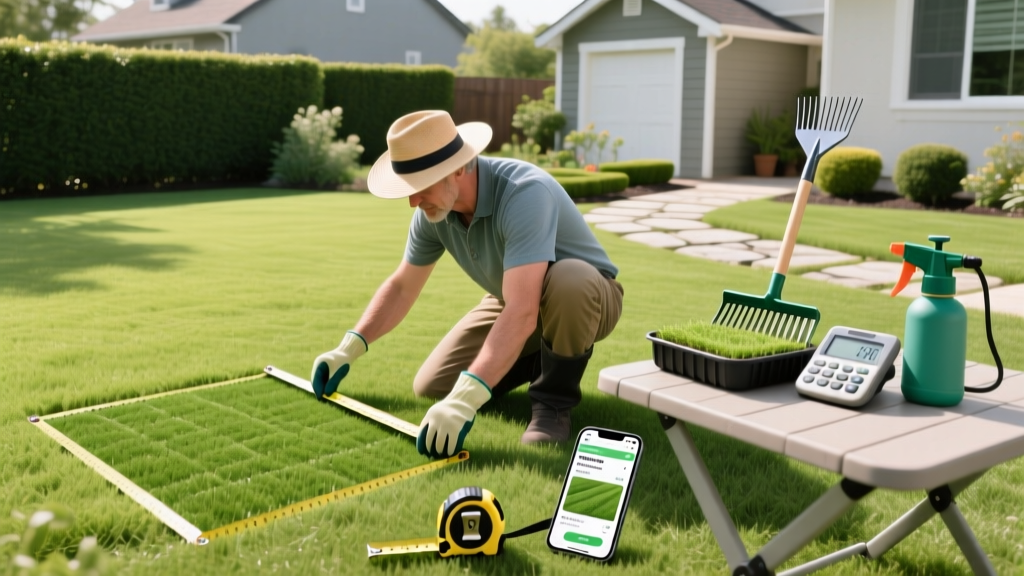
How to Calculate Yard Sq Feet for Exact Lawn Care Dosage & Costs
The True Cost of Guessing Your Turf Area
Applying lawn care products without knowing your exact yard sq feet is a financial and ecological gamble. Overestimating your turf area leads to chemical burn, wasted budget, and toxic runoff into local watersheds. Underestimating results in patchy weed control and thin grass that invites disease. According to the Environmental Protection Agency (EPA), nutrient runoff from over-fertilized residential lawns is a leading contributor to localized water pollution. To achieve a professional-grade lawn in 2026, precision is mandatory. This guide breaks down exactly how to measure your yard sq feet, translate that number into precise product dosages, and build an accurate annual maintenance budget.
3 Methods to Measure Your Yard Sq Feet Accurately
Before you buy a single bag of seed or jug of herbicide, you must establish your baseline square footage. Here are the three most reliable methods, ranked by accuracy.
1. The Digital Mapping Method (Highest Accuracy)
For rectangular or complex lots, digital mapping is the gold standard. Tools like Google Earth or specialized landscaping software (e.g., iScape or SketchUp) allow you to drop pins on the corners of your property to calculate the exact area. Crucial Step: You must manually subtract the footprint of your house, driveway, patios, and large garden beds. If your total lot is 10,000 sq ft, but your house and hardscapes cover 3,500 sq ft, your actual treatable yard sq feet is 6,500.
2. The Measuring Wheel Method (Best for Physical Verification)
A digital measuring wheel (costing roughly $30 to $50) is ideal for verifying digital estimates or measuring irregular curves. Walk the perimeter of your turf zones, breaking the yard into smaller geometric shapes (squares, rectangles, triangles). Calculate the area of each shape and sum them up. This method is highly recommended by the University of Minnesota Extension for homeowners dealing with sloped or uneven terrain where satellite imagery might distort scale.
3. The Pacing Method (Quick Estimation)
If you need a rapid estimate, measure your stride length in feet (the average adult stride is roughly 2.5 feet). Walk the length and width of your turf areas, counting your steps. Multiply your steps by 2.5 to get the dimensions, then multiply length by width. This method carries a 10-15% margin of error and should only be used for rough budgeting, never for calibrating liquid herbicides.
Warning: The Hardscape Subtraction Rule
Never apply granular or liquid products to your total lot size. Sweeping fertilizer off a concrete driveway back onto the grass creates localized salt buildup, killing the turf edges. Always calculate only the permeable, planted turf area.
Never apply granular or liquid products to your total lot size. Sweeping fertilizer off a concrete driveway back onto the grass creates localized salt buildup, killing the turf edges. Always calculate only the permeable, planted turf area.
Dosage Matrix: Translating Yard Sq Feet to Product Volume
Once you have your exact yard sq feet, you must convert product label rates (which are almost always listed per 1,000 sq ft) into your specific application volume. Below is a dosage matrix for the most common 2026 lawn care inputs.
| Product Type | Standard Rate per 1,000 Sq Ft | Example: 6,500 Yard Sq Feet |
|---|---|---|
| Granular Fertilizer (24-0-6) | 2.5 to 3.0 lbs | 16.25 to 19.5 lbs total |
| Tall Fescue Seed (Overseed) | 3.0 to 5.0 lbs | 19.5 to 32.5 lbs total |
| Pre-Emergent (Prodiamine 65 WDG) | 0.18 to 0.27 oz (by weight) | 1.17 to 1.75 oz total |
| Liquid Herbicide (2,4-D Amine) | 2 tbsp in 1-2 gal water | 13 tbsp in 6.5 to 13 gal water |
Note: Always read the specific manufacturer label. Rates for active ingredients like Mesotrione or Prodiamine vary heavily based on your specific grass species (e.g., Bermuda vs. Kentucky Bluegrass).
The Tarp Calibration Test: Verifying Your Spread Rate
Knowing your yard sq feet is only half the battle; your equipment must deliver the product at the correct rate. The NC State Turfgrass Program recommends the 'Tarp Test' for granular spreaders like the Scotts EdgeGuard or Lesco Professional models.
- Set up a catch zone: Lay down a 10 ft by 10 ft tarp in your driveway (exactly 100 sq ft).
- Load the hopper: Fill your spreader with your chosen granular product and set the dial to the manufacturer's recommended setting.
- Execute a pass: Walk over the tarp at your normal, steady application pace (roughly 3 mph), engaging the spreader before you hit the tarp and disengaging it after you pass.
- Weigh the catch: Collect all the granules from the tarp and weigh them on a digital kitchen scale.
- Do the math: Multiply the weight caught by 10. If you caught 0.25 lbs (4 oz) on the 100 sq ft tarp, your spreader is applying 2.5 lbs per 1,000 sq ft. Adjust the dial up or down and repeat until you hit your target dosage.
Pro Tip: Liquid Sprayer Calibration
For liquid applications, spray water onto a 1,000 sq ft marked area of your driveway and time how long it takes. If it takes 2 minutes to cover 1,000 sq ft, and your nozzle outputs 1 gallon per minute, you know you need to mix your chemical concentrate into exactly 2 gallons of water to cover that 1,000 sq ft area evenly.
For liquid applications, spray water onto a 1,000 sq ft marked area of your driveway and time how long it takes. If it takes 2 minutes to cover 1,000 sq ft, and your nozzle outputs 1 gallon per minute, you know you need to mix your chemical concentrate into exactly 2 gallons of water to cover that 1,000 sq ft area evenly.
Budgeting by the Square Foot: DIY vs. Professional Costs
With your exact yard sq feet established, you can accurately forecast your 2026 lawn care budget. Fertilizer supply chains have largely stabilized, bringing granular prices back to predictable ranges. Here is a cost breakdown comparing a DIY approach versus hiring a professional lawn care service for a standard 6,500 sq ft turf area.
| Service / Product | DIY Cost (6,500 Sq Ft) | Pro Service Cost (6,500 Sq Ft) |
|---|---|---|
| Annual Fertilizer (4 Apps) | $65 - $90 | $220 - $300 |
| Pre & Post-Emergent Weed Control | $45 - $70 | $180 - $250 |
| Core Aeration (Fall) | $75 (Machine Rental) | $150 - $200 |
| Total Annual Estimated Cost | $185 - $235 | $550 - $750 |
While DIY saves roughly 60% to 70% annually, it requires an upfront investment in equipment. A high-quality broadcast spreader ($80-$120) and a 4-gallon backpack sprayer ($60-$100) will add $140 to $220 to your first-year costs, but these tools will easily last 5 to 10 years with basic winterization.
Frequently Asked Questions
How do I calculate yard sq feet for an irregularly shaped lawn?
Break the irregular shape into a series of smaller, manageable geometric shapes (rectangles, triangles, and circles). Calculate the area of each individual shape using standard formulas (e.g., Area = Length × Width for rectangles; Area = 0.5 × Base × Height for triangles), then add all the areas together to get your total yard sq feet.
Does my city's property tax record show my exact turf area?
No. Municipal property records list your total lot size, which includes the footprint of your home, driveway, sidewalks, and easements. You must manually subtract these non-permeable hardscapes to find your true treatable yard sq feet.
What happens if I apply pre-emergent to 5,000 sq ft when I actually have 6,000 sq ft?
Under-dosing pre-emergent herbicides like Prodiamine or Dithiopyr is worse than over-dosing. If you stretch the product to cover more yard sq feet than intended, the chemical barrier in the soil will be too thin. This allows crabgrass and poa annua seeds to germinate and break through the barrier, rendering the entire application useless.