
Home & Garden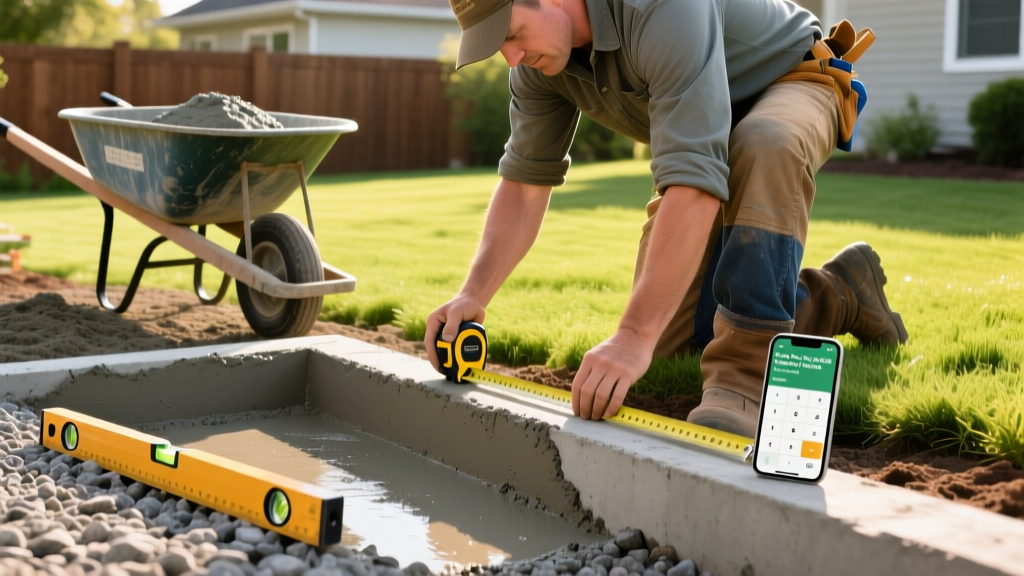
How Do You Find Cubic Yards of Concrete? Fixing DIY Pour Math
Concrete is an unforgiving material. Once the ready-mix truck arrives at your driveway, a chemical clock starts ticking. You typically have 90 minutes before slump loss renders the mixture unworkable. In this high-pressure window, the most common point of failure for DIY landscapers isn't the finishing technique—it's the initial volume calculation. Miscalculating your yardage leads to catastrophic short-pours, structural weak points, or hundreds of dollars wasted on excess material that hardens into useless rubble.
If you are wondering how do you find cubic yards of concrete for your next hardscape project, you must look beyond basic online calculators. Standard calculators assume perfect, level, empty forms. Real-world outdoor projects involve slopes, sub-bases, and thickened edges. This guide diagnoses the mathematical traps that ruin DIY pours and provides the exact frameworks to calculate your yardage with professional precision.
Diagnosis: The Sub-Base and Excavation Trap
The single most frequent cause of concrete over-ordering is confusing excavation depth with concrete depth. According to guidelines from the American Concrete Institute (ACI), a standard residential patio requires a 4-inch concrete slab resting on a 2-to-4-inch compacted gravel sub-base.
⚠️ The Excavation Error: If you dig a trench 6 inches deep and lay down 2 inches of crushed gravel, your actual concrete depth is only 4 inches (0.33 feet). If you calculate your cubic yards using the 6-inch excavation depth, you will order 50% more concrete than your forms can hold. The truck driver will dump it, it will overflow your wooden forms, and you will spend hours breaking up cured concrete from your lawn.
The Fix: Always measure your forms after the sub-base is compacted. Measure the distance from the top of the gravel to the top of your string line or wooden form board. Use this exact measurement for your depth variable.
The Core Formulas: Calculating Exact Yardage
Concrete is sold by the cubic yard. One cubic yard equals 27 cubic feet (3 ft x 3 ft x 3 ft). To find your yardage, you must convert all linear measurements to feet, calculate the total cubic feet, and divide by 27.
1. Rectangular Slabs (Patios, Driveways, Shed Pads)
The formula for standard rectangles is straightforward, but precision matters down to the decimal.
- Formula: Length (ft) × Width (ft) × Depth (ft) ÷ 27 = Cubic Yards
- Example: A 10 ft × 12 ft patio, poured at 4 inches thick (0.333 ft).
- Math: 10 × 12 × 0.333 = 39.96 cubic feet. 39.96 ÷ 27 = 1.48 cubic yards.
2. Circular Pours (Fire Pits, Tree Rings, Hot Tub Pads)
Circles require calculating the area using Pi (3.1416) and the radius squared.
- Formula: (3.1416 × Radius² × Depth in feet) ÷ 27 = Cubic Yards
- Example: A 12-foot diameter hot tub pad (6 ft radius), poured at 6 inches thick (0.5 ft).
- Math: 3.1416 × 36 × 0.5 = 56.54 cubic feet. 56.54 ÷ 27 = 2.09 cubic yards.
3. Irregular and Meandering Walkways
Do not attempt to guess the area of a curved path. Break the walkway down into a series of overlapping rectangles and trapezoids. Calculate the cubic footage of each individual geometric block, add them together, and then divide the grand total by 27.
Quick-Reference Volume Matrix
Use this matrix for rapid field estimations. These figures assume a perfectly level sub-grade and do not include the mandatory waste factor (detailed below).
| Total Square Footage | 4-Inch Thickness (Cubic Yards) | 6-Inch Thickness (Cubic Yards) | Typical Project Application |
|---|---|---|---|
| 100 sq ft | 1.23 | 1.85 | Small walkway / AC pad |
| 250 sq ft | 3.09 | 4.63 | Standard backyard patio |
| 400 sq ft | 4.94 | 7.41 | Large entertainment area |
| 600 sq ft | 7.41 | 11.11 | Single-car driveway pad |
Troubleshooting Common Measurement Disasters
Even with perfect math, real-world variables alter your volume requirements. Here is how to diagnose and adjust for site-specific anomalies.
Problem 1: The "Cold Joint" from a Short Pour
Symptom: You run out of concrete before filling the final 10% of the form. You order a second batch, but the first batch has already begun to set, creating a visible, structurally weak seam known as a cold joint.
Diagnosis: You calculated the exact mathematical volume but failed to account for form deflection, sub-grade imperfections, and spillage.
The Fix: Apply the 10% Overage Rule. Always multiply your final cubic yard calculation by 1.10. If your math says 3.0 yards, order 3.3 yards. According to the National Ready Mixed Concrete Association (NRMCA), ordering slightly over is standard industry practice to account for minor grade variations and form bowing under the hydrostatic pressure of wet concrete.
Problem 2: Edge Cracking on Driveways
Symptom: The perimeter of your newly poured driveway cracks and crumbles within the first winter freeze-thaw cycle.
Diagnosis: The edges were poured at the same 4-inch thickness as the center. Driveways require a "thickened edge" or integral grade beam to support the weight of vehicle tires turning at the perimeter.
The Fix: Calculate the perimeter trench separately. If your slab is 4 inches thick, but your perimeter trench is 12 inches deep and 12 inches wide, calculate the volume of that perimeter trench and add it to your total slab yardage. Failing to add this hidden volume will guarantee a short-pour.
Decision Framework: Ready-Mix vs. Bagged Concrete
Once you know how do you find cubic yards of concrete, the next critical decision is procurement. The economics of concrete shifted significantly in 2026, making the threshold for ordering a truck lower than in previous years.
- Bagged Concrete (80 lb bags): Yields 0.60 cubic feet per bag. It takes exactly 45 bags to equal one cubic yard. At an average 2026 retail price of $5.75 per bag, one cubic yard costs roughly $258.75 in materials alone, excluding the cost of renting a motorized mixer ($75/day) and the immense physical toll of moving 3,600 lbs of material.
- Ready-Mix Truck: The national average for standard 4,000 PSI ready-mix is $145 to $175 per cubic yard in 2026. A single cubic yard delivered to your site costs roughly $165.
💡 The Procurement Threshold: If your project requires more than 0.75 cubic yards (roughly 34 bags), order ready-mix. The labor savings and guaranteed consistent PSI mix far outweigh the delivery fee. Be aware that most batch plants charge a "short-load fee" (typically $50 to $75) for orders under 10 cubic yards. Factor this flat fee into your budget for small patio pours.
Final Verification Checklist Before the Truck Arrives
- Re-measure depth: Check the sub-base depth at five different points inside the form. Average them out.
- Verify square footage: Measure diagonals on rectangular forms. If the diagonals are not perfectly equal, your form is a parallelogram, not a rectangle, and your area calculation will be slightly off.
- Calculate the 10% buffer: Multiply your final yardage by 1.10.
- Communicate with the batch plant: Tell the dispatcher your exact application (e.g., "flatwork patio, broom finish"). They will adjust the slump (water content) to ensure the concrete isn't too wet, which can cause shrinkage cracking if they add water on-site to make it flow easier.
Mastering concrete volume calculation is about respecting the material's physical realities. By diagnosing sub-base traps, applying geometric breakdowns for irregular shapes, and utilizing the 10% overage rule, you eliminate the guesswork. When the truck backs into your driveway, you will have the exact volume required to execute a flawless, structurally sound pour.