
Home & Garden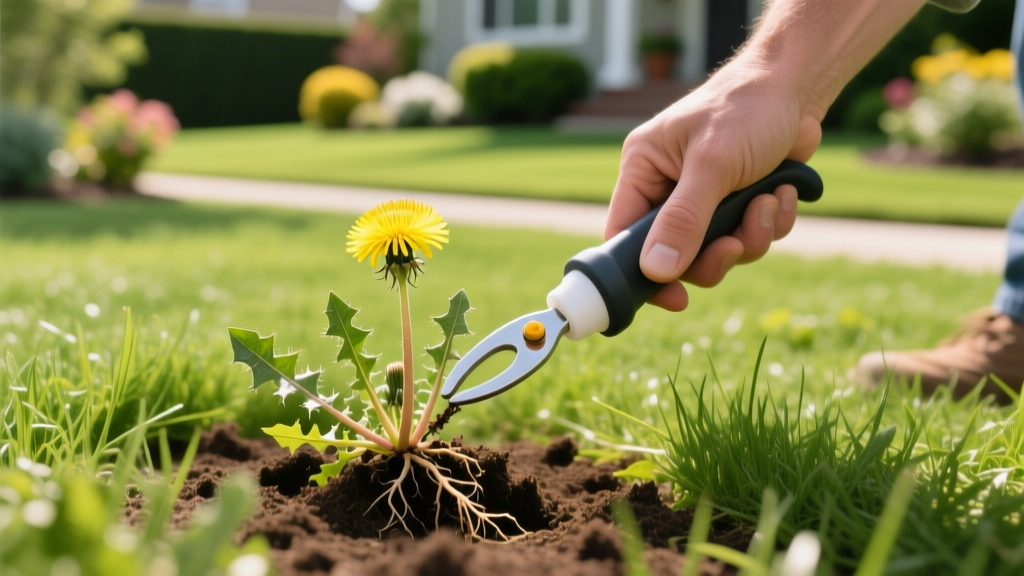
How to Get Rid of Dandelions in Your Yard: Spot-Treatment Guide
The Biology of Taraxacum officinale: Why Spot Treatment is Mandatory
Understanding how to get rid of dandelions in your yard requires recognizing the plant's survival mechanisms. The common dandelion (Taraxacum officinale) is a perennial broadleaf weed anchored by a brittle, fleshy taproot that can penetrate 10 to 15 inches into compacted soil. If you sever the taproot and leave just one inch of the crown tissue behind, the plant will regenerate multiple new rosettes within 14 days. Furthermore, a single mature dandelion head produces up to 400 wind-dispersed achenes (seeds), making broadcast spraying of non-selective herbicides a counterproductive strategy that damages surrounding desirable turf.
Spot-treatment isolates the active ingredient or mechanical force to the individual weed, preserving the soil microbiome and preventing turf canopy thinning. According to Penn State Extension, targeted post-emergent applications and precise mechanical extraction remain the most ecologically sound methods for managing isolated dandelion outbreaks in residential lawns.
⚠️ Critical Timing Warning: Never attempt to pull or chemically treat dandelions when they are in the active seed-blow stage (the white puffball phase). The physical disturbance of pulling will release thousands of viable seeds into the surrounding turf. If you see puffballs, carefully bag the seed heads in a plastic bag before attempting root extraction or herbicide application.
Mechanical Extraction Protocol: Tools and Technique
For lawns with fewer than 20 dandelions per 1,000 square feet, mechanical extraction is highly effective and eliminates chemical runoff. The goal is complete taproot removal without excessive soil disruption.
Recommended Extraction Tools
- Fiskars 39-Inch Stand-Up Weeder ($38 - $45): Features a serrated stainless steel claw that grips the taproot below the crown. Best for loamy or slightly moist soils.
- Grandpa's Weeder Original ($30 - $35): Uses a long-handled lever and a narrow 2-prong fork to pop the root out. Superior for heavy clay soils where the Fiskars claw might struggle to penetrate deeply.
- Soil Knife (Hori Hori) ($20 - $25): Essential for precision digging around dandelions growing in landscape beds or near hardscape edges where stand-up tools cannot reach.
Step-by-Step Extraction Method
- Hydrate the Soil: Water the target area deeply 24 hours before extraction. The soil must be moist to a depth of at least 6 inches to reduce taproot friction and prevent snapping.
- Position the Tool: Center the weeder's claws directly over the dandelion crown (the center of the rosette). Push the foot platform down until the blades are fully submerged (minimum 3 inches deep).
- Leverage, Don't Yank: Pull the handle back toward you at a 45-degree angle. Let the tool's fulcrum lift the soil plug. Yanking upward will snap the brittle taproot.
- Inspect the Root: Examine the extracted root. If it ends in a clean, blunt break rather than a tapered tip, the lower portion is still in the ground. Mark the spot with a landscaping flag and re-treat in 10 days.
Chemical Spot-Treatments: Active Ingredient Matrix
When mechanical extraction is impractical, selective post-emergent herbicides are required. The University of Minnesota Extension notes that systemic herbicides are vastly superior to contact herbicides for dandelions, as they translocate the active ingredient down into the taproot. Below is a comparison of the most effective active ingredients for residential spot-treatment.
| Active Ingredient | Product Example (Retail) | Est. Cost | Mode of Action | Turf Safety |
|---|---|---|---|---|
| 2,4-D + Dicamba + MCPP | Ortho WeedClear for Lawns | $15 / 32oz | Synthetic auxin (growth regulator) | Safe for most cool & warm-season grasses |
| FeHEDTA (Iron HEDTA) | Fiesta Turf Weeder / Natria | $45 / 32oz | Iron toxicity (oxidative stress) | Safe for cool-season; stains warm-season |
| Triclopyr + Fluoxypyr | Spectracide Weed Stop | $12 / 32oz | Synthetic auxin | Cool-season only (damages Bermuda/Zoysia) |
| Quinclorac | Drive XLR8 (Pro grade) | $85 / 16oz | Synthetic auxin / cell division inhibitor | Excellent for all turf types |
Application Best Practices for Systemic Herbicides
Apply liquid spot-treatments when daytime temperatures are between 65°F and 85°F. Temperatures above 85°F cause the herbicide to volatilize (turn into a gas), which can drift and damage nearby ornamental shrubs or garden vegetables. Always add a non-ionic surfactant (like Dyna-Gro Pro-Spread, $15/pint) at a rate of 1 teaspoon per gallon of mixed spray. Dandelion leaves have a waxy cuticle that repels water-based sprays; the surfactant breaks this surface tension, ensuring the chemical penetrates the leaf tissue and reaches the taproot.
Organic Spot-Treatments: Efficacy vs. Soil Risk
Many homeowners seek organic alternatives, but natural spot-treatments carry significant agronomic trade-offs. The most common organic recommendation is horticultural vinegar (20% to 30% acetic acid).
Agronomic Warning: While 20% acetic acid (e.g., Green Gobbler Industrial Strength, $30/gallon) will rapidly desiccate dandelion foliage within 4 hours, it is strictly a contact herbicide. It will not kill the taproot. The dandelion will resprout in 7 to 10 days. Furthermore, repeated applications of high-concentration acetic acid will severely depress your soil pH, creating an acidic environment that inhibits desirable turfgrass nutrient uptake and harms beneficial soil nematodes.
If you must use an organic contact spray, combine it with a strict manual extraction schedule. Spray the foliage to wilt the plant, wait 24 hours, and then use a Hori Hori knife to excavate the weakened root system. Another emerging organic option is clove oil (eugenol) based herbicides, which disrupt plant cell membranes, but they suffer from the same taproot-survival limitations as acetic acid.
Preventative Maintenance: The Pre-Emergent Strategy
Spot-treating existing weeds is reactive; preventing germination is proactive. Dandelion seeds require bare soil and sunlight to germinate. Maintaining a dense turf canopy mowed at 3.5 to 4 inches will naturally shade out 80% of dandelion seedlings.
For severe historical infestations, apply a pre-emergent herbicide containing Dithiopyr (e.g., Dimension 2EW, $120/gallon) in early spring when soil temperatures consistently reach 50°F at a 2-inch depth. Dithiopyr inhibits root development in germinating seeds and offers early post-emergent control of young dandelion seedlings (up to the 3-leaf stage). Note that pre-emergents will not affect mature dandelions with established taproots, which still require the spot-treatment protocols outlined above.
Troubleshooting Spot-Treatment Failures
| Symptom | Probable Cause | Corrective Action |
|---|---|---|
| Leaves curl and cup, but plant survives and resprouts in 2 weeks. | Herbicide applied during drought stress; plant shut down vascular system, preventing translocation to root. | Water lawn deeply for 3 days, wait 48 hours, and reapply systemic herbicide. |
| Foliage turns brown in 24 hours, but new leaves emerge from the center. | Used a contact-only organic spray (vinegar/soap) or mowed immediately after chemical application. | Switch to a systemic auxin herbicide (2,4-D/Triclopyr). Do not mow for 48 hours post-application. |
| Mechanical extraction tool slips and fails to grip the root. | Soil is too dry and compacted; clay has locked around the taproot. | Use a soil probe or heavy screwdriver to punch 4 holes around the weed, flood with water, wait 24 hours, and retry. |