
Home & Garden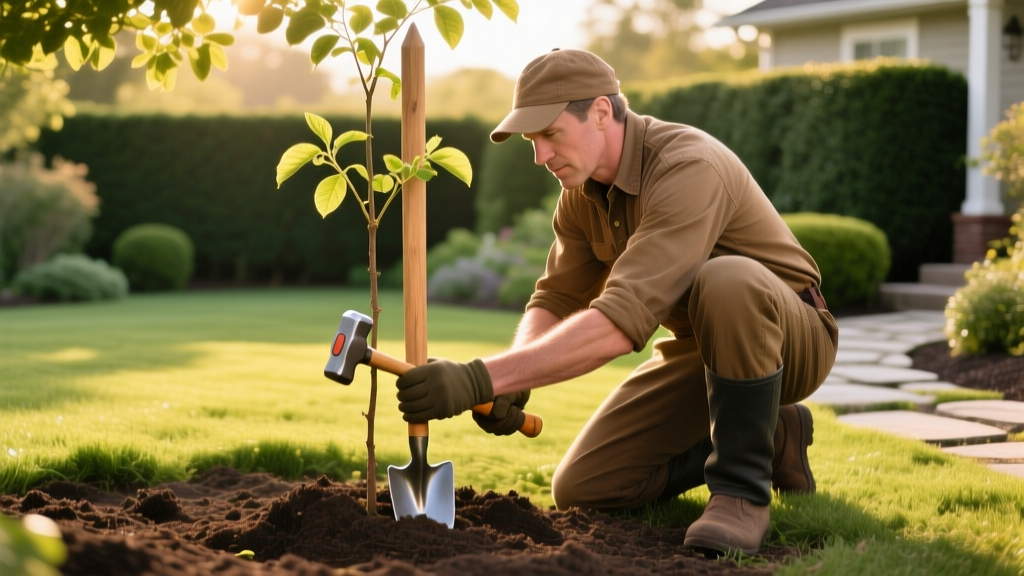
How to Drive a Stake in the Ground for Trees and Garden Structures
Driving a stake in the ground seems trivial until you hit a layer of compacted subsoil, glacial till, or dry hardpan. Whether you are anchoring a 15-foot privacy trellis, supporting a newly planted Quercus rubra (red oak), or securing heavy-duty landscape fabric, the holding power of your stake depends entirely on soil shear strength, embedment depth, and lateral load distribution. A poorly driven stake will heave during winter freeze-thaw cycles or snap under the wind load of a mature canopy. This guide details the precise soil mechanics, tool selections, and installation protocols required for permanent garden staking.
Soil Mechanics and Frost Line Heave
The primary cause of stake failure in residential landscapes is not lateral wind pressure, but vertical frost heave. When the ground freezes, water in the soil expands by approximately 9%, creating an upward hydraulic force that grips the surface area of your stake. If the base of the stake does not extend below the local frost line, the freezing soil will push it upward, ruining your alignment and compromising structural integrity.
Warning: Know Your Frost Line
In USDA Hardiness Zone 4, the frost line can reach 60 inches deep. In Zone 6, it averages 36 inches. If you are driving a stake for a permanent structure (like a vineyard trellis or heavy netting frame), you must either bury the stake below this depth or use a concrete bell-f footing at the base to anchor it below the active freeze zone. For temporary seasonal tree staking, frost heave is less critical, but soil compaction remains a major factor.
In USDA Hardiness Zone 4, the frost line can reach 60 inches deep. In Zone 6, it averages 36 inches. If you are driving a stake for a permanent structure (like a vineyard trellis or heavy netting frame), you must either bury the stake below this depth or use a concrete bell-f footing at the base to anchor it below the active freeze zone. For temporary seasonal tree staking, frost heave is less critical, but soil compaction remains a major factor.
Material Selection Matrix for Garden Stakes
Choosing the wrong material leads to rot, bending, or soil toxicity. Below is a comparison of the most common staking materials used in modern landscaping, with 2026 market pricing for standard 6-foot to 8-foot lengths.
| Material | Best Application | Lateral Strength | Avg. Cost (6-8 ft) |
|---|---|---|---|
| 1.25" Galvanized Steel T-Post | Heavy trellises, deer fencing, structural netting | Exceptional | $9.50 - $14.00 |
| 2x2 Pressure-Treated Pine | Tree staking, temporary plant support | Moderate (prone to snapping) | $4.00 - $7.50 |
| 1/2" Fiberglass Reinforced Plastic | Lightweight saplings, tomato plants, row covers | Low (flexes under load) | $3.00 - $5.00 |
| 1/2" Copper-Plated Ground Rod | Landscape lighting, low-voltage wire anchoring | High (but very thin profile) | $12.00 - $18.00 |
Step-by-Step Execution for Hardpan and Clay Soils
Attempting to drive a wooden or steel stake directly into dry, compacted clay (Vertisol) will result in shattered wood or a bent T-post. The soil must be prepared to reduce its shear resistance before the driving phase begins.
The 24-Hour Hydration Protocol
Water is the most effective soil lubricant. Exactly 24 hours before you plan to drive the stake, use a 5-gallon bucket to slowly pour 10 to 15 gallons of water directly onto the target insertion point. This allows the moisture to percolate down 18 to 24 inches, softening the clay matrix without turning the surface into unworkable mud. If you attempt to drive a stake immediately after watering, the top 3 inches will turn to slick sludge, preventing the soil from gripping the stake once it dries.
Pre-Drilling and Driving Technique
For heavily compacted soils or areas with high rock content, pre-drilling is mandatory.
- Mark the Depth: Wrap bright landscaping tape around your stake to indicate the exact embedment depth. The universal rule for structural holding power is that one-third of the total stake length must be submerged. For a 6-foot stake, drive it 24 inches deep.
- Pilot Hole: Use a 24-inch manual post hole digger (PHD) or a 2-inch rock auger attached to a heavy-duty cordless drill to bore a pilot hole to half the required depth (e.g., 12 inches). The pilot hole should be slightly narrower than the stake's diameter to ensure tight soil friction.
- The Driving Tool: Never use a standard 16-ounce claw hammer. Use a 3-pound or 4-pound drilling hammer (mash hammer) or a specialized post driver sleeve. The mass of the hammer delivers kinetic energy that fractures the soil ahead of the stake, rather than just pushing soil out of the way.
- Strike Zone: If driving a wooden stake, place a scrap block of hardwood over the top to prevent the maul from mushrooming and splintering the driving end.
Arborist Standards for Tree Staking
Improper tree staking causes more damage than wind. According to research published by the University of Wisconsin-Madison Extension, trees that are rigidly staked fail to develop proper trunk taper and root anchorage. The trunk must be allowed to sway slightly in the wind to stimulate the production of reaction wood.
"Stake trees only when absolutely necessary, such as for top-heavy evergreens or in extremely windy sites. When staking is required, use two stakes placed outside the root ball, and secure the tree using wide, flexible materials in a figure-eight pattern to prevent bark girdling."
— Arbor Day Foundation Planting Guidelines
When driving the stakes for a tree, position them 18 to 24 inches away from the central trunk to avoid severing the primary structural roots. Use 1-inch tubular polyester webbing for the ties, checking them every 30 days to ensure they are not cutting into the expanding cambium layer. Remove the stakes entirely after one full growing season.
Troubleshooting Lateral Load Failures
If your stakes are leaning or pulling out under lateral pressure, diagnose the failure using this matrix:
- Symptom: Stake bends at the soil line.
Cause: Insufficient embedment depth or using a material with low yield strength (like thin fiberglass) for a high-wind application.
Fix: Upgrade to a 1.25" steel T-post and increase embedment depth to 40% of total length. - Symptom: Stake pulls straight up out of the ground.
Cause: Frost heave or lack of soil friction in sandy loam soils.
Fix: In sandy soils, drive the stake at a 10-degree angle away from the direction of the lateral pull, or attach a subterranean deadman anchor (a horizontal piece of wood buried 18 inches deep and wired to the stake). - Symptom: Soil cracks and craters around the base of the stake.
Cause: The lateral load is exceeding the soil's bearing capacity, often seen in dry, loose topsoil.
Fix: Backfill the immediate 6-inch radius around the stake with crushed angular gravel (3/4-inch crushed stone) and tamp it vigorously. The angular edges of the gravel will lock together, creating a rigid collar that distributes the lateral load over a wider surface area.