
Home & Garden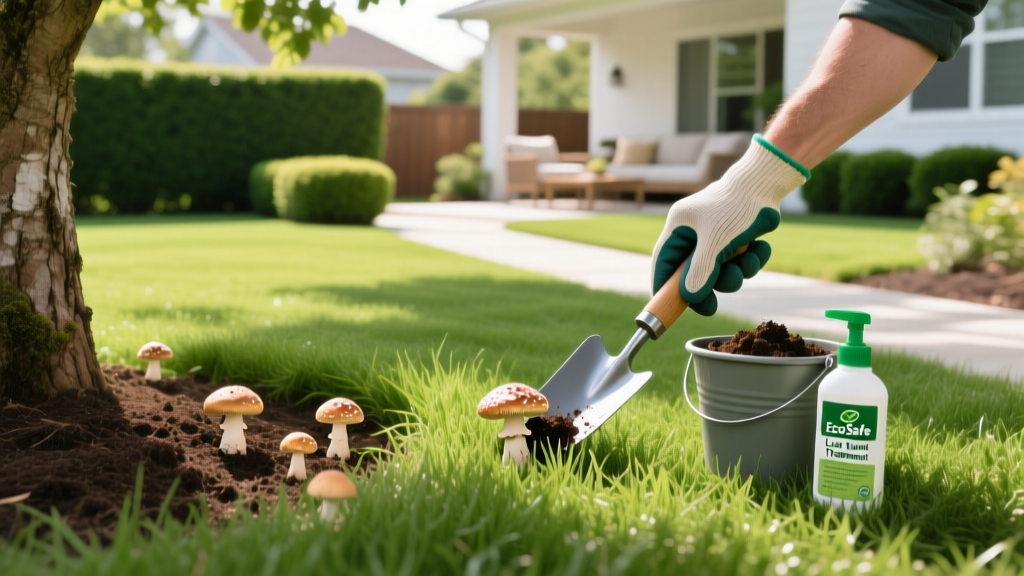
How to Get Rid of Mushrooms in Yard: A Step-by-Step Lawn Guide
The Biology: Why Mushrooms Invade Your Turf
To effectively eliminate mushrooms in yard environments, you must first understand what you are actually fighting. The mushrooms popping up through your grass are merely the fruiting bodies—the reproductive structures—of a much larger, subterranean fungal network called mycelium. Mycelium thrives on decaying organic matter, such as buried tree roots, thick thatch layers, and decomposing grass clippings, combined with consistent soil moisture.
The Mycelium Iceberg: Plucking the visible mushroom only removes about 2% of the total fungal organism. The remaining 98% (the mycelium) continues to digest organic matter in your soil. To stop the fruiting cycle, you must alter the environmental conditions that allow the mycelium to thrive, specifically targeting soil moisture and thatch accumulation.
While mushrooms are generally beneficial decomposers that recycle nutrients back into the soil, they become a nuisance when they invade high-traffic lawn areas, create unsightly fairy rings, or pose a toxicity risk to foraging pets. The following protocol shifts your lawn's microclimate to make it inhospitable to fungal fruiting.
5-Step Protocol to Eliminate Surface Fungi
Follow this sequence to systematically dismantle the conditions that trigger mushroom blooms. Skip steps, and the mycelium will simply wait for the next heavy rain to fruit again.
- Physical Extraction (Do Not Mow): Mowing over mushrooms shreds the caps and spreads millions of spores across your turf, potentially colonizing new areas. Instead, wear gardening gloves, grasp the mushroom at the base of the stalk, and twist while pulling to extract the entire structure. Dispose of them in a sealed yard waste bag, not your compost bin.
- Thatch Reduction: Mycelium feeds on thatch. Measure your thatch layer by cutting a small wedge into the soil with a spade. If the spongy brown layer exceeds 0.5 inches, rent a power dethatcher (typically $65–$85 per day at local equipment rental centers). Set the blade depth to penetrate 1/4 inch into the soil surface to mechanically tear out the fungal food source.
- Core Aeration: Compacted soil traps water in the upper root zone, creating the perfect humid incubator for fungi. Rent a walk-behind core aerator to pull 2-to-3-inch soil plugs. Leave the plugs on the lawn to dry and break down; the soil microbes in the plugs will help digest the remaining thatch. Professional aeration services charge roughly $15 to $18 per 1,000 square feet.
- Targeted Nitrogen Application: Accelerate the decomposition of buried organic matter by applying a fast-release nitrogen fertilizer. Use a 3-1-2 or 4-1-2 NPK ratio (like a 24-6-12 turf builder). Apply exactly 1 pound of actual nitrogen per 1,000 square feet. This stimulates soil bacteria to outcompete the fungi and break down the decaying wood or roots feeding the mycelium.
- Irrigation Recalibration: Fungi require constant surface moisture to fruit. Transition from frequent, shallow watering (e.g., 10 minutes daily) to deep, infrequent soaking. Apply 1 to 1.5 inches of water per week in two or three sessions, preferably between 4:00 AM and 6:00 AM, allowing the grass blades to dry completely before nightfall.
Moisture & Shade Management Matrix
Environmental control is the most critical long-term deterrent. Use the matrix below to diagnose your yard's specific microclimate issues and apply the correct structural fix.
| Yard Condition | Moisture Profile | Mushroom Risk | Required Action |
|---|---|---|---|
| Dense Tree Canopy + Clay Soil | Chronic high moisture; slow evaporation | Extreme | Prune lower tree limbs to 8 feet to increase UV penetration and airflow. |
| North-Facing Slope | Moderate moisture; limited direct sun | High | Install French drains or dry creek beds to redirect subsurface runoff. |
| Over-irrigated Flat Turf | Artificial saturation; pooling | Moderate | Audit sprinkler heads; replace standard nozzles with MP Rotators for slower absorption. |
Fungicide Realities: Chemical vs. Cultural Controls
Many homeowners immediately search for chemical solutions, but fungicides are rarely the silver bullet for yard mushrooms. According to turfgrass pathology guidelines, most over-the-counter fungicides target foliar diseases (like dollar spot or brown patch) rather than the saprophytic fungi that produce lawn mushrooms.
- Systemic Fungicides (e.g., Azoxystrobin, Propiconazole): Products like Heritage SC or Banner MAXX can suppress fungal activity, but they are expensive ($70–$120 per bottle) and do not eradicate the mycelium feeding on buried wood. They are best reserved for severe, turf-killing fairy rings rather than standard mushroom outbreaks.
- Contact Fungicides (e.g., Chlorothalonil): These only kill the visible mushroom cap on contact and do nothing to the underground network. They are a waste of resources for this specific problem.
- Organic Sprays (Neem Oil, Baking Soda): While safe for pets and the environment, altering the soil pH temporarily with baking soda or applying neem oil only deters fruiting for a few days. They do not provide long-term eradication.
Note: Always consult the Environmental Protection Agency's pesticide safety guidelines before applying any chemical treatment to areas where children or pets play.
Edge Cases: Fairy Rings and Pet Safety
The Fairy Ring Dilemma: If your mushrooms are forming a distinct, expanding circle (a fairy ring), you are likely dealing with a Type 2 or Type 3 ring. Type 2 rings stimulate dark green, rapid grass growth due to nitrogen release, while Type 3 rings only produce mushrooms. Eradicating an established fairy ring requires aggressive core aeration, heavy nitrogen fertilization, and potentially soil surfactants to penetrate the hydrophobic mycelium mat.
Toxicity Warning for Pets
Dogs are notoriously curious and may ingest yard mushrooms during foraging. While the vast majority of saprophytic lawn mushrooms (like the common ink cap or meadow mushroom) are non-lethal, they can cause severe gastrointestinal distress. However, species like Inocybe or Clitocybe, which occasionally appear in mulched beds adjacent to lawns, contain muscarine and can be fatal. If your dog consumes an unidentified mushroom, do not wait for symptoms. Contact your veterinarian immediately or consult the ASPCA Animal Poison Control Center for emergency triage protocols.
Frequently Asked Questions
Will applying lime or changing soil pH kill yard mushrooms?
No. The myth that mushrooms only grow in acidic soil is false. Saprophytic fungi thrive across a wide pH range (5.5 to 7.5). Applying lime to raise your soil pH will only affect the grass's nutrient uptake; it will not starve or kill the mycelium network.
Should I remove buried tree stumps to stop mushroom growth?
Yes, if they are the primary food source. If mushrooms are concentrated in a specific 5-foot radius, there is likely a decaying root mass or buried construction debris beneath the soil. Excavating and removing the buried wood removes the mycelium's food supply, effectively ending the mushroom cycle in that zone.
Can I eat the mushrooms growing in my lawn?
Absolutely not. Accurate identification of wild fungi requires microscopic spore print analysis and expert mycological knowledge. Many toxic species closely resemble edible varieties, and lawn mushrooms can absorb heavy metals, pesticides, or pet waste pathogens from the soil environment.