
Home & Garden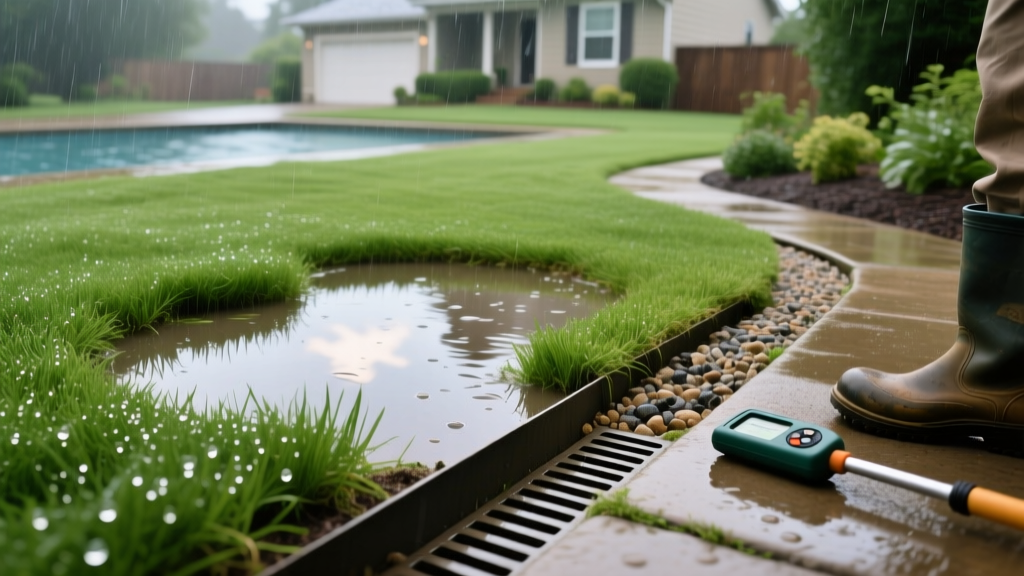
How to Fix Water Pooling in Yard After Heavy Rain
The 15-Minute Yard Audit: Diagnosing the Pooling
Water pooling in yard after heavy rain is rarely a random event; it is a symptom of specific soil or topographical failures. Before purchasing any drainage materials, you must identify whether the issue is caused by surface grading, soil compaction, or a high water table. Turfgrass roots begin to suffocate and rot within 24 hours of standing water due to anaerobic conditions, making rapid diagnosis critical.
Perform the "Puddle Test" to isolate the variable. After a heavy rain, mark the perimeter of the standing water with landscaping paint. Wait 48 hours. If the water remains, you have a drainage failure. Next, measure your yard's slope. The universal building code standard for residential drainage requires a 2% grade—meaning a 1/4-inch drop per 1 foot of horizontal distance away from your foundation. For a point 10 feet from your house, the ground must be exactly 2.5 inches lower than the foundation baseline. Use a 4-foot carpenter's level and a tape measure to verify this metric.
Expert Insight: Soil composition dictates your baseline drainage capacity. Heavy clay soils percolate water at less than 0.1 inches per hour, meaning a 2-inch rain event will inherently pool on the surface for up to 20 hours even with perfect grading. Sandy loam percolates at 0.5 to 2.0 inches per hour. According to the USDA Natural Resources Conservation Service, identifying your soil compaction level is the mandatory first step before altering surface topography.
Level 1 Fixes: Soil & Surface Solutions (Under $150)
If your yard meets the 2% slope requirement but water still pools, the culprit is subsurface compaction or thatch buildup. Water is hitting a hardpan layer of soil and moving laterally instead of infiltrating.
Core Aeration and Compost Topdressing
Do not use spike aerators; they actually increase compaction by pushing soil outward. Rent a walk-behind core aerator (such as a Billy Goat PL1800H, typically $85 per day from local equipment rental yards). This machine extracts 3-inch deep, 5/8-inch wide soil plugs, physically breaking the hardpan layer.
- Aerate the lawn in two perpendicular passes to create a grid of holes spaced 3 inches apart.
- Leave the extracted soil plugs on the lawn to break down naturally.
- Immediately topdress the area with 1/4 inch of screened, aged compost. The compost will wash into the aeration holes, permanently altering the soil structure and increasing the percolation rate of heavy clay.
Aggressive Dethatching
If the spongy layer of dead organic matter (thatch) between your soil and grass blades exceeds 1/2 inch, it acts as a hydrophobic barrier. Use a power dethatcher to rip out this layer. A healthy lawn should have less than 1/4 inch of thatch to allow rapid water infiltration.
Level 2 Fixes: Regrading & Surface Drainage ($150 - $500)
When the 15-minute audit reveals a negative slope (water sloping toward the house) or severe depressions, surface regrading and catch basins are required.
Strategic Regrading
Order screened topsoil (budget roughly $35 to $50 per cubic yard). Spread the soil in low-lying areas, using a heavy landscaping rake to blend it into the existing grade. The goal is to re-establish the 1/4-inch-per-foot slope. Seed the bare soil immediately with a quick-germinating perennial ryegrass to prevent erosion during the next storm.
Installing a Surface Catch Basin
For isolated low spots where regrading is impossible, install a catch basin. The industry standard is the NDS 12 in. x 12 in. Plastic Catch Basin (Model #001004), which costs around $38. Dig a hole to fit the basin so the grate sits exactly 1/4 inch below the surrounding soil grade. This slight depression ensures water flows into the grate rather than over it. Connect the basin outlet to a 4-inch drainage pipe.
Level 3 Fixes: Subsurface Drainage & Dry Wells ($500+)
If your property sits at the bottom of a hill or has a high water table, surface fixes will fail. You must intercept and relocate the water using subsurface systems.
The French Drain: Avoiding the Beginner's Mistake
Most DIY French drains fail within three years because homeowners use cheap, black corrugated pipe and unwashed gravel. The corrugated pipe crushes under soil pressure, and unwashed gravel contains "fines" (stone dust) that clog the pipe perforations.
The Professional Specification:
- Pipe: Use 4-inch SDR 35 PVC sewer pipe with pre-drilled holes. It costs about $15 per 10-foot stick but will not crush under heavy soil loads.
- Gravel: Use strictly 3/4-inch washed drainage gravel. The washing process removes dust, ensuring water flows freely.
- Fabric: Line the trench with 3-ounce or 4-ounce non-woven geotextile fabric (approx. $40 for 100 sq ft). Woven landscape fabric will clog; non-woven fabric allows water through while blocking silt.
Dig a trench 12 to 18 inches deep, maintaining the 2% slope. Line the trench with fabric, add 2 inches of gravel, lay the PVC pipe holes-down, cover with gravel to 2 inches below the surface, fold the fabric over the top like a burrito, and cover with topsoil.
The Dry Well Solution for Heavy Clay
If you have nowhere to route a French drain (e.g., no municipal storm drain or lower elevation), you must store the water underground using a dry well. The NDS Flo-Well System (Model #R0009) retails for approximately $135 and holds up to 50 gallons of water, allowing it to slowly percolate into the subsoil over several days. The EPA notes that decentralized subsurface storage is a highly effective green infrastructure method for reducing localized stormwater runoff and preventing soil erosion.
Drainage Solution Decision Matrix
| Yard Symptom | Root Cause | Recommended Fix | Estimated Cost | DIY Difficulty |
|---|---|---|---|---|
| Shallow, widespread puddling across flat lawn | Soil compaction / Thatch | Core Aeration + Compost Topdressing | $85 - $150 | Beginner |
| Water flowing toward house foundation | Negative surface grading | Topsoil Regrading (2% slope) | $100 - $300 | Intermediate |
| Deep pooling in one specific low spot | Topographical depression | NDS 12x12 Catch Basin | $75 - $150 | Intermediate |
| Constant soggy soil / high water table | Subsurface saturation | SDR 35 PVC French Drain | $400 - $800 | Advanced |
| Nowhere to route runoff water | Flat property / Clay subsoil | NDS Flo-Well Dry Well System | $200 - $400 | Advanced |
When to Call a Professional Landscaper
While aeration, grading, and shallow catch basins are manageable weekend projects, you must hire a licensed drainage contractor if the water pooling is occurring within 5 feet of your home's foundation and your basement shows signs of efflorescence (white, chalky mineral deposits on concrete). Furthermore, if your property requires moving more than 10 cubic yards of soil to achieve the 2% grade, the cost of renting a mini-skid steer ($250/day) and the physical labor involved make professional earthmoving services (typically $1,500 to $3,500) a more efficient investment.