Home & Garden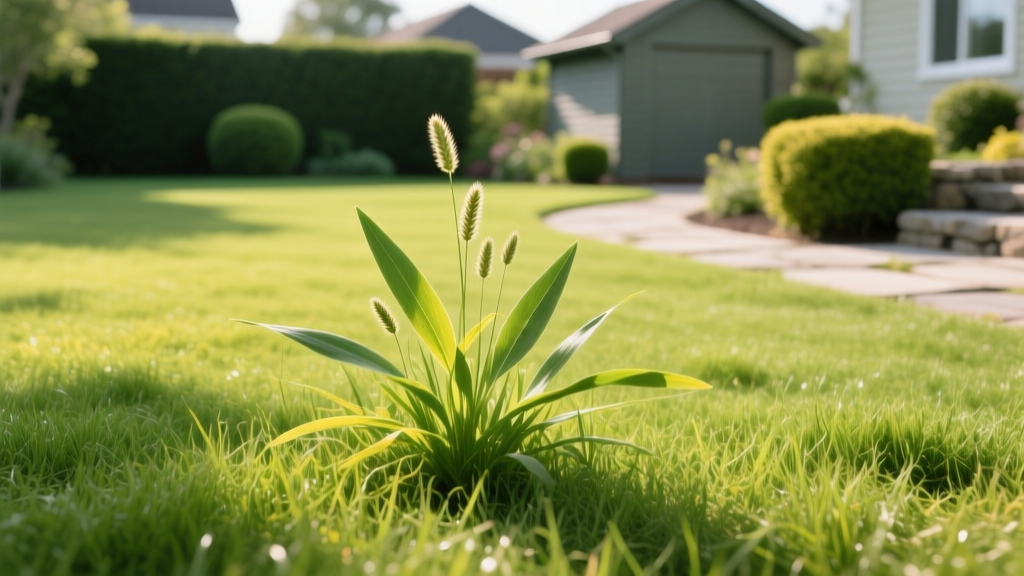
Spot-Treating Goosegrass: Identification and Eradication Guide
The Anatomy of a Turf Invader
Goosegrass (Eleusine indica) is an aggressive, annual summer weed that thrives in the exact conditions homeowners inadvertently create: heavily compacted, high-traffic soil where desirable turfgrass roots struggle to penetrate. Unlike crabgrass, which features a sprawling growth habit and rolled vernation, goosegrass grows in a tight, prostrate rosette with folded vernation. Its most definitive visual marker is the base of the plant, which exhibits a distinct silver or white coloration at the crown, transitioning into dark green, wiry, and heavily ridged leaf blades.
Field Identification Checklist:
- Crown: Silver/white base, heavily compressed.
- Stems: Flattened, wiry, and highly resistant to tearing by hand.
- Seedhead: 2 to 6 spikes resembling a zipper, emerging from a single central point (often called "crowfoot" or "wiregrass").
- Root System: Deep, fibrous taproot that anchors firmly into hardpan soil.
According to weed science research from NC State Turffiles, goosegrass can produce over 140,000 seeds per plant if left unmowed, and these seeds remain viable in the soil seedbank for years. Spot-treating mature plants is only half the battle; preventing germination in compacted zones is the ultimate cure.
Why Post-Emergent Spot Treatment is Notoriously Difficult
Homeowners frequently report that standard broadleaf or generic grassy weed killers fail against goosegrass. This failure is due to two biological defenses. First, goosegrass develops a highly waxy cuticle on its mature leaves, causing water-based herbicide solutions to bead up and roll off before absorption occurs. Second, its fibrous root system stores carbohydrates efficiently, allowing the plant to recover from sub-lethal chemical burns.
To achieve a successful kill, you must breach the waxy cuticle using a dedicated surfactant and apply the herbicide when the plant is in its early "tiller" stage (before the zipper-like seedheads emerge and while the plant has fewer than 4 leaves). Once goosegrass matures past the 5-leaf stage, chemical spot-treatment efficacy drops by over 60%, necessitating manual extraction.
Chemical Spot-Treatment Matrix by Lawn Type
Selecting the correct active ingredient is critical, as using the wrong chemistry will either fail to kill the weed or cause severe phytotoxicity to your desirable turf. Below is the professional-grade dosing matrix for a standard 1-gallon pump sprayer calibrated to cover 1,000 square feet.
| Lawn Type | Active Ingredient | Product Example | Mix Rate (per 1 gal) | Required Surfactant |
|---|---|---|---|---|
| Cool-Season (Fescue, Bluegrass, Ryegrass) | Fenoxaprop-p-ethyl | Acclaim Extra | 0.75 fl oz | Non-Ionic Surfactant (NIS) at 0.25% |
| Cool-Season (Alternative) | Fluazifop-p-butyl | Fusilade II | 0.50 fl oz | Methylated Seed Oil (MSO) |
| Warm-Season (Bermuda, Zoysia) | Chemical control is highly restricted/risky | Manual + Pre-emergent | N/A | N/A |
Warning for Warm-Season Lawns: According to the University of California IPM, post-emergent chemical control of goosegrass in mature Bermuda or Zoysia lawns is exceptionally difficult for homeowners. Products containing clethodim or fluazifop will severely stunt or kill Bermuda grass. For warm-season lawns, the only viable spot-treatment is manual extraction of the taproot followed by a localized pre-emergent application.
Step-by-Step Application Protocol (Cool-Season Lawns)
If you are managing a cool-season lawn and utilizing Fenoxaprop-p-ethyl (Acclaim Extra), precision is mandatory. Follow this exact protocol to ensure the herbicide breaches the plant's defenses.
- Calibrate Your Sprayer: Mark a 1,000 sq ft area (e.g., 20x50 ft). Fill your pump sprayer with 1 gallon of water and spray the area evenly. If you run out of water before finishing the area, adjust your walking pace or nozzle tip to ensure 1 gallon covers exactly 1,000 sq ft.
- Mix the Solution: Add 0.75 fl oz (approx. 22 ml) of Acclaim Extra to the 1-gallon sprayer. Add 0.25 fl oz (approx. 7.5 ml) of a high-quality Non-Ionic Surfactant (such as DyneAmic or a generic NIS). Agitate the tank thoroughly.
- Timing the Application: Apply only when daytime temperatures are between 65°F and 85°F. Applications made when temperatures exceed 90°F will cause rapid volatilization and potential turf burn. Do not apply if rain is forecast within 24 hours.
- Targeted Spraying: Use a cone-spray nozzle to drench the center crown of the goosegrass rosette. Avoid broadcasting the chemical over the entire lawn; spot-treating conserves product and reduces turf stress.
- Follow-Up: Goosegrass will yellow and necrotic over 14 to 21 days. If green tissue remains at the crown after 21 days, a second application at the same rate may be made, provided it is at least 14 days after the initial treatment.
The Root Cause Fix: Relieving Soil Compaction
Treating the weed without treating the soil guarantees goosegrass will return the following summer. Goosegrass is an indicator species for soil compaction. When soil bulk density exceeds 1.4 g/cm³, desirable turfgrass roots suffocate, but goosegrass thrives.
Aeration and Topdressing Specifications
To permanently alter the soil profile in high-traffic zones where goosegrass clusters, you must perform mechanical core aeration. Rent a walk-behind core aerator (do not use spike aerators, which worsen compaction by creating a hardpan layer beneath the spikes). Set the machine to pull cores that are a minimum of 3 inches deep and 2 to 3 inches apart.
Immediately following aeration, apply a topdressing of coarse sand or a 70/30 sand-to-compost mix at a rate of 1 cubic yard per 1,000 square feet. Drag the mix into the aeration holes using a stiff-tined rake. This creates permanent macropores in the soil, allowing water, oxygen, and fertilizer to reach your desirable turfgrass roots, effectively outcompeting future goosegrass invasions.
Manual Extraction Technique for Mature Plants
If the goosegrass has already developed its signature "zipper" seedheads, chemical herbicides will not translocate effectively to the roots. You must extract the plant manually. Do not simply pull the wiry leaves; they will snap off at the crown, leaving the taproot intact to regenerate within 7 days.
Use a stand-up weeding tool equipped with a serrated claw (such as the Fiskars Stand-Up Weeder). Position the claw directly over the silver crown, step firmly on the foot platform to drive the tines 4 inches into the soil, and pull back on the handle to lever the entire root mass out. Place extracted plants in a sealed yard waste bag—do not compost them, as home compost piles rarely reach the 140°F threshold required to destroy goosegrass seeds.
Frequently Asked Questions
Can I use pre-emergent to stop goosegrass?
Yes, and it is the most effective control method. Apply Prodiamine (Barricade) at a rate of 0.18 oz per 1,000 sq ft when soil temperatures at a 2-inch depth consistently reach 60°F in the spring. Goosegrass germinates slightly later than crabgrass, so a split application (half-rate in early spring, half-rate 45 days later) provides a continuous chemical barrier through peak summer germination.
Will vinegar or organic herbicides kill goosegrass?
No. Horticultural vinegar (20% acetic acid) is a contact desiccant that will burn the top growth of goosegrass but will not penetrate the waxy cuticle deeply enough to kill the fibrous taproot. The plant will regenerate from the crown within 5 to 7 days, making organic contact herbicides an ineffective use of time and money for this specific species.