
Home & Garden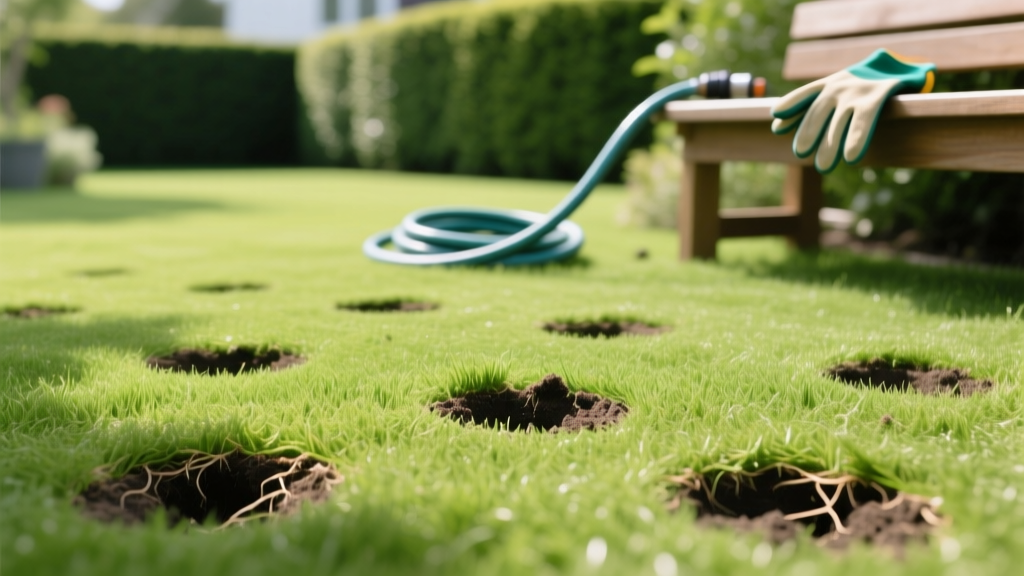
What Causes Dime Size Holes in Yard? A Beginner's Guide
The 18-Millimeter Mystery: Why Your Lawn Looks Pockmarked
A standard US dime measures exactly 17.91 millimeters (0.705 inches) in diameter. When you step outside and notice your turf dotted with holes matching this exact profile, it is natural to assume a pest invasion is destroying your root system. However, in the vast majority of cases, dime size holes in yard environments are the byproduct of highly beneficial soil activity. Earthworms, ground-nesting bees, and emerging turf insects all create exit or aeration shafts that fall perfectly into the 1/4-inch to 3/4-inch range.
As a beginner navigating lawn care, misidentifying these holes can lead to disastrous decisions, such as applying broad-spectrum insecticides that annihilate your soil's natural aeration workforce. Before reaching for chemical treatments, you must accurately diagnose the architect of the holes based on soil mounding, seasonal timing, and hole geometry.
Quick Diagnostic Check:
- Is there a small mound of granular, pellet-like soil? Likely an earthworm midden or solitary bee nest.
- Is the hole perfectly round with no soil mound? Likely an emerging June bug or cicada.
- Is the soil clumpy and the hole closer to 1 inch? Look out for skunks or armadillos foraging for grubs.
The Usual Suspects: Identifying the Architect
Earthworms and the 'Midden' Effect
Nightcrawlers (Lumbricus terrestris) and gray worms (Aporrectodea) are the primary engines of soil health. When soil temperatures sit between 50°F and 65°F and moisture levels are high (typically in early spring and late autumn), these worms pull organic matter into their burrows and excrete nutrient-rich castings on the surface. According to Penn State Extension, these castings form small, dime-sized mounds known as middens. The hole in the center of the midden is the worm's aeration shaft. While these mounds can make a lawn feel bumpy underfoot and dull mower blades, they are a sign of elite soil biology. A healthy lawn should host 50 to 300 earthworms per square yard.
Ground-Nesting Solitary Bees (Andrenidae)
If the dime size holes in yard appear in early spring (March through May) in areas where the turf is slightly thin, you are likely looking at the nests of solitary ground bees. Unlike aggressive social wasps, these native pollinators are docile. The males lack stingers entirely, and the females rarely sting unless crushed. The University of Minnesota Extension notes that these bees prefer well-drained, sandy soils with sparse grass cover. Their nests feature a clean, 1/4-inch round hole surrounded by a tiny, granular mound of excavated soil that easily washes away with rainfall.
Emerging Turf Insects (June Bugs & Cicadas)
In late May through June, you may notice perfectly round, 3/8-inch holes scattered across the yard with no soil mounds. These are exit tunnels created by adult June bugs (Phyllophaga) emerging from the soil after spending one to three years in the grub stage. While the grubs themselves can damage roots if populations exceed 10 per square foot, the adult exit holes are harmless and will close naturally after a few heavy rainstorms.
Diagnostic Comparison Matrix
Use this matrix to cross-reference your lawn's specific symptoms against the most common culprits.
| Culprit | Hole Diameter | Soil Mound Type | Peak Season | Lawn Impact |
|---|---|---|---|---|
| Earthworms | 1/4' to 1/2' | Pellet-like castings | Spring / Fall | Highly Beneficial |
| Solitary Bees | 1/4' to 3/8' | Fine, granular dust | Early Spring | Beneficial Pollinator |
| June Bugs | 3/8' round | None (clean exit) | Late Spring | Neutral (grubs may feed) |
| Skunks/Raccoons | 1' to 3' | Torn sod, large clods | Late Summer / Fall | Harmful (indicates grubs) |
When Dime-Size Holes Signal a Bigger Problem
While true dime-sized holes are rarely a threat, they can sometimes be the leading edge of a larger foraging pattern. If you notice the holes are clustered near the edges of the lawn, accompanied by torn grass blades, or gradually increasing in size to the diameter of a golf ball, you are likely dealing with nocturnal foragers like skunks, raccoons, or armadillos. These animals use their sharp claws to punch small test holes into the turf to sniff out white grubs. If you confirm grub activity by performing a soapy water flush (mix 2 tablespoons of dish soap in 2 gallons of water and pour over a 1-square-yard area; grubs will surface within 5 minutes), you will need to apply a targeted curative grub control product containing trichlorfon in late summer, rather than treating the holes themselves.
The 4-Step Lawn Leveling Protocol (Skip the Heavy Roller)
Beginners often make the critical mistake of using a heavy water-filled lawn roller to flatten earthworm mounds and bee nests. This compacts the soil to over 200 PSI, suffocating grassroots and destroying the pore space required for water infiltration. Instead, use topdressing to safely level the lawn while preserving soil biology.
- Scalp and Collect: Lower your mower deck to 1.5 inches and bag the clippings. This exposes the holes and mounds, allowing the leveling mix to reach the soil surface directly.
- Mix the Topdressing Blend: Combine 70% washed river sand (not masonry sand, which contains too much clay) with 30% finely screened compost. In 2026, bulk topdressing mixes typically cost between $45 and $85 per cubic yard. A standard 5,000-square-foot lawn requires roughly 1.5 cubic yards for a 1/4-inch application.
- Apply and Drag: Shovel the mix into small piles across the lawn. Use a weighted steel landscape drag mat or a stiff push broom to work the mixture down into the dime-sized holes and over the mounds. Ensure the grass blades remain at least 50% exposed to prevent smothering.
- Water and Settle: Apply exactly 0.5 inches of water immediately after dragging to wash the sand into the earthworm shafts and bee burrows, locking the soil into a smooth, level grade.
Expert Insight: Never apply pre-emergent herbicides if you are trying to encourage ground-nesting bees or deep-burrowing earthworms. Many chemical barriers create a hydrophobic crust on the soil surface that prevents these beneficial insects from completing their nesting cycles.
Beginner FAQs
Will filling the holes with sand kill the earthworms?
No. Earthworms are highly adaptable and will simply burrow through the new sand layer to reach the organic matter below. In fact, adding coarse washed sand improves soil drainage, which earthworms prefer, as they avoid waterlogged, anaerobic environments.
How can I tell if a dime-sized hole is from a dangerous wasp?
Dangerous social wasps, like yellowjackets, typically build nests with entrance holes closer to 1 inch in diameter, and you will see heavy, aggressive traffic of multiple insects entering and exiting the same hole. Solitary ground bees operate alone, with only one bee per hole, and they exhibit a slow, non-aggressive flight pattern.
Should I treat my lawn for grubs if I see June bug exit holes?
Not automatically. Seeing a few exit holes is normal. Only treat for grubs if you count more than 8 to 10 grubs per square foot during a soil inspection, or if you see secondary damage from skunks digging up the turf to eat them.