Home & Garden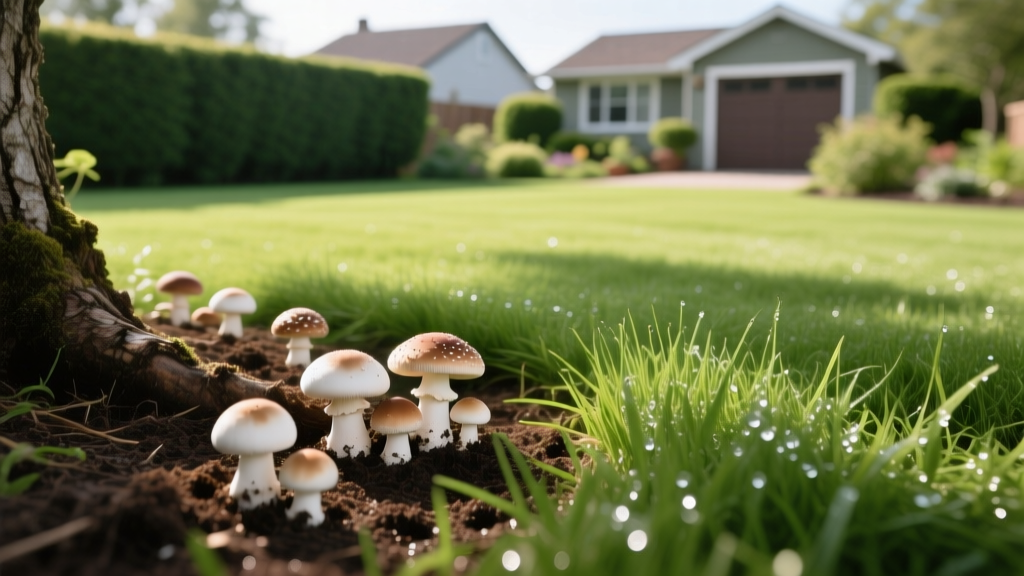
How to Identify and Eradicate Common Yard Mushrooms
The Mycelium Iceberg: Why Surface Removal Fails
Most homeowners view common yard mushrooms as an overnight invasion, but they are merely the reproductive fruiting bodies of a much larger, pre-existing underground mycelial network. When you see a mushroom cap breaking through your turfgrass, the fungus has likely been digesting organic matter in your soil for months or even years. Kicking them over or mowing them down only removes the temporary fruit; it does nothing to address the subterranean mycelium that spans hundreds of square feet beneath your lawn.
Expert Insight: Saprophytic fungi, which cause 90% of lawn mushroom outbreaks, are actually beneficial decomposers. They break down dead tree roots, buried construction lumber, and excessive thatch, recycling nutrients back into the soil. The goal of eradication is not to sterilize your soil, but to alter the environmental conditions that trigger the fruiting phase.
The Diagnostic Triad: Identifying Your Lawn's Vulnerabilities
Mushroom fruiting requires a very specific convergence of three environmental factors. If common yard mushrooms are appearing in your landscape, your yard is currently providing at least two of the following conditions:
- Persistent Moisture: Soil moisture levels consistently above 20% volumetric water content, often caused by over-irrigation, poor drainage, or compacted clay soils that prevent percolation.
- Abundant Organic Matter: A thatch layer exceeding 0.5 inches in depth, buried stumps, decaying root systems from previously removed trees, or heavy applications of uncomposted wood mulch.
- Canopy Shade: Dense tree canopies that limit UV penetration and reduce the evaporation rate of the topsoil, keeping the microclimate damp well into the afternoon.
Field Guide to 4 Common Yard Mushrooms
Accurate identification dictates your response strategy. While most turf-dwelling fungi are harmless to the grass itself, their toxicity profiles vary wildly. According to the Penn State Extension, the following species are the most frequent offenders in residential landscapes.
| Mushroom Type | Visual Identifiers | Toxicity Risk | Primary Cause |
|---|---|---|---|
| Fairy Ring (Chlorophyllum molybites) |
Large white/tan caps forming distinct circles; often surrounded by a ring of dark green, accelerated grass growth. | High (Severe gastrointestinal distress) | Heavy thatch layers and buried woody debris. |
| Lawn Puffballs (Calvatia spp.) |
Round, white, stemless spheres ranging from golf ball to grapefruit size. Release brown spore dust when crushed. | Low (Edible when pure white inside, but risky) | High soil nitrogen and decaying surface organics. |
| Inky Caps (Coprinopsis spp.) |
Tall, narrow, bell-shaped grey caps that rapidly dissolve into a black, ink-like liquid within 24 hours. | Moderate (Toxic if consumed with alcohol) | Wood chips, mulch, and buried construction scrap. |
| Dead Man's Fingers (Xylaria polymorpha) |
Greyish-black, tough, finger-like protrusions emerging directly from the soil surface. | Low (Inedible, hard texture) | Exclusively grows on buried dead tree roots. |
Step-by-Step Eradication and Prevention Protocol
To permanently suppress fruiting, you must disrupt the mycelium's environment. Follow this sequential protocol to starve the fungus and restore your turf.
Step 1: Mechanical Disruption and Moisture Auditing
Immediately remove visible fruiting bodies by raking or mowing to prevent spore dispersal. Next, audit your irrigation system. Turfgrass requires roughly 1 to 1.5 inches of water per week, including rainfall. Switch to deep, infrequent watering cycles (e.g., 0.5 inches twice a week) rather than daily shallow watering, which keeps the top inch of soil perpetually saturated and triggers fungal fruiting.
Step 2: Thatch Reduction and Core Aeration
Measure your thatch layer by cutting a small wedge of turf with a spade. If the spongy brown layer between the green grass and the soil exceeds 0.5 inches, rent a power dethatcher. Follow this with core aeration, pulling 3-inch soil plugs spaced 2 to 3 inches apart. This physically severs the mycelial network, introduces oxygen to the soil (which suppresses anaerobic fungal activity), and improves water percolation. The Royal Horticultural Society heavily emphasizes aeration as the primary cultural control for fungal outbreaks.
Step 3: Nitrogen Manipulation
Counterintuitively, applying a fast-release nitrogen fertilizer can help eliminate mushrooms caused by buried wood or stumps. Fungi and bacteria compete for nitrogen when breaking down carbon-heavy wood. By applying 1 pound of actual nitrogen per 1,000 square feet (using a product like urea or ammonium sulfate), you stimulate soil bacteria to outcompete the fungi, accelerating the decomposition of the buried wood until the food source is entirely depleted.
Step 4: Stump and Root Extraction
If mushrooms are clustered in a specific 5-foot radius, you likely have a decaying root system or buried lumber beneath the soil. You must excavate the area to a depth of 12 to 18 inches, remove all woody debris, and backfill with a 70/30 mix of native topsoil and coarse sand to ensure future drainage.
The Fungicide Fallacy: Why Chemicals Waste Your Money
Many homeowners waste $80 to $150 on broad-spectrum chemical fungicides containing active ingredients like Azoxystrobin or Propiconazole, only to see mushrooms return the next week. These chemicals are designed to target pathogenic fungi that attack living grass blades (such as Brown Patch or Dollar Spot). They are largely ineffective against saprophytic fungi that feed on dead organic matter deep in the soil profile. The mycelial network is simply too deep and massive for surface-applied contact fungicides to penetrate and eradicate. Save your budget for mechanical aeration and soil amendment instead.
Pet and Child Safety Protocols
CRITICAL WARNING: Never attempt to identify a wild mushroom using smartphone apps or visual guesswork to determine edibility. Misidentification of species like Chlorophyllum molybites (which closely resembles edible supermarket button mushrooms) can lead to severe poisoning.
If a child or pet ingests any part of an unknown yard mushroom, do not wait for symptoms to appear. Immediately contact the Pet Poison Helpline or your local Poison Control Center. If possible, carefully dig up a complete specimen—including the base of the stem and the surrounding soil—and place it in a paper bag (not plastic, which accelerates decomposition) to bring to the veterinarian or toxicologist for precise identification. Rapid onset of vomiting or lethargy within two hours of ingestion is a primary indicator of severe toxicity requiring immediate emergency intervention.