
Home & Garden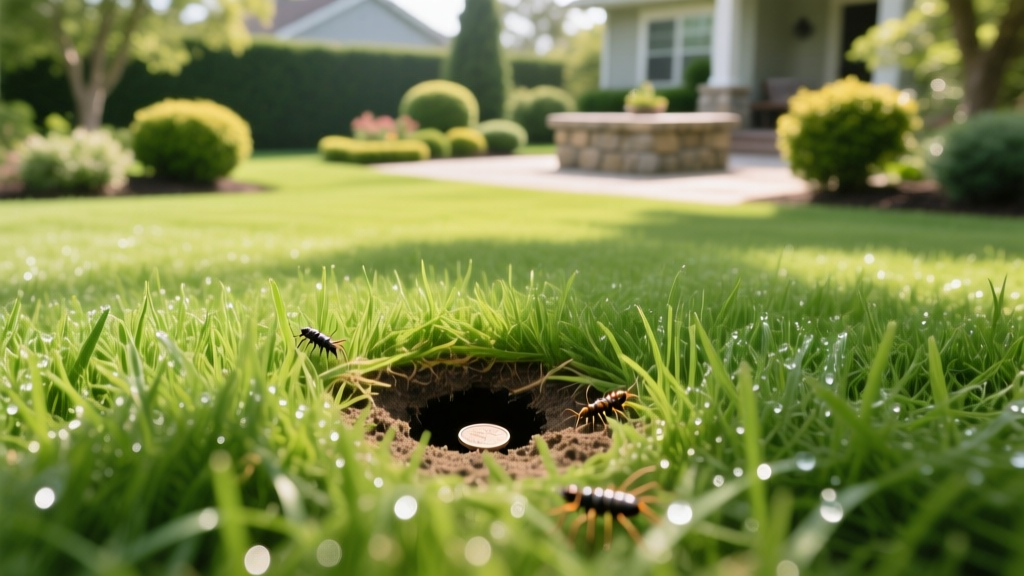
Identify and Fix Dime Sized Holes in Yard: A Guide
The 17.91mm Mystery: Why Exact Dimensions Matter
When homeowners spot small punctures in their turf, the immediate reaction is often pest control. However, identifying the exact diameter is the most critical diagnostic step. A standard US dime measures exactly 17.91 millimeters (0.705 inches). When you find dime sized holes in yard spaces, you are looking at a highly specific subset of subterranean activity. Holes smaller than this (1/8 inch) typically indicate ants or emerging midges, while holes larger than a quarter (1 inch) point to rodents, skunks, or large cicada-killer wasps. The 3/4-inch to 1-inch range is the biological sweet spot for beneficial soil aerators and specific ground-nesting pollinators.
The Suspect Matrix: Identifying the Culprit
Before applying any amendments or treatments, cross-reference the physical characteristics of the holes against this diagnostic matrix.
| Culprit | Hole Diameter | Mound Presence | Soil Preference | Threat Level |
|---|---|---|---|---|
| Nightcrawlers (Earthworms) | 0.5 - 0.75 inches | Granular castings (middens) | Moist, high organic matter | None (Beneficial) |
| Ground-Nesting Bees | 0.25 - 0.75 inches | None or tiny soil turret | Dry, sparse, well-drained | None (Crucial Pollinators) |
| Crayfish / Crawdads | 0.75 - 1.5 inches | Chimney-like mud towers | Saturated, poor drainage | Low (Drainage issue) |
| Foraging Birds (Robins) | 0.5 - 1.0 inches | None (torn grass edges) | Soft, recently watered | Moderate (Symptom of grubs) |
1. Earthworms (Lumbricus terrestris)
Nightcrawlers are the most common cause of dime sized holes in yard environments, particularly in the spring and fall when soil moisture is high. They pull organic matter down into their burrows, leaving behind small, granular mounds of excrement called middens. According to the University of Minnesota Extension, these burrows can extend up to six feet deep, acting as natural core aeration that improves water infiltration and breaks up soil compaction.
2. Solitary Ground-Nesting Bees (Andrenidae)
Over 70% of native bee species nest underground. Unlike social wasps, solitary mining bees are non-aggressive and rarely sting. They prefer areas of the lawn where the grass is thin and the soil is dry and sandy. You will see dozens of dime-sized holes clustered together in bare patches during early spring. Penn State Extension emphasizes that these bees are vital for early-season pollination and should never be treated with insecticides.
3. Crayfish and Poor Drainage
If the dime sized holes in yard lowlands are accompanied by 2-to-3-inch mud chimneys, you have a crayfish infestation. Crayfish require high water tables to survive. Their presence is not a pest problem; it is a symptom of severe soil compaction and poor surface drainage. The University of Kentucky Entomology Department notes that attempting to poison crayfish is ineffective unless the underlying hydrology of the yard is corrected.
4. Bird Foraging (The Secondary Symptom)
Sometimes the holes are not made by the creature living inside them. Robins, flickers, and starlings will peck and dig dime-sized divots to extract soil-dwelling larvae. If you see irregular, dime-sized holes with torn grass edges scattered randomly across the lawn, the birds are likely hunting Japanese beetle or June bug grubs. The birds are the symptom; the grubs are the disease.
The Field Diagnostic Protocol
To confirm your suspect, execute these three non-destructive field tests.
The Pencil Test (Depth and Angle)
Gently insert a standard #2 pencil into the hole. Earthworm burrows descend vertically or at a slight angle and will easily accept the pencil to a depth of 6-12 inches. Bee burrows often have a slight downward slope and branch horizontally after 3-4 inches. If the pencil hits a solid wall at 1 inch, it is likely a shallow ant or spider excavation.
Gently insert a standard #2 pencil into the hole. Earthworm burrows descend vertically or at a slight angle and will easily accept the pencil to a depth of 6-12 inches. Bee burrows often have a slight downward slope and branch horizontally after 3-4 inches. If the pencil hits a solid wall at 1 inch, it is likely a shallow ant or spider excavation.
The Flour Track Test (Nocturnal Activity)
Sprinkle a fine ring of all-purpose flour around a cluster of holes at dusk. Check the site the next morning with a flashlight. Earthworms leave distinct, slimy drag marks through the flour. Rodents or insects will leave specific footprints, helping you rule out mammalian diggers that occasionally mimic larger insect holes.
Sprinkle a fine ring of all-purpose flour around a cluster of holes at dusk. Check the site the next morning with a flashlight. Earthworms leave distinct, slimy drag marks through the flour. Rodents or insects will leave specific footprints, helping you rule out mammalian diggers that occasionally mimic larger insect holes.
The Grub Verification Dig
If you suspect bird foraging, use a flat spade to peel back a 12x12 inch square of turf directly adjacent to the holes. Count the number of C-shaped, white grubs in the top 3 inches of soil. If you find more than 8-10 grubs per square foot, your lawn requires targeted biological intervention.
If you suspect bird foraging, use a flat spade to peel back a 12x12 inch square of turf directly adjacent to the holes. Count the number of C-shaped, white grubs in the top 3 inches of soil. If you find more than 8-10 grubs per square foot, your lawn requires targeted biological intervention.
Targeted Remediation and Lawn Recovery
Management strategies must align with the identified culprit. Blanket pesticide applications are ecologically damaging and financially wasteful.
Managing Earthworm Middens
Do not attempt to eliminate earthworms. To manage the bumpy surface caused by their castings, wait for the lawn to dry completely, then use a stiff push broom to sweep the granular mounds back into the turf canopy. For severe unevenness, rent a heavy lawn roller (approx. 300 lbs when water-filled, typically $25/day at equipment rental centers) and roll the lawn in early spring when the soil is slightly moist but not saturated.
Encouraging Ground-Nesting Bees
If the holes belong to mining bees, the best action is inaction. The holes will naturally fill in after their 4-to-6-week nesting season. To improve the aesthetic of the bare patches they prefer, overseed the area in late summer with a drought-tolerant fescue blend to thicken the canopy, which naturally deters future bee nesting in that exact spot without harming the colony.
Fixing Crayfish Habitats (Hydrology Correction)
To evict crayfish, you must dry out their environment. Install a French drain using 4-inch perforated corrugated pipe wrapped in landscape fabric, buried in a trench with a minimum 1% slope (1 inch of drop per 8 feet of run). Topdress the saturated area with 1/4 inch of coarse sand to improve surface percolation. As of 2026, a 50lb bag of coarse horticultural sand averages $12-$15, making this a highly cost-effective drainage fix.
Treating the Grub Root Cause
If birds are digging the holes to eat grubs, apply Bacillus thuringiensis galleriae (Btg) or beneficial nematodes (Heterorhabditis bacteriophora). Btg products target the larvae specifically without harming earthworms or pollinators. Apply at a rate of 1.5 lbs per 1,000 square feet in late summer when grubs are small and actively feeding near the surface. Water the product in immediately with 1/4 inch of irrigation to move the spores into the root zone.