
Home & Garden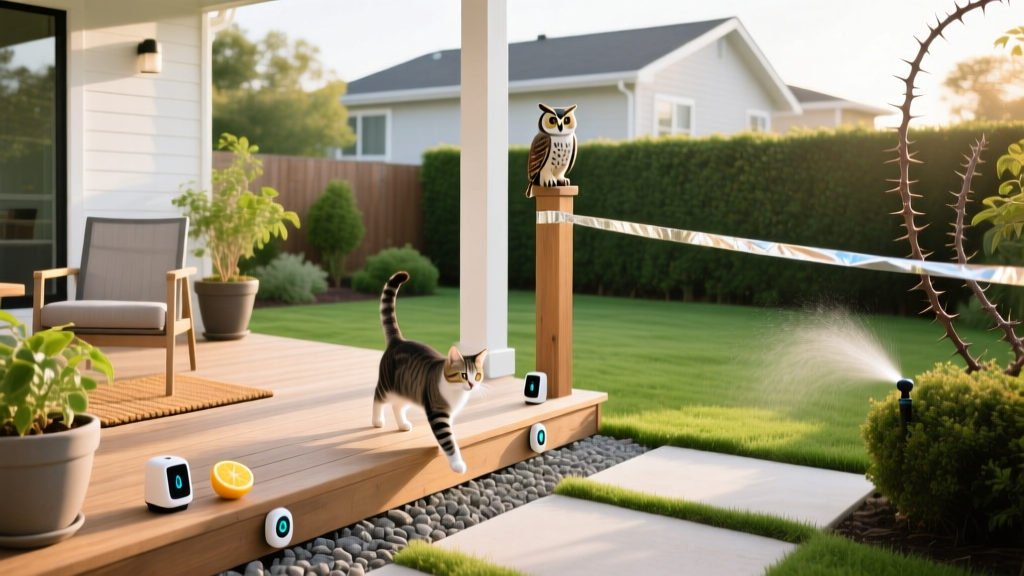
How to Keep Cats Off Your Porch: 7 Proven Deterrents
Why Felines Target Your Porch
Before deploying deterrents, it is critical to understand why neighborhood or stray cats view your porch as prime real estate. Felines are driven by three environmental needs: thermal regulation, elevated vantage points, and territory marking. Concrete and wooden porch decks act as thermal mass, absorbing solar radiation during the day and releasing it at night, creating an ideal sleeping spot. Furthermore, porches offer windbreaks and elevated sightlines to monitor prey or rival animals. When a cat scratches your outdoor furniture or leaves waste in your potted plants, it is depositing pheromones to claim this high-value territory. Erasing these scent markers with an enzymatic cleaner is the mandatory first step before any deterrent will work.
The 3-Tier Deterrence Framework
Professional wildlife managers rely on a layered approach rather than a single silver bullet. To successfully keep cats off your porch, combine Olfactory Repellents (Tier 1), Technological Barriers (Tier 2), and Tactile Modifications (Tier 3). Relying on just one method almost always results in habituation.
Tier 1: Olfactory and Scent Repellents
Cats possess roughly 200 million odor sensors in their nasal cavity, compared to a human's 5 million. This makes their olfactory system highly sensitive to specific volatile organic compounds (VOCs). However, not all scents are created equal, and many popular DIY remedies fail due to environmental degradation.
The Chemistry of Citrus and D-Limonene
While cats despise the smell of citrus, simply scattering lemon peels on your porch is ineffective. The active repellent compound, D-limonene, degrades rapidly under UV light and washes away completely after a single rainstorm. For lasting results, use commercial encapsulated formulas like Nature's MACE Cat Repellent (approximately $25 for a 32oz ready-to-spray bottle). These products use time-release polymer capsules that protect the active garlic and pepper oils from UV degradation, lasting up to 60 days outdoors.
Botanical Deterrents
Planting Coleus canina (often marketed as the 'Scaredy Cat' plant) in containers near your porch steps releases a pungent odor when brushed against. Alternatively, spraying a diluted rosemary and vinegar solution on the perimeter of your porch railing creates an invisible scent fence. Reapply every 48 hours during the initial two-week training period.
| Repellent Type | Active Ingredient | Outdoor Lifespan | Cost Estimate | Efficacy Rating |
|---|---|---|---|---|
| DIY Citrus Peels | D-Limonene | 1-2 Days | $5 | Low |
| Encapsulated Sprays | Garlic/Pepper Oils | 45-60 Days | $20-$30 | High |
| Predator Urine | Coyote/Fox Urine | 7-14 Days | $15-$25 | Medium |
| Coleus Canina Plant | Terpenes | Seasonal | $10-$15 | Medium |
Tier 2: Technological and Physical Barriers
When scent alone fails to break a cat's established territorial habit, you must introduce unpredictable physical consequences. According to The Humane Society of the United States, harmless but startling automated devices are the most effective way to retrain neighborhood cats without causing injury.
Calibrating Motion-Activated Sprinklers
The Orbit 62100 Yard Enforcer (retailing around $75) is the industry standard for porch perimeter defense. It utilizes a passive infrared (PIR) sensor to detect the heat signature of an approaching animal.
Setup Guide for Porches:
- Mounting Height: Place the unit 12 to 18 inches off the ground. Cats approach low to the ground; mounting it at human waist height will result in the PIR sensor missing the heat signature entirely.
- Sensitivity Dial: Set the detection range to 30 feet. If set to the maximum 70 feet, passing cars or pedestrians will trigger false activations, draining the 4 AA batteries prematurely.
- Water Pressure: Connect to a standard hose bib. Ensure your water pressure is between 30 and 80 PSI. Pressures below 30 PSI will result in a weak spray that fails to startle the animal.
Ultrasonic Deterrents: The Habituation Problem
Ultrasonic devices emit high-frequency sound waves (typically 13.5kHz to 45.5kHz) that are irritating to felines but largely inaudible to adult humans. The Aspectek Predator Guard Ultrasonic Animal Repeller ($45) is highly effective, but only if you utilize frequency modulation. Cats are highly adaptable; if the device emits a static, unchanging frequency, the cat will habituate to the noise within 10 to 14 days and ignore it. You must manually change the frequency dial on the device every three days, or purchase a model with an automatic sweeping frequency oscillator.
Tier 3: Tactile Defenses and Furniture Proofing
Cats are digitigrade animals, meaning they walk on their toes. Their paw pads are highly sensitive to texture and pressure. You can exploit this biological trait to make your porch furniture and railings deeply unappealing.
- Plastic Spike Mats: Products like the ScatMat Pet Training Mat ($40) feature blunt, flexible plastic spikes. They do not pierce the skin or cause pain, but the uneven pressure distribution makes it physically impossible for a cat to settle down and sleep. Tuck these under your outdoor sofa cushions or lay them flat on porch railings where cats like to balance.
- Double-Sided Tape: For wooden porch posts that cats use as scratching posts, wrap the bottom 24 inches in heavy-duty, weather-resistant double-sided tape (such as Sticky Paws Outdoor). The adhesive sensation on their paw pads triggers an immediate retreat response.
- Aluminum Foil Myth vs. Reality: While many blogs suggest laying down aluminum foil, this is a temporary fix. Foil tears easily, blows away in the wind, and loses its crinkling acoustic properties once it gets wet or creased. Invest in proper tactile mats instead.
CRITICAL TOXICITY WARNINGS
Never use mothballs (naphthalene or paradichlorobenzene) as an outdoor cat deterrent. Not only is this highly toxic to cats, dogs, and local wildlife, but using mothballs outdoors is a violation of federal law enforced by the Environmental Protection Agency (EPA). Furthermore, avoid applying raw essential oils (like peppermint, eucalyptus, or tea tree) directly to porch surfaces. According to the ASPCA Animal Poison Control, these concentrated oils can cause severe hepatic failure and respiratory distress in felines if inhaled or absorbed through their paw pads.
Troubleshooting Common Deterrent Failures
If you have deployed the 3-Tier Framework and cats are still invading your porch, consult this diagnostic checklist to identify the failure point:
Pro Tip: Cats are creatures of routine. If a neighbor's cat visits your porch at exactly 6:00 AM, ensure your motion-activated sprinkler or ultrasonic device is powered on and positioned to intercept that specific approach vector. Predictability in your defense is just as important as the deterrent itself.
- Symptom: The cat ignores the ultrasonic device.
Diagnosis: Acoustic habituation or physical obstruction.
Fix: Change the frequency dial. Ensure no dense foliage or porch lattice is blocking the line-of-sight of the speaker, as high-frequency sound waves do not penetrate solid objects well. - Symptom: The motion sprinkler triggers constantly with no animals present.
Diagnosis: Thermal interference.
Fix: The PIR sensor is likely being triggered by heat reflecting off a nearby glass window or a dark-colored grill cover. Reposition the sensor to face away from heat-absorbing surfaces. - Symptom: The cat avoids the floor but jumps directly onto the porch roof or high shelves.
Diagnosis: Vertical bypass.
Fix: Install clear polycarbonate bird spikes along the top edges of your porch roof or wrap high shelves in the aforementioned double-sided tape.
Reclaiming your porch requires patience. Felines have deeply ingrained territorial maps, and it typically takes 14 to 21 days of consistent, negative reinforcement (via water, texture, or scent) to permanently rewrite their mental map and force them to seek shelter elsewhere in the neighborhood.

