
Home & Garden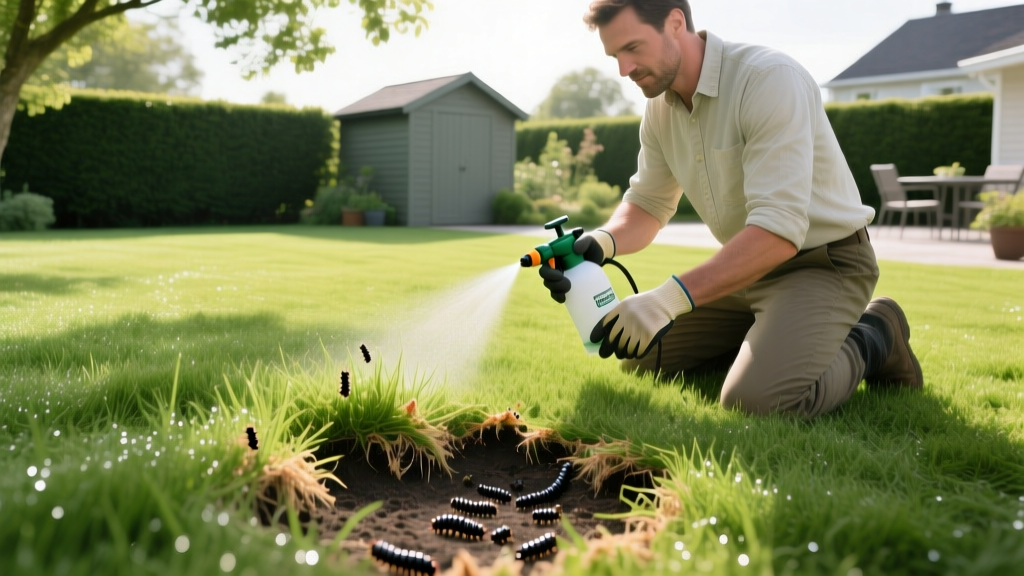
How to Kill Armyworms in Your Lawn: A Step-by-Step Treatment Guide
The 48-Hour Threat: Identifying Fall Armyworm Damage
Fall armyworms (Spodoptera frugiperda) are not a slow-moving nuisance; they are a rapid-strike defoliator. A severe infestation can scalp a healthy bermudagrass, zoysia, or fescue lawn in 48 to 72 hours. Unlike grub damage, which attacks the root system from below, armyworms consume the foliar canopy from the top down. Early detection is the only way to prevent total turf loss.
According to the University of Florida IFAS, initial damage often mimics drought stress or mower scalping. The grass blades will appear 'frosted' or translucent at the tips where the larvae have scraped away the green tissue. As the larvae mature into their fifth and sixth instars, they consume the entire blade, leaving behind only the tough midrib and a layer of greenish-brown, sawdust-like excrement known as frass.
The Soap Flush Test: Confirming the Infestation
Do not apply insecticides based on visual damage alone. Confirm the presence and population density of armyworms using a soap flush. Mix 2 tablespoons of lemon-scented liquid dish soap (such as Dawn) into 1 gallon of water. Pour the solution evenly over a 1-square-foot area at the leading edge of the damaged zone—the border where green grass meets brown grass. Wait 3 to 5 minutes. The soap irritates the larvae's cuticle, forcing them to the surface.
Treatment Threshold: If you count 3 to 4 larvae per square foot, immediate chemical intervention is required. Identify the larvae by the distinct, pale inverted 'Y' shape on the front of their dark brown heads and the longitudinal stripes running down their greenish-brown bodies.
Step-by-Step Armyworm Eradication Protocol
Once the threshold is met, execute the following eradication steps to halt the defoliation and protect the turf's crown.
Step 1: Canopy Reduction and Debris Removal
Before applying any treatment, lower your mower deck. For warm-season grasses like bermudagrass, mow down to 1 to 1.5 inches. For tall fescue, drop to 2 inches. This removes the upper canopy where the majority of eggs are laid and where early-instar larvae hide from UV light. Bag the clippings immediately and dispose of them off-site to physically remove thousands of eggs and small larvae from the property.
Step 2: Selecting the Right Active Ingredient
Choosing the correct insecticide depends on your lawn's proximity to water sources, local pollinator activity, and your budget. The Texas A&M AgriLife Extension notes that rotating modes of action is critical to prevent chemical resistance.
| Active Ingredient | Brand Example | Mode of Action | Residual Control | Pollinator Safety | Approx. Cost / 1k sq ft |
|---|---|---|---|---|---|
| Bifenthrin | Talstar P | Pyrethroid (Sodium channel modulator) | 14–21 Days | Highly Toxic to Bees | $0.04 - $0.06 |
| Chlorantraniliprole | Acelepryn SC | Anthranilic diamide (Ryanodine receptor) | 28+ Days | Safe (No bee warning) | $0.15 - $0.20 |
| Spinosad | Conserve SC | Spinosyn (Nicotinic receptor) | 7–10 Days | Moderate (Toxic until dry) | $0.10 - $0.12 |
| Bt kurstaki | Dipel DF | Microbial (Gut toxin for young instars) | 3–5 Days | Completely Safe | $0.05 - $0.08 |
Expert Recommendation: For rapid knockdown of a massive, active infestation, use a pyrethroid like Bifenthrin. However, for long-term management, high-value turf, or properties with active pollinator gardens, invest in Chlorantraniliprole (Acelepryn). While the upfront cost is higher (roughly $140-$160 per quart), a single quart treats up to 10,000 square feet at the highest label rate, and it provides exceptional safety for non-target organisms.
Step 3: Precision Application Timing and Technique
Armyworms are nocturnal feeders. They hide in the thatch during the heat of the day and emerge at dusk to consume the canopy. Therefore, liquid applications must be made in the late afternoon or early evening.
CRITICAL WARNING: If you are using a pyrethroid (Bifenthrin, Cyfluthrin), never apply it when turf is in bloom or when bees are actively foraging. Pyrethroids are highly toxic to aquatic invertebrates and bees. Ensure the spray has completely dried before allowing pets or children back onto the lawn.
Use a backpack sprayer equipped with a flat-fan nozzle (such as a TeeJet 8002VS) calibrated to deliver 1.5 to 2.0 gallons of finished solution per 1,000 square feet. This high water volume ensures the chemical penetrates the thatch and coats the lower stems where the larvae are hiding. Do not water in liquid contact insecticides. You want the active ingredient to dry on the foliage where the armyworms will ingest it. (Note: If using a granular formulation, you must irrigate with 1/4 inch of water immediately after spreading to activate the carrier).
Post-Treatment Lawn Recovery Strategy
Once the armyworms are eradicated, the turf will look severely stressed, brown, and scalped. The grassroots and crown are usually still alive, but the plant has lost its ability to photosynthesize efficiently.
- Week 1-2 (Stress Mitigation): Do not apply high-nitrogen fertilizers immediately. Forcing rapid, weak top growth on a compromised root system will invite secondary fungal diseases like Pythium blight. Instead, apply a liquid kelp biostimulant or a 0-0-7 potassium-based stress fertilizer to aid in cellular recovery and osmoregulation.
- Week 3-4 (Canopy Rebuilding): Once new green shoots emerge from the crown, apply a balanced, slow-release fertilizer (e.g., 16-4-8 or 20-0-5 with 50% sulfur-coated urea) at a rate of 0.75 lbs of actual nitrogen per 1,000 square feet.
- Irrigation: Maintain consistent soil moisture. Provide 1 inch of water per week, split into two deep watering sessions, to encourage the remaining nodes to push new stolons and rhizomes.
Preventative Measures for the Following Season
Armyworms do not overwinter in northern climates; they migrate northward from the Gulf Coast each spring and summer on weather fronts. Prevention relies on monitoring and biological barriers.
- Pheromone Monitoring: Set up a green unitrap baited with a fall armyworm pheromone lure in June. A sudden spike in moth captures indicates that egg-laying females are in the area, giving you a 10-day lead time before the destructive larval stage begins.
- Beneficial Nematodes: As a biological preventative, apply Steinernema carpocapsae nematodes to the lawn in late summer. These microscopic worms actively hunt and infect soil-dwelling pests, including armyworm pupae and early instars, disrupting their life cycle without the use of synthetic chemicals.
- Thatch Management: Core aerate your lawn annually. Armyworms thrive in thick, spongy thatch layers that provide high humidity and protection from predators. Keeping thatch below 0.5 inches exposes them to desiccation and ground beetles.