Home & Garden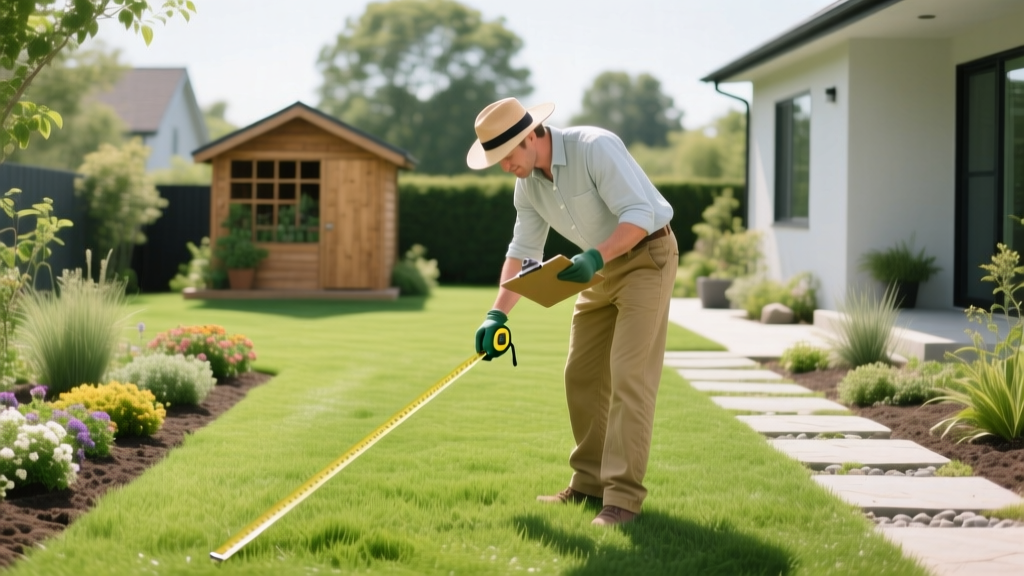
How to Measure Square Footage of Yard for Sod, Seed, and Fertilizer
The True Cost of Guessing Your Lawn Size
Ordering landscaping materials based on a visual estimate is the most common financial mistake new homeowners make. In 2026, premium sod costs between $0.45 and $0.85 per square foot installed, while bulk topsoil and specialized turfgrass seed carry their own strict coverage ratios. If you overestimate your yard by just 20%, you are paying for pallets of sod that will dry out and die before you can lay them. If you underestimate, you will face mismatched seed batches or visible fertilizer burn lines where overlapping applications occur.
According to Penn State Extension, precise turfgrass area calculation is the mandatory first step for proper soil amendment and seeding rates. This guide breaks down exactly how to measure square footage of yard spaces, accounting for irregular property lines, sloped terrain, and non-turf hardscapes.
Three Methods to Measure Your Lawn Area
The method you choose depends on your yard's size, terrain, and the material you are buying. Seed and fertilizer allow for a 5% margin of error; sod and pre-emergent herbicides require near-exact precision.
Method 1: The Pacing Technique (Best for Fertilizer & Seed)
For rectangular or square yards under 5,000 square feet, your own stride is a surprisingly effective tool. The average adult walking stride is roughly 2.5 feet.
- Step 1: Walk the length of your lawn, counting your steps. Multiply by 2.5.
- Step 2: Walk the width, counting steps. Multiply by 2.5.
- Step 3: Multiply the length by the width to get your gross square footage.
Pro Tip: Calibrate your stride by measuring exactly 10 feet with a tape measure, walking it naturally, and dividing 10 by your step count to find your exact stride multiplier.
Method 2: Measuring Wheel (Best for Sod & Irregular Borders)
If you are laying sod, you need exact numbers to avoid paying restocking fees for unused pallets. A professional measuring wheel, such as the Keson P1810 (approximately $35), rolls along the ground and tracks distance mechanically or digitally. Walk the perimeter of your turf zones, breaking curved garden beds into straight-line segments to map the boundaries accurately.
Method 3: Digital GPS Mapping (Best for Large or Wooded Lots)
For properties over 10,000 square feet or those with dense tree canopies, physical measuring is inefficient. Use desktop software like Google Earth Pro. Zoom into your property, select the 'Polygon' tool, and click along the borders of your grass areas. The software will instantly calculate the exact square footage of the drawn shape. Alternatively, apps like iScape or the native Apple Measure app use LiDAR (on Pro-model iPhones/iPads) to map smaller, defined backyard spaces in augmented reality.
Geometric Formulas for Irregular Lawn Shapes
Very few yards are perfect rectangles. To figure out how to measure square footage of yard spaces with curves, angles, or circular driveways, break the property down into basic geometric shapes, calculate each individually, and add them together.
| Shape | Formula | Real-World Application |
|---|---|---|
| Rectangle / Square | Length × Width | Main front or back lawn blocks |
| Right Triangle | (Base × Height) / 2 | Corner lots or property line pinch-points |
| Circle | π × Radius² (3.14 × r × r) | Circular garden beds or tree rings to subtract |
| Trapezoid | ((Base 1 + Base 2) / 2) × Height | Side yards that widen toward the back fence |
Deducting Non-Turf Areas (The Subtraction Rule)
A common error is using the total lot size from your property survey rather than the actual turf area. You must subtract hardscapes and planting beds from your gross measurement to avoid buying excess materials.
- Measure the square footage of your driveway, walkways, and patios.
- Measure the footprint of your home's foundation.
- Measure the surface area of pools, hot tubs, and permanent mulch/rock garden beds.
- Subtract the sum of these areas from your total lot square footage.
Expert Callout: The 5-10% Sod Waste Rule
While you should never overbuy seed or fertilizer, you must overbuy sod. When cutting sod to fit around curved garden beds, sprinkler heads, and property corners, you will generate offcuts that cannot be reused. Always add 5% to your final net square footage for standard rectangular yards, and up to 10% for yards with highly irregular, curved borders.
While you should never overbuy seed or fertilizer, you must overbuy sod. When cutting sod to fit around curved garden beds, sprinkler heads, and property corners, you will generate offcuts that cannot be reused. Always add 5% to your final net square footage for standard rectangular yards, and up to 10% for yards with highly irregular, curved borders.
Adjusting for Slopes and Terrain
Most digital mapping tools and pacing methods calculate the 2D footprint of your yard. However, if your yard is sloped, the actual 3D surface area requiring seed, water, and sod is larger than the flat map suggests.
According to turf management guidelines from the University of Minnesota Extension, sloped terrain increases surface area and accelerates water runoff, requiring adjustments in both material volume and application techniques.
The Slope Multiplier Framework
To find the true surface area of a sloped lawn, you technically use the cosine of the slope angle. For practical homeowner purposes, use this reference chart:
- Mild Slope (5 to 10 degrees): Add 2% to your total square footage.
- Moderate Slope (11 to 20 degrees): Add 5% to your total square footage.
- Steep Slope (21 to 30 degrees): Add 10% to your total square footage.
Edge Case Warning: On slopes exceeding 15 degrees, broadcast spreading of seed will result in severe washout during the first rain. You must use a hydraulic mulch/tackifier binder or lay down biodegradable erosion control blankets (like jute netting) pinned with 6-inch landscape staples.
Translating Square Footage to Material Volumes
Once you know exactly how to measure square footage of yard spaces, you must convert that number into purchasing units. Materials are rarely sold by the square foot; they are sold by weight or volume coverage.
| Material | Standard Coverage Rate | Purchasing Unit Example |
|---|---|---|
| Kentucky Bluegrass Seed | 2 - 3 lbs per 1,000 sq ft | 50 lb bag covers ~16,000 sq ft |
| Tall Fescue Seed | 5 - 6 lbs per 1,000 sq ft | 50 lb bag covers ~8,500 sq ft |
| Granular Fertilizer | Varies by N-P-K ratio | Standard 40 lb bag covers 5,000 to 15,000 sq ft |
| Topsoil (1 inch depth) | 3.15 cubic feet per 100 sq ft | 1 cubic yard covers ~320 sq ft at 1" deep |
"Always check the active ingredient percentage on herbicide and fertilizer labels. A 40lb bag of cheap fertilizer with high filler content might only cover 5,000 square feet, while a premium 40lb bag with higher nitrogen concentration can safely cover 15,000 square feet. Your square footage math dictates the bag you pull off the shelf."
Frequently Asked Questions
What is the easiest app to measure my lawn?
For most homeowners, the free Google Earth Pro desktop application offers the most accurate polygon drawing tools for mapping turf zones. On mobile, the Apple Measure app (using LiDAR on compatible devices) or third-party apps like LawnStarter's area calculator provide quick, GPS-based estimates suitable for fertilizer purchasing.
How do I measure a yard with heavy tree coverage?
GPS apps often fail under dense canopies due to satellite signal degradation. Use a physical measuring wheel to trace the perimeter. Alternatively, measure the 'drip line' (the outer edge of the tree branches) of your trees, calculate the area of those circles, and subtract them from your total lot size, as grass rarely grows under the dense shade of the inner drip line.
Do I measure the house footprint when calculating lawn size?
Yes, if you are starting from your total lot size on a property survey. You must subtract the square footage of your home's foundation, driveway, and any detached structures (sheds, garages) to arrive at the actual 'turfable' square footage.