
Home & Garden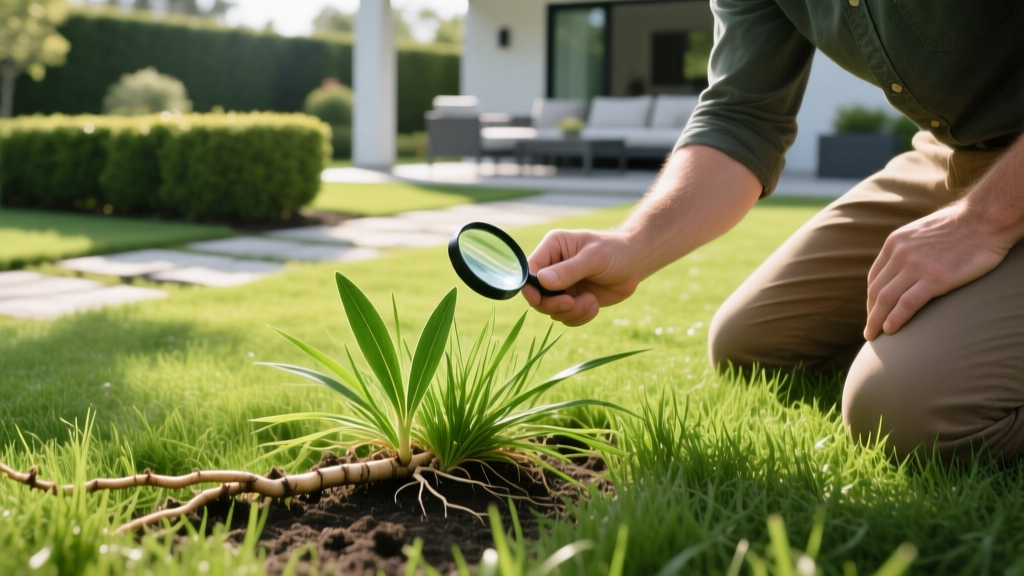
Quackgrass Identification and Spot-Treatment Guide for Home Lawns
The Anatomy of Quackgrass: Key Identification Markers
Accurate quackgrass identification is the critical first step in turf management, as misdiagnosing this perennial weed often leads to ineffective treatments and rapid landscape degradation. Quackgrass (Elymus repens) is a cool-season perennial grassy weed that thrives in poorly drained, compacted soils, but it will aggressively colonize healthy Kentucky bluegrass, tall fescue, and perennial ryegrass lawns if left unchecked.
To confidently identify quackgrass, you must examine the collar region—the area where the grass blade meets the stem. Unlike many common lawn weeds, quackgrass possesses distinct auricles. These are narrow, claw-like appendages that clasp around the stem. Additionally, the leaf blades are flat, typically 1/4 to 1/2 inch wide, and feature a prominent midrib with a rough, sandpaper-like texture on the upper surface. The vernation (the way the youngest leaf is folded in the shoot) is rolled, not folded.
Diagnostic Pro-Tip: The Auricle Test
Part the grass canopy and locate the collar. If you see distinct, finger-like auricles wrapping around the stem, and the leaf base is reddish or white, you are almost certainly dealing with quackgrass. Annual ryegrass also has auricles, but its vernation is folded, and it lacks the extensive underground rhizome network.
Part the grass canopy and locate the collar. If you see distinct, finger-like auricles wrapping around the stem, and the leaf base is reddish or white, you are almost certainly dealing with quackgrass. Annual ryegrass also has auricles, but its vernation is folded, and it lacks the extensive underground rhizome network.
Quackgrass vs. Look-Alikes: A Diagnostic Matrix
Homeowners frequently confuse quackgrass with crabgrass, tall fescue, or annual ryegrass. Applying a crabgrass killer (like quinclorac) to quackgrass will yield zero results, wasting time and chemical resources. Use this matrix to isolate the exact species in your turf.
| Feature | Quackgrass | Crabgrass | Tall Fescue | Annual Ryegrass |
|---|---|---|---|---|
| Vernation | Rolled | Folded | Rolled | Folded |
| Auricles | Present (Claw-like) | Absent | Absent | Present (Short) |
| Ligule | Membranous, short | Hairy fringe | Membranous, short | Membranous |
| Root Structure | White Rhizomes | Fibrous / Stolons | Deep Fibrous | Fibrous |
| Growth Habit | Upright, spreading | Prostrate, star-like | Bunch-type clumps | Upright, rapid |
The Rhizome Network: Why Surface Pulling Fails
The primary reason quackgrass dominates lawns is its subterranean architecture. According to Penn State Turfgrass Science, quackgrass rhizomes can account for up to 60% of the plant's total biomass, penetrating hardpan soil layers up to 8 inches deep. These white, scaly rhizomes are segmented by nodes, and every single node contains a dormant bud capable of generating a completely new plant.
When homeowners attempt to pull quackgrass by hand or use a rototiller to break up the soil, they inevitably snap the brittle rhizomes. A single 1-inch fragment left in the soil will regenerate within 7 to 14 days. Consequently, mechanical cultivation often transforms a single localized patch into a widespread infestation. If you opt for manual removal, you must adhere to the 8-inch excavation rule, using a specialized weeding fork to gently sift through the soil and extract the entire rhizome network intact.
Spot-Treatment Protocols: Chemical and Mechanical Routes
Because quackgrass is a cool-season grassy weed, selectively killing it in a cool-season lawn (like Kentucky bluegrass or fescue) without damaging the surrounding turf is nearly impossible for homeowners. Therefore, spot-treatment requires precision application of non-selective herbicides or targeted physical removal.
Protocol A: Precision Non-Selective Application (Cool-Season Turf)
For cool-season lawns, a 41% glyphosate solution (such as Compare-N-Save Concentrate, retailing around $25 to $30 per gallon in 2026) is the most reliable chemical control. However, broadcasting glyphosate will kill your desirable turf. You must use a targeted application method:
- Wick Applicator Method: Mix a 2% glyphosate solution (approx. 2.6 fl oz per gallon of water). Use a rope-wick applicator or a dedicated lawn paintbrush to physically wipe the solution onto the quackgrass blades. Because quackgrass often grows slightly taller and faster than surrounding dormant or slow-growing turf, you can gently drag the wick over the canopy, coating only the weed.
- Cone Nozzle Spot Spraying: If using a pump sprayer, remove the standard flat-fan nozzle and attach a narrow cone nozzle. Lower the spray pressure to 15 PSI to eliminate drift. Spray only the center of the quackgrass clump until the blades are visibly wet but not dripping.
- Timeline: Glyphosate takes 7 to 14 days to translocate down to the rhizomes. Do not mow for 48 hours before or after application to ensure maximum leaf surface area for absorption.
Protocol B: Selective Herbicide Options (Warm-Season Turf & Beds)
If you are managing a warm-season lawn (Bermudagrass, Zoysiagrass, or Centipedegrass), you have access to selective post-emergent herbicides that will kill quackgrass without harming your turf. Look for products containing fluazifop-p-butyl (e.g., Ortho Grass B Gon for Landscapes, roughly $15 per bottle). Apply at a rate of 0.5 fl oz per gallon of water, adding a non-ionic surfactant at 0.25% v/v to ensure the chemical penetrates the waxy cuticle of the quackgrass blade. Two applications spaced 14 days apart are usually required to achieve complete rhizome kill.
The University of California Statewide IPM Program emphasizes that chemical control of quackgrass is most effective when the plant is actively growing and not under drought or heat stress. Applying herbicides when daytime temperatures exceed 85°F will result in rapid foliar burn, halting the translocation process before the chemical reaches the deep rhizomes.
Post-Eradication Recovery and Pre-Emergent Defense
Once the quackgrass patches have turned completely brown and the rhizomes are dead, rake out the debris and prepare the soil for renovation. Core aerate the exposed soil to relieve the compaction that likely allowed the quackgrass to establish initially. Top-dress with 1/4 inch of screened compost and overseed with a competitive, rhizomatous turfgrass like Kentucky bluegrass or a modern turf-type tall fescue blend.
Timing Your Pre-Emergent Defense
While quackgrass spreads primarily via rhizomes, mature plants also produce seed heads in late spring. To prevent new seedlings from establishing, apply a high-quality pre-emergent herbicide like Prodiamine 65 WDG (Barricade). The professional-grade 5 lb bag costs approximately $85 in 2026 and treats over 5,000 square feet. Apply at a rate of 0.46 oz per 1,000 sq ft when soil temperatures at a 2-inch depth consistently reach 50°F to 55°F for three consecutive mornings. Water the product in with exactly 0.5 inches of irrigation to activate the chemical barrier in the top inch of the soil profile, securing your lawn against future grassy weed invasions.