
Home & Garden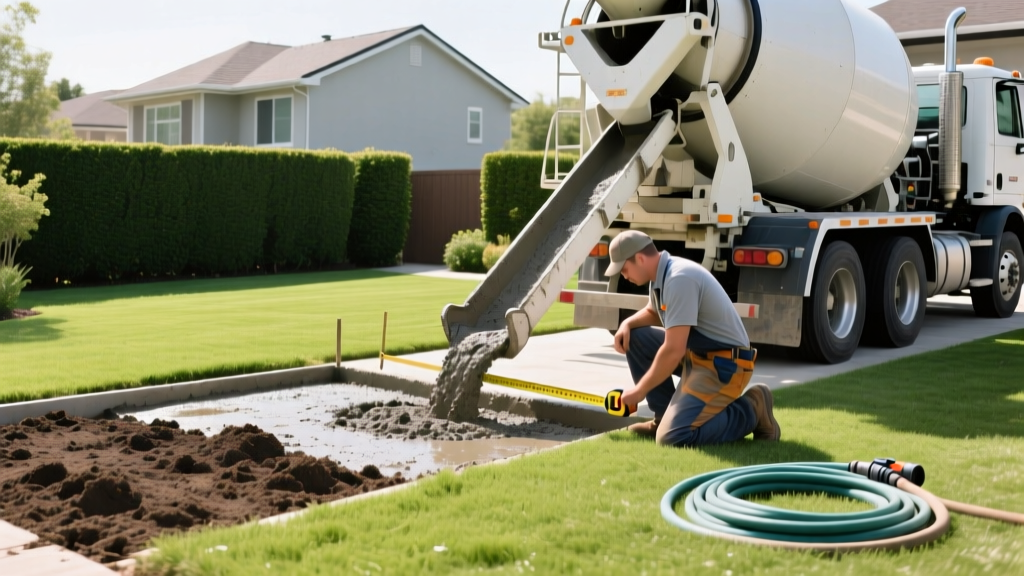
How Many Yards of Concrete Per Truck? Coverage & Cost Guide
The Short Answer: Volumetric Capacity vs. Legal Weight Limits
When ordering ready-mix for a backyard patio, shed base, or retaining wall footing, the most common question is how many yards of concrete per truck actually arrive on your site. A standard commercial concrete mixer truck features a drum with a volumetric capacity of 10 cubic yards. However, you will almost never receive a full 10-yard load.
Due to Department of Transportation (DOT) highway weight restrictions, a standard 3-axle ready-mix truck is legally limited to carrying 8 to 9 cubic yards of concrete per trip. According to the Federal Highway Administration, the federal bridge formula caps gross vehicle weights to protect local infrastructure. Because wet concrete weighs approximately 4,050 pounds per cubic yard, a 10-yard load adds 40,500 pounds of payload to a truck that already weighs 25,000 pounds empty. This 65,500-pound total frequently exceeds state and federal axle weight limits, forcing batch plants to short-load trucks to remain street-legal.
⚠️ The 80% Weight Limit Rule: Never order a 'full' 10-yard truck if your local municipality enforces strict 3-axle weight limits. Always cap your order at 8.5 or 9 yards maximum for standard trucks to avoid the driver being forced to dump excess concrete on the street or refuse delivery.
Concrete Coverage Calculator: Yards to Square Footage
To accurately estimate how many trucks you need for your garden project, you must convert cubic yards to square footage based on your planned slab thickness. One cubic yard equals 27 cubic feet. The National Ready Mixed Concrete Association (NRMCA) recommends a minimum thickness of 4 inches for standard pedestrian patios and 5 to 6 inches for driveways or heavy-load pads.
| Slab Thickness | 1 Yard Covers | 5 Yards Covers | 8 Yards Covers |
|---|---|---|---|
| 4 Inches (Standard Patio) | 81 sq. ft. | 405 sq. ft. | 648 sq. ft. |
| 5 Inches (Hot Tub Base) | 64.8 sq. ft. | 324 sq. ft. | 518 sq. ft. |
| 6 Inches (RV Pad / Retaining) | 54 sq. ft. | 270 sq. ft. | 432 sq. ft. |
Quick Math Formula: Multiply your project's Length (ft) x Width (ft) x Depth (ft), then divide by 27. For a 20x20 foot patio poured at 4 inches (0.33 ft) thick: (20 x 20 x 0.33) / 27 = 4.88 cubic yards. You would order 5 yards.
2026 Cost Breakdown: Yardage, Short Loads, and Hidden Fees
Pricing for ready-mix concrete fluctuates based on regional cement availability, fuel surcharges, and aggregate costs. As of early 2026, homeowners should budget for the following baseline rates when ordering from local batch plants:
- Base Ready-Mix Cost: $135 to $165 per cubic yard (standard 3,000 PSI mix).
- Short-Load Fee: $50 to $80 per missing yard for orders under 8 cubic yards.
- Concrete Pump Truck: $150 base fee + $65 per hour (required if the truck cannot back directly up to your forms).
- Weekend / Saturday Delivery: $100 to $150 flat surcharge.
- Fuel & Environmental Surcharges: 3% to 5% of the total material cost.
The Short-Load Penalty Explained
If your garden project only requires 3 yards of concrete for a small shed base, you will be hit with a short-load penalty. Batch plants charge this because the truck's operating costs (driver, fuel, wear-and-tear) are the same whether it carries 3 yards or 8 yards. For a 3-yard order, you will pay for the 3 yards ($150 x 3 = $450) plus a 5-yard short-load penalty ($60 x 5 = $300), bringing your total material cost to $750. This makes small orders disproportionately expensive.
Mini-Mixers vs. Standard Trucks for Garden Projects
For residential landscaping and garden projects, standard 8-yard trucks are often overkill and physically too large to navigate narrow side-yards or fragile driveways. Mini-mixers (also known as volumetric mixers or small-batch trucks) solve this problem.
| Feature | Standard Ready-Mix Truck | Mini-Mixer / Volumetric Truck |
|---|---|---|
| Capacity | 8 to 9 cubic yards | 1 to 4 cubic yards |
| Vehicle Width | 8 to 9 feet | 5 to 6 feet |
| Driveway Damage Risk | High (up to 66,000 lbs GVW) | Low (under 26,000 lbs GVW) |
| Short-Load Fees | Yes (under 8 yards) | No (pay only for what you use) |
| Cost Per Yard | $135 - $165 | $160 - $190 |
According to guidelines published by the American Concrete Institute (ACI), proper consolidation and curing are vital for structural integrity. Mini-mixers are excellent for garden paths, small water feature bases, and post-hole footings because they eliminate the panic of a massive 8-yard load arriving all at once, giving DIYers more time to screed and finish the concrete before it sets.
Matching PSI to Your Outdoor Project
When you call the batch plant, they will ask what PSI (pounds per square inch) mix you need. Do not default to the cheapest option; structural failure in garden hardscapes is almost always tied to improper PSI selection.
- 2,500 PSI (Budget/Non-Structural): Acceptable for standard 4-inch shed bases, light-duty garden pathways, and non-load-bearing patio slabs. Cost: ~$135/yard.
- 3,000 PSI (Standard Residential): The industry standard for 4-to-5-inch patios, fire pit surrounds, and standard driveway extensions. Offers better freeze-thaw resistance. Cost: ~$145/yard.
- 4,000 PSI (Heavy Load): Mandatory for hot tub pads, RV parking pads, and retaining wall footings. The concentrated dynamic load of a filled 6-person hot tub requires high-compressive strength to prevent corner cracking. Cost: ~$165/yard.
Site Prep and Access Requirements
A standard concrete truck is 10 feet wide, 14 feet tall, and requires a 50-foot turning radius. Before scheduling delivery, verify the following site conditions to avoid a 'truck-turnaround' fee (typically $150-$250 if the driver cannot safely access the pour site):
- Clear the Path: Remove all overhead branches under 14 feet. Concrete trucks are exceptionally tall and will snap low-hanging oak or maple limbs.
- Protect the Turf: If the truck must drive off the driveway onto your lawn to reach the backyard, lay down 3/4-inch plywood track mats to prevent deep axle ruts in your turf.
- Washout Zone: Designate a 4x4 foot area covered in heavy mil plastic where the driver can wash out the chute. The alkaline washout water (pH 11-12) will kill your grass instantly if dumped directly on the soil.
- Form Inspection: Ensure all 2x4 wooden forms are braced with stakes every 16 inches. Wet concrete exerts immense hydrostatic pressure and will blow out weak forms, wasting material and ruining your landscaping.
Frequently Asked Questions
How long do I have to work with the concrete once the truck arrives?
Standard ready-mix concrete begins its initial set in roughly 90 to 120 minutes after water is added at the batch plant. However, in hot summer weather (above 85°F), your working window shrinks to 60 minutes. Always have your screeds, floats, and edging tools laid out and your finishing crew ready before the truck pulls into the driveway.
Can a concrete truck drive on my residential driveway?
Proceed with extreme caution. A fully loaded standard truck weighs up to 66,000 pounds. Standard 4-inch thick residential concrete driveways are only rated for passenger vehicles (approx. 4,000 lbs). If your driveway is less than 5 inches thick or lacks a compacted gravel sub-base, the truck will likely crack the slab. Use a concrete pump truck to keep the mixer on the street and pump the wet mix to your backyard forms.
What happens if I order too much concrete?
You are responsible for the excess. Batch plants charge for the entire volume loaded onto the truck. If you order 6 yards and only use 5, you must have a pre-planned 'overflow' area to dump the remaining yard, such as extra stepping stones or a secondary garden border. Never ask the driver to dump excess concrete on the street or in a storm drain, as this carries severe municipal fines.

