
Home & Garden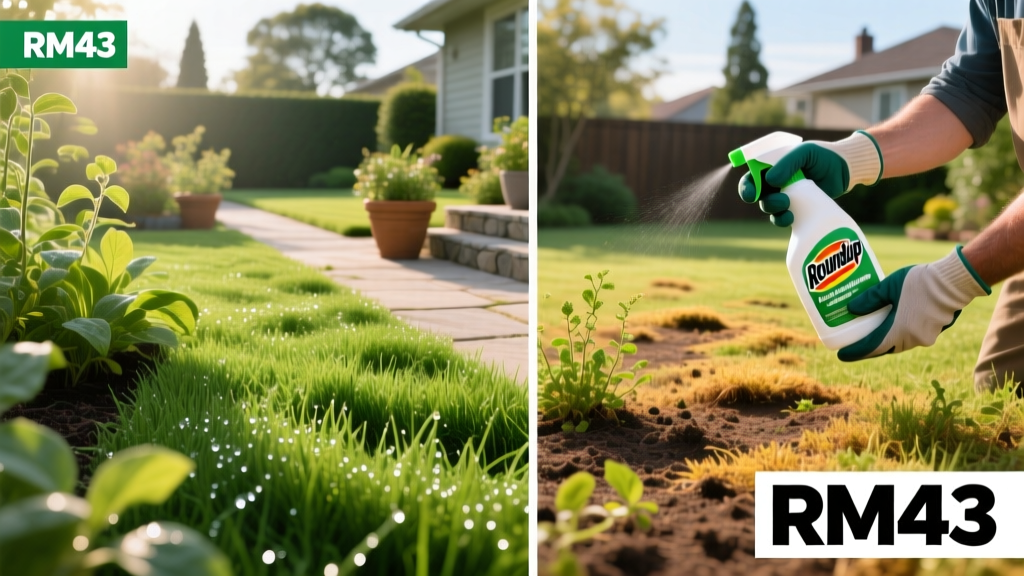
RM43 vs Roundup: Which Herbicide is Right for You?
Choosing the wrong herbicide is one of the most expensive mistakes a homeowner can make. Beginners frequently assume that all liquid weed killers function identically, leading to a catastrophic misunderstanding between standard glyphosate products (like Roundup) and total vegetation killers (like RM43). While both products share a common primary active ingredient, their secondary chemistry dictates entirely different use cases. Applying RM43 to a garden bed or near desirable trees can sterilize your soil and kill mature landscaping, while using standard Roundup on a gravel driveway will result in endless weed regrowth.
This guide breaks down the exact chemical differences, dilution rates, and real-world failure modes of RM43 vs Roundup so you can select the precise tool for your outdoor project.
The Active Ingredient Breakdown
Both products rely on glyphosate as their primary systemic herbicide. Glyphosate works by inhibiting the EPSP synthase enzyme, effectively shutting down a plant's ability to produce essential amino acids. However, the secondary ingredients change the entire behavior of the spray.
- Roundup (Standard/Pro): Relies almost exclusively on glyphosate (typically 41% to 50.2% concentration). It is a systemic, non-selective herbicide with zero soil residual activity. Once it binds to soil particles, it becomes inert.
- RM43: Combines glyphosate (43%) with Imazapyr. Imazapyr is a broad-spectrum herbicide that remains active in the soil for months, preventing seed germination and killing plants via root uptake. According to the National Pesticide Information Center, Imazapyr is highly mobile in soil and can persist for up to a year depending on microbial activity and soil composition.
⚠️ The Residual Warning: Because Imazapyr does not break down immediately upon soil contact, RM43 is strictly a bare-ground herbicide. Never use it where you intend to plant grass, flowers, or vegetables in the near future.
RM43 Deep Dive: The Bare Ground Specialist
RM43 is engineered for areas where you want zero vegetation for an extended period. It is the industry standard for fence lines, gravel driveways, utility poles, and the space immediately beneath wooden decks.
Application Specifics & Pricing
As of 2026, a gallon of RM43 concentrate typically retails between $75 and $95. Because it is highly concentrated and offers long-term residual control, the cost-per-square-foot is exceptionally low for large industrial or rural properties.
- Dilution Rate: Mix 6 fluid ounces of RM43 per 1 gallon of water to treat 400 square feet of bare ground.
- Surfactant Requirement: Unlike many consumer Roundup products, RM43 often requires the addition of a non-ionic surfactant (NIS) at a rate of 1 ounce per gallon to ensure the spray sticks to waxy weed leaves.
- Rainfastness: Becomes rainfast in approximately 2 hours.
- Replanting Timeline: Do not plant desirable vegetation in treated areas for 6 to 12 months.
Roundup Deep Dive: The Lawn & Garden Renovation Tool
When homeowners refer to 'Roundup,' they are usually referring to Roundup Pro (41% glyphosate) or Roundup Super Concentrate. This formulation is designed to kill existing weeds without compromising the soil's future viability. It is the correct choice for lawn renovation, clearing overgrown garden beds before laying mulch, or spot-treating dandelions in a turfgrass lawn.
Application Specifics & Pricing
A gallon of Roundup Pro concentrate generally costs between $45 and $55. While cheaper upfront than RM43, it requires more frequent applications because it offers no pre-emergent or residual soil control.
- Dilution Rate: Mix 2.5 fluid ounces of Roundup Pro per 1 gallon of water for general annual weed control. Increase to 4 ounces for tough perennial weeds like bindweed or Canada thistle.
- Surfactant Requirement: Roundup Pro includes a built-in surfactant system (Transline technology), meaning no additional additives are required.
- Rainfastness: Highly rainfast in as little as 30 minutes to 2 hours, depending on humidity and temperature.
- Replanting Timeline: You can safely plant ornamental flowers, trees, and shrubs 3 days after application, and seed or sod new lawns 7 days after application.
Head-to-Head Comparison Matrix
| Feature | RM43 (Total Vegetation) | Roundup Pro (Standard) |
|---|---|---|
| Active Ingredients | 43% Glyphosate + Imazapyr | 41% Glyphosate |
| Soil Residual Activity | Up to 12 Months | None (Inert upon soil contact) |
| Primary Use Case | Gravel driveways, fence lines, bare ground | Lawn renovation, garden beds, spot treatment |
| Safe to Replant? | No (Wait 6-12 months) | Yes (3 days for beds, 7 days for turf) |
| Surfactant Included? | Usually No (Add NIS) | Yes |
| Approx. Cost (1 Gallon) | $75 - $95 | $45 - $55 |
Real-World Failure Modes & Edge Cases
Understanding the chemistry is only half the battle. The Environmental Protection Agency and university extension offices frequently document homeowner errors resulting from herbicide misuse. Here are the most common edge cases to avoid:
1. The Drip Line Disaster (Tree Root Uptake)
The most severe mistake beginners make with RM43 is spraying it on weeds located beneath the canopy of desirable trees. A tree's root system typically extends well beyond its visible drip line. Because Imazapyr is highly water-soluble and mobile in soil, it leaches downward and is absorbed by the tree's fine feeder roots. The tree may appear healthy for six months, only to exhibit severe chlorosis (yellowing) and eventual death the following spring. Never use RM43 within 30 feet of a desirable tree.
2. The Drift Misconception
When using standard Roundup, wind drift that lands on a desirable plant will kill the leaves it touches, but the soil below remains safe. When RM43 drifts onto a lawn or garden bed, it not only kills the foliage it contacts but also sterilizes the soil where the droplets land, leaving dead, barren spots that will not recover until the Imazapyr degrades months later.
3. Temperature Inversions and Volatility
While glyphosate is not highly volatile, applying either product during early morning temperature inversions can cause the spray mist to hang in the air and drift unpredictably onto neighboring properties or desirable plants. Always apply between 60°F and 85°F when winds are steady at 3 to 10 mph.
Step-by-Step Application Decision Tree
Use this rapid framework to determine which product to load into your pump sprayer:
- Do you plan to plant grass, flowers, or shrubs in this exact spot within the next 12 months?
- Yes: Use Roundup. Wait 7 days, then plant.
- No: Proceed to step 2.
- Are there desirable trees or large shrubs within 30 feet of the treatment area?
- Yes: Use Roundup. (RM43 will likely kill the trees via root uptake).
- No: Proceed to step 3.
- Is the target area a gravel driveway, stone path, or fence line where zero vegetation is desired?
- Yes: Use RM43. Add non-ionic surfactant, mix at 6 oz/gallon, and apply on a dry, windless day.
By matching the herbicide's chemical profile to your specific landscaping goals, you eliminate the frustration of persistent weed regrowth while protecting your soil's long-term viability and your existing trees.

