
Home & Garden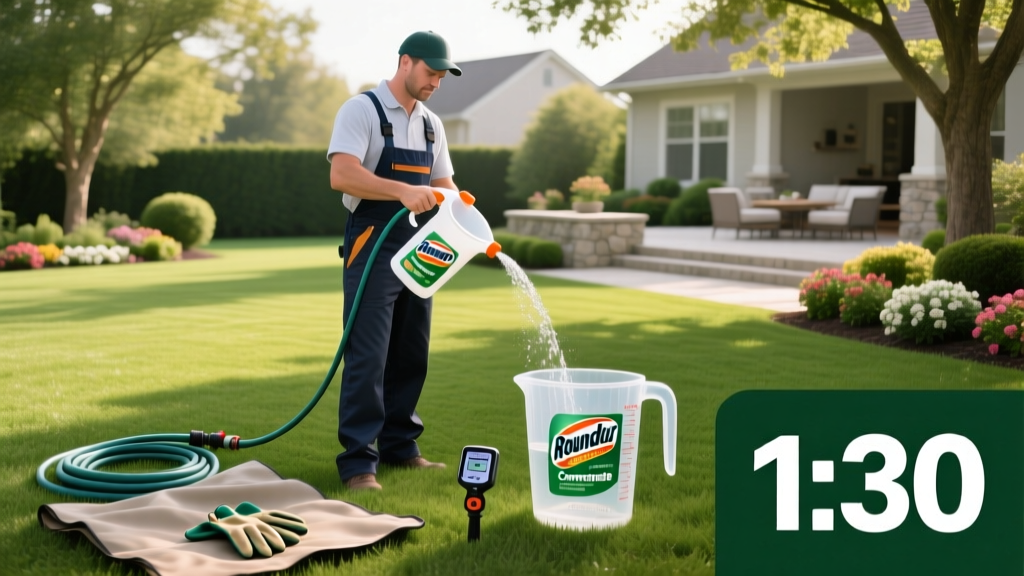
Roundup Concentrate Mix Ratio: Exact Dosage, Coverage & Cost Guide
The Core Chemistry: Why Exact Ratios Matter
Applying herbicide is an exercise in precision chemistry, not guesswork. Getting the Roundup concentrate mix ratio wrong results in two equally expensive failures: under-dosing breeds resistant weeds and wastes your time, while over-dosing burns the leaf tissue before the active ingredient (glyphosate) can translocate to the root system, allowing perennials to regenerate. To calculate the correct dosage, you must first identify which concentrate formulation you are holding, as the active ingredient (AI) percentages vary drastically between consumer and prosumer lines.
The two most common liquid concentrates on the market are Roundup Weed & Grass Killer Concentrate (18% glyphosate) and Roundup Super Concentrate (50.2% glyphosate). The 18% formulation often includes pelargonic acid for rapid visual burn-down, while the 50.2% Super Concentrate is a pure systemic killer that requires a non-ionic surfactant (NIS) to penetrate the waxy cuticle of the weed leaf. Misidentifying your product and using the wrong ratio will either destroy your budget or fail to kill deep-rooted perennials like field bindweed or Canada thistle.
The Master Roundup Concentrate Mix Ratio Chart
The following matrix provides the exact volumetric measurements for a standard 1-gallon and 2-gallon tank sprayer. These ratios are calibrated based on the manufacturer label instructions and independent university extension guidelines for optimal translocation.
| Target Weed Type | Roundup Concentrate (18% AI) | Super Concentrate (50.2% AI) | Estimated Coverage per Gallon |
|---|---|---|---|
| Annual Weeds (Crabgrass, Chickweed) | 6 fl oz (12 tbsp) / gal | 1.5 fl oz (3 tbsp) / gal | 1,000 sq ft (Broadcast) |
| Tough Perennials (Dandelion, Thistle) | 9 fl oz (18 tbsp) / gal | 2.5 fl oz (5 tbsp) / gal | 600 sq ft (Spot/Directed) |
| Woody Brush & Vines (Poison Ivy, Kudzu) | 12 fl oz (24 tbsp) / gal | 3.5 fl oz (7 tbsp) / gal | 300 sq ft (Foliar Drench) |
CRITICAL APPLICATION NOTE: Coverage rates assume you are using a flat-fan nozzle (such as a TeeJet 8002VS) held 18 inches above the target, walking at a steady pace of 2.5 mph. If you are using a cone nozzle, your droplet size increases, reducing coverage area by up to 30% and increasing chemical drift.
Step-by-Step Tank Sprayer Calibration & Mixing Protocol
The physical order in which you combine water, herbicide, and adjuvants dictates the stability of the solution. Dumping concentrate into an empty tank and then adding water causes severe foaming, making it impossible to measure the final volume accurately.
- Pre-fill with Water: Fill your tank sprayer exactly halfway with clean water. If you are mixing a 2-gallon batch, start with 1 gallon of water.
- Add Water Conditioner (If Required): If your local water supply is hard (high in calcium or magnesium), add Ammonium Sulfate (AMS) now. The standard rate is 1.3 ounces of AMS per gallon of water. This prevents hard water ions from binding to the glyphosate molecules, which neutralizes the herbicide before it even hits the weed.
- Measure and Add Concentrate: Using a dedicated, clearly marked measuring cup (never use kitchen utensils), measure the exact fl oz required from the chart above and pour it into the tank.
- Add Surfactant: If using the 50.2% Super Concentrate, add 0.5 fl oz of a high-quality non-ionic surfactant (like Methylated Seed Oil or a dedicated NIS) per gallon of mixed solution. Skip this step if using a 'Pro' version that already contains built-in surfactants.
- Top Off and Agitate: Add the remaining water to reach your target fill line. Secure the lid tightly and shake the tank vigorously for 15 seconds to ensure a homogenous emulsion.
- Pressurize and Test: Pump the sprayer to 40 PSI. Spray onto a concrete driveway for 3 seconds to clear the hose of unmixed water before targeting your weeds.
Cost Analysis: Concentrate vs. Ready-to-Use (RTU)
Many homeowners default to Ready-to-Use (RTU) trigger sprayers for convenience, but the financial penalty is staggering when scaling up to full-yard treatments. Let us break down the real-world economics based on average 2026 retail pricing.
The RTU Premium
A standard 1.33-gallon RTU trigger sprayer retails for approximately $22.00. This equates to $16.54 per mixed gallon. Furthermore, RTU formulas are typically diluted to a mere 1.2% to 2% active ingredient, making them ineffective against mature perennial weeds.
The Concentrate Advantage
A 35.2 oz (1.04 quart) bottle of Roundup Super Concentrate (50.2% AI) retails for roughly $65.00. At the standard perennial mix ratio of 2.5 fl oz per gallon, this single bottle yields 16.3 gallons of finished spray solution. Dividing the $65.00 bottle cost by 16.3 gallons results in a cost of $3.98 per mixed gallon.
The Bottom Line: Mixing your own concentrate yields a 75% cost savings per gallon compared to RTU products, while delivering up to 25 times the active ingredient concentration to the target weed. For any job requiring more than 2 gallons of mixed solution, concentrate is the only financially logical choice.
Environmental Safety, Drift Mitigation, and PPE
Glyphosate is a non-selective herbicide; it will kill any green plant tissue it contacts. Managing spray drift is not just about protecting your neighbor's prize roses—it is a regulatory and environmental imperative. According to the Environmental Protection Agency (EPA), proper handling and application techniques are vital to minimize environmental exposure and prevent runoff into storm drains or waterways.
When mixing and applying, you must adhere to the EPA's safe handling guidelines for pesticides. This mandates specific Personal Protective Equipment (PPE):
- Chemical-Resistant Gloves: Nitrile or neoprene gloves (minimum 14 mil thickness). Latex and standard gardening gloves are porous and will absorb the chemical.
- Eye Protection: Unvented safety goggles. Wrap-around safety glasses are insufficient as they do not protect against upward splash-back when pressurizing the tank.
- Apparel: Long-sleeved shirts, long pants, and closed-toe shoes with socks. Avoid wearing leather boots, as leather absorbs liquid herbicides and cannot be decontaminated.
Drift Prevention Framework: Never spray when wind speeds exceed 10 mph. Utilize a coarse droplet size by lowering your sprayer pressure to 20-25 PSI and using an air-induction nozzle (like the TeeJet AIXR). Coarse droplets are heavy enough to fall straight down onto the weed canopy, whereas fine mists will ride thermal updrafts and land on non-target vegetation up to 50 feet away.
Tank Decontamination Protocol
Never use a sprayer that previously held Roundup to apply liquid fertilizers or insecticides to your lawn without a rigorous triple-rinse. Flush the tank, hose, and wand with a 1% ammonia solution (1.25 oz of household ammonia per gallon of water) to neutralize residual glyphosate, followed by two clear water rinses. Failure to do so will result in severe phytotoxicity the next time you foliar-feed your turfgrass.