Home & Garden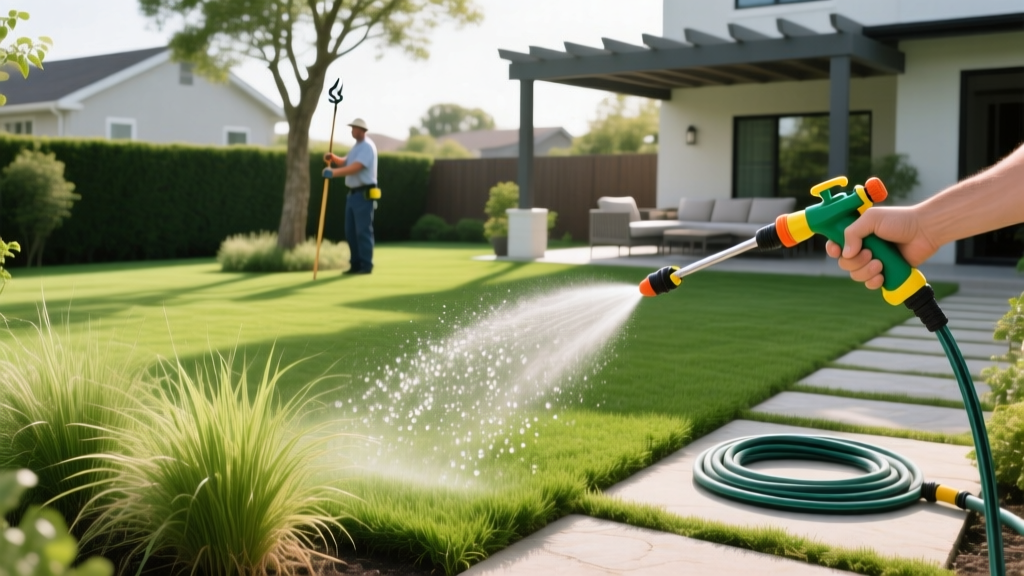
How Long Does Roundup Last? Dosage, Coverage & Residual Guide
The Breakdown: How Long Roundup Lasts in Different Environments
When homeowners ask, "how long does Roundup last?" the answer depends entirely on the environment it occupies. Glyphosate, the active ingredient in Roundup, behaves distinctly differently on plant foliage, in the soil matrix, and inside its original container. Understanding these timelines is critical for optimizing your dosage, minimizing waste, and protecting your garden's soil ecology.
| Environment | Longevity / Half-Life | Primary Degradation Factor |
|---|---|---|
| In the Soil | 30 to 45 days (average half-life) | Microbial breakdown & soil binding |
| On Plant Foliage | 7 to 14 days to full translocation | Plant metabolism & cellular disruption |
| On Hardscapes (Driveways) | 2 to 4 hours (until UV/Rain degradation) | UV radiation & physical wash-off |
| In Original Container | 3 to 5 years (shelf life) | Temperature fluctuations & seal integrity |
Soil Residual Activity and Planting Timelines
A common misconception is that Roundup acts as a long-term soil sterilant. According to the Environmental Protection Agency (EPA), glyphosate binds tightly to soil particles upon contact. Once bound, it becomes largely inactive and unavailable for uptake by plant roots. The National Pesticide Information Center (NPIC) notes that soil microbes eventually break down the bound chemical, with an average half-life of 30 to 45 days in typical garden soils. Because it does not remain active in the soil, Roundup consumer labels generally permit planting ornamental flowers and shrubs just 24 hours after application, and edible crops after 3 days.
⚠️ Critical Soil Warning: While glyphosate itself does not sterilize soil, applying Roundup products labeled as "Extended Control" or "Max Control" introduces secondary pre-emergent herbicides (like imazapic or pendimethalin). These secondary chemicals do linger in the soil for 3 to 6 months to prevent seed germination. Always check the active ingredients list before spraying areas where you plan to sow grass seed or plant vegetables.
Dosage and Coverage: Maximizing Your Roundup Investment
The longevity of your weed control is directly tied to your mixing ratios. Under-dosing leads to partial kills and herbicide-resistant weeds, while over-dosing wastes money and increases soil chemical loads without improving efficacy.
Exact Mixing Ratios for Roundup Super Concentrate (50.2% Glyphosate)
- General Annual Weeds: 2.5 fluid ounces (5 tablespoons) per 1 gallon of water. Covers approximately 1,000 square feet.
- Perennial Weeds & Brush: 5.0 fluid ounces (10 tablespoons) per 1 gallon of water. Covers approximately 1,000 square feet.
- Heavy Brush & Poison Ivy: 6.5 fluid ounces (13 tablespoons) per 1 gallon of water.
The Science of Coverage: Droplet Size Matters
How long Roundup lasts on a leaf surface before drying or washing off depends on your sprayer nozzle. Use a flat-fan nozzle or adjust your adjustable brass nozzle to a fine mist setting. You want the leaves to be thoroughly wet but not dripping. Dripping means the chemical is falling directly into the soil, where it immediately binds and becomes useless for foliar translocation. A standard 1-gallon pump sprayer calibrated to a fine mist will yield roughly 250 to 300 square feet of coverage per tank fill.
Cost Guide: Concentrate vs. Ready-to-Use Formulations
Choosing the right formulation drastically alters your cost per square foot. While Ready-to-Use (RTU) formulations offer convenience, they are heavily diluted and economically inefficient for large yards.
| Product Type | Average Retail Price (2026) | Total Yield / Coverage | Cost per 1,000 Sq. Ft. |
|---|---|---|---|
| Roundup Ready-to-Use (1.33 Gal) | $22.00 | ~400 sq. ft. | $55.00 |
| Roundup Super Concentrate (35.2 oz) | $48.00 | ~22 Gallons (22,000 sq. ft.) | $2.18 |
| Generic Glyphosate 41% (1 Gal) | $35.00 | ~40 Gallons (40,000 sq. ft.) | $0.88 |
Expert Recommendation: Reserve the $22 RTU trigger sprayers exclusively for isolated driveway cracks or single patio weeds. For any fence line, garden bed edging, or lawn renovation exceeding 500 square feet, purchase the Super Concentrate or a generic 41% glyphosate agricultural concentrate. The upfront cost of a $15 to $25 pump sprayer pays for itself after a single application.
Environmental Factors That Alter Longevity and Efficacy
The environment dictates how long the active ingredient remains viable on the plant and how quickly it degrades.
Rainfastness Timelines
Rainfastness refers to how long the product must remain on the leaf before rain renders it ineffective.
- Roundup Super Concentrate: Rainfast in 30 minutes.
- Roundup Ready-to-Use: Rainfast in 2 hours.
- Generic 41% Glyphosate (without surfactant): Requires 4 to 6 hours; adding a non-ionic surfactant (0.5 oz per gallon) reduces this to 1 hour.
Temperature and UV Degradation
Glyphosate translocates through the plant's phloem. This biological process requires active plant growth. If you spray when temperatures are below 55°F, the plant's metabolism is too slow to pull the chemical down to the roots, resulting in a superficial leaf burn that lasts only a few weeks before the weed recovers. Optimal application temperatures are between 65°F and 85°F. Furthermore, spraying on hardscapes exposed to direct, intense UV radiation will cause the chemical to photodegrade within hours if it is not absorbed by a weed.
Expert Application Strategy for Long-Lasting Weed Control
Follow this precise sequence to ensure the herbicide reaches the root system, providing permanent control for the targeted plant.
- Mow or Trim First: Do not spray tall, overgrown weeds. Mow them down and wait 3 to 4 days. This forces the plant to push new, tender growth, which absorbs glyphosate much faster than mature, waxy leaves.
- Check the Forecast: Ensure no rain is expected for at least 6 hours and winds are under 5 mph to prevent drift onto desirable ornamentals.
- Mix with Distilled Water: If your local tap water is "hard" (high in calcium and magnesium), the minerals will bind to the glyphosate in the tank, neutralizing it before it even hits the weed. Use distilled water or add 1 tablespoon of ammonium sulfate per gallon to condition hard tap water.
- Apply to Dry Foliage: Never spray early in the morning when dew is present. Dew dilutes the mixture and causes runoff. Spray between 10:00 AM and 2:00 PM when leaves are completely dry.
- Wait Before Disturbing: Do not pull, mow, or disturb the weeds for at least 7 days. The leaves may look dead in 48 hours, but the chemical requires a full week to translocate into the rhizomes and taproots.
Frequently Asked Questions
Does Roundup lose its effectiveness if left in a sprayer over winter?
Yes. Once glyphosate is mixed with water, it begins to hydrolyze and degrade. Furthermore, if the mixture freezes and thaws, it can separate and crystallize, permanently clogging your sprayer's check valves. Always mix only what you need for that specific day's application and triple-rinse the tank afterward.
How long does it take to see results?
Under optimal conditions (75°F, active growth), annual weeds will show visible yellowing and wilting within 2 to 4 days. Perennial weeds with deep taproots, like bindweed or wild blackberry, can take 10 to 14 days to show complete systemic collapse. If the weed is still green at the base after 14 days, a second targeted application is required.