
Home & Garden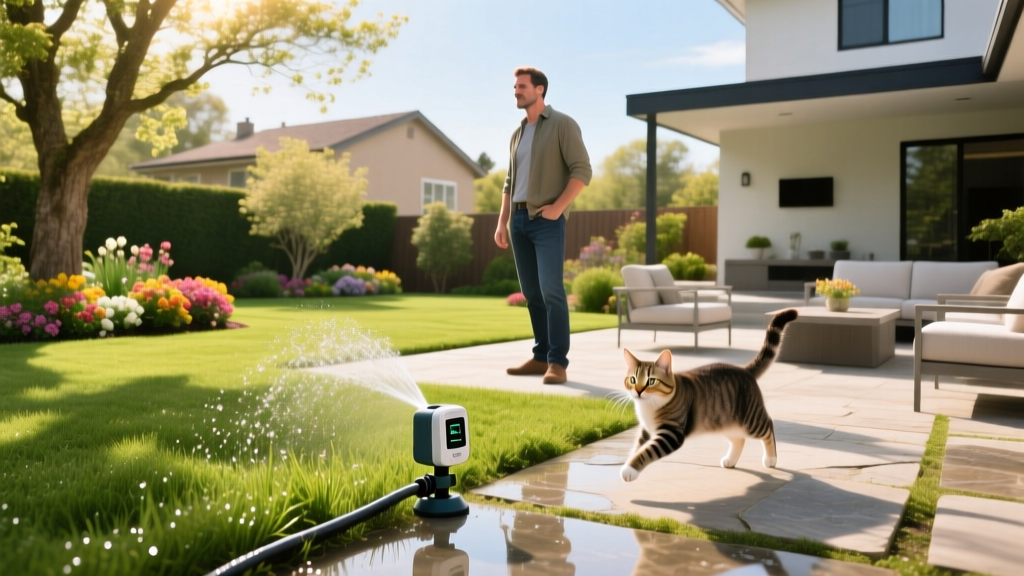
How to Scare Cats Away From Your House: Proven Yard Defenses
The Diagnostic Approach: Why Cats Target Your Property
Successfully figuring out how to scare cats away from your house requires more than randomly spraying repellents. Felines are highly territorial and habitual; they return to specific yards because those environments fulfill a biological need. Before investing in deterrents, diagnose the primary attractant driving the intrusion.
The 3 Primary Feline Attractants
- The Litter Box Effect: Freshly tilled soil, loose mulch, and dry sand pits mimic the texture of commercial cat litter. Cats prefer to bury their waste in fine, easily diggable substrates to hide their scent from predators.
- The Hunting Grounds: Yards with high populations of voles, mice, or ground-nesting birds attract cats looking for prey. If you have an active rodent problem, cats will follow the food source.
- The Sanctuary: Elevated decks, open crawl spaces, and dense shrubbery near the foundation provide dry, wind-blocked shelter for resting and nesting.
Once you identify the attractant, you can deploy a layered defense strategy. Relying on a single method usually results in habituation, where the cat eventually ignores the deterrent. A robust perimeter combines active disruption, passive barriers, and landscape modification.
Tier 1: Active Perimeter Deterrents (Motion and Sound)
Active deterrents rely on the element of surprise to trigger a cat's flight response. These are most effective for large yard perimeters and garden beds that are difficult to cover with physical barriers.
| Product Model | Mechanism | Avg. Cost | Effective Range | Primary Failure Mode |
|---|---|---|---|---|
| Orbit 62100 Yard Enforcer | PIR Motion + Water Burst | $75 - $85 | 70 ft. sensor / 35 ft. spray | Weak solenoid click if using lithium AA batteries instead of alkaline. |
| Contech ScareCrow | PIR Motion + Water Burst | $50 - $60 | 40 ft. sensor / 30 ft. spray | Internal valve freezing and cracking if left connected during winter. |
| Aspectek Ultrasonic Repeller | Ultrasonic Waves + LED Flash | $35 - $45 | 30 ft. conical sensor | Ineffective on older cats with high-frequency hearing loss. |
Optimizing Motion-Activated Sprinklers
The Orbit 62100 Yard Enforcer is widely considered the industry standard for humane pest control. Its Passive Infrared (PIR) sensor detects the heat signature of a passing animal. To maximize efficacy, set the device to 'Day and Night' mode rather than 'Night Only', as stray and neighborhood cats are highly active at dawn and dusk. Position the sprinkler head at a height of 12 to 18 inches to ensure the water burst hits the cat's torso, which is far more startling than spraying the ground near their paws.
Tier 2: Passive Texture and Scent Barriers
While active deterrents protect large zones, passive barriers are required for high-value target areas like newly seeded lawn patches, vegetable gardens, and decorative flower beds.
Texture Deterrents: The Scat Mat and Hardware Cloth
Cats despise walking on prickly or unstable surfaces. Plastic Scat Mats (typically priced around $25 for a pack of five) feature blunt, flexible spikes that are uncomfortable but will not puncture paw pads. For a more permanent, invisible solution, use 1/2-inch galvanized hardware cloth (chicken wire). Lay the wire flat over the soil and cover it with 2 inches of mulch. The wire allows water and roots to pass through but prevents cats from digging deep enough to use the area as a latrine.
Scent Repellents: Liquid Fence and Putrescent Egg Solids
Commercial scent repellents like Liquid Fence Cat & Dog Repellent rely on putrescent whole egg solids (typically at a 2.5% concentration) and garlic oil to trigger a predator-avoidance instinct. Apply the granular formula heavily around the perimeter of your property. Crucial maintenance note: Scent barriers degrade rapidly. You must reapply Liquid Fence every 30 days, or immediately after your yard receives 1 inch of rainfall, or the barrier will fail.
Toxicity Warning: The Mothball and Essential Oil Myth
Many outdated gardening forums recommend scattering mothballs or spraying concentrated peppermint and tea tree oils to repel cats. Do not do this. According to the Environmental Protection Agency (EPA), mothballs contain naphthalene or paradichlorobenzene, which are highly toxic pesticides. Using them outdoors is illegal, contaminates your local groundwater, and can cause fatal hemolytic anemia in cats, dogs, and local wildlife. Similarly, concentrated essential oils can cause severe hepatic toxicity in felines. Always stick to EPA-registered, pet-safe botanical repellents.
Tier 3: Landscape Modification and Rodent Control
If your yard is a hunting ground, no amount of sprinklers will keep cats away permanently. You must eliminate the prey drive by addressing the local rodent population.
- Secure Compost and Trash: Ensure all outdoor compost bins are fully enclosed. Open compost attracts insects, which attract mice, which attract cats.
- Clear Brush Piles: Remove dense ground cover, ivy, and wood piles within 10 feet of your home's foundation to eliminate vole habitats.
- Plant Feline-Repellent Flora: While not a standalone solution, interplanting Coleus caninus (often sold as the 'Scaredy Cat' plant) or dense, prickly shrubs like barberry beneath your windows can discourage cats from lounging near the house.
Step-by-Step: Sealing Foundation Sanctuaries
If cats are sleeping under your deck or porch, you must physically block access without trapping an animal inside.
- Inspect the perimeter at dusk to ensure no cats are currently nesting under the structure.
- Dig a narrow trench 6 inches deep along the perimeter of the deck lattice or foundation gap.
- Bury 1/2-inch hardware cloth into the trench, bending the bottom 6 inches outward in an 'L' shape away from the deck. This prevents animals from digging under the barrier.
- Backfill the trench and secure the top of the wire to the deck framing using galvanized staples.
Maintenance and Troubleshooting Matrix
Even the best perimeter defenses require troubleshooting as animals adapt. Use this matrix to diagnose and correct common deterrent failures.
| Symptom | Probable Cause | Corrective Action |
|---|---|---|
| Cat ignores the ultrasonic repeller. | The cat is older with degraded high-frequency hearing, or the frequency dial is set too high. | Lower the frequency dial to 13.5 kHz - 17.5 kHz, or switch to a motion-activated water sprinkler. |
| Cat returns to the garden bed after rain. | Rain washed away the putrescent egg solid scent barrier. | Reapply granular scent repellent immediately after the soil surface dries. |
| Sprinkler triggers but water pressure is a weak trickle. | Low battery voltage failing to fully open the solenoid valve, or debris in the inline filter. | Replace with fresh alkaline AA batteries (never use heavy-duty or lithium) and clean the mesh hose filter. |
| Cat bypasses the perimeter and climbs the fence. | Overhanging tree branches or fence rails provide an aerial bridge. | Install a 2-foot section of angled PVC pipe on top of the fence to create a slippery, unclimbable surface. |
Figuring out how to scare cats away from your house is an ongoing process of environmental management. By combining the immediate shock of motion-activated water, the physical barrier of sub-surface hardware cloth, and the elimination of local rodent habitats, you create a multi-sensory environment that felines will naturally choose to avoid. For further reading on humane wildlife management, consult resources provided by the Humane Society of the United States to ensure your deterrents remain safe for all local fauna.