
Home & Garden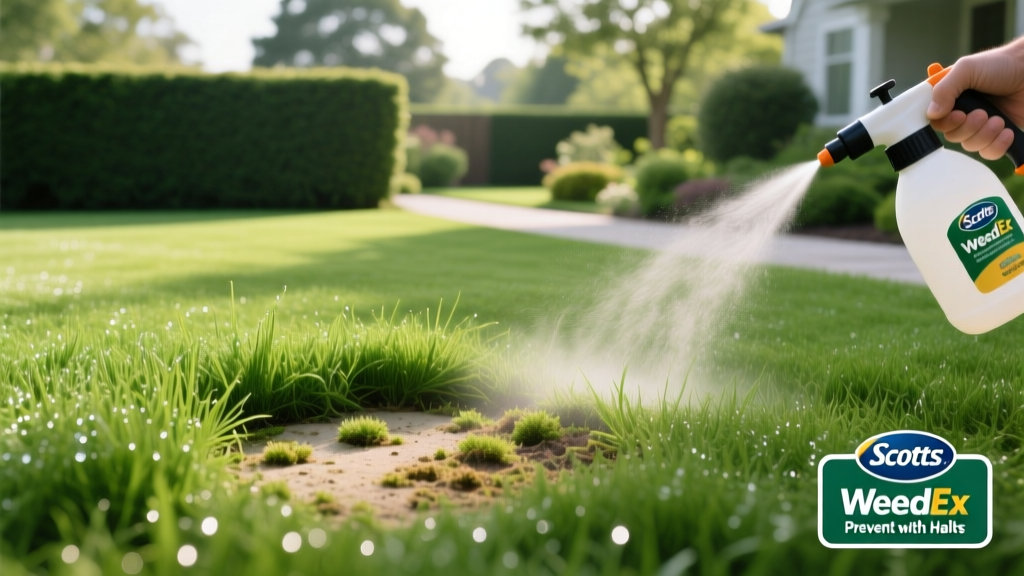
Scotts WeedEx Prevent with Halts: Spot Treatment vs Prevention
The #1 Homeowner Mistake: Using Pre-Emergents on Existing Weeds
Every summer, thousands of homeowners walk into garden centers, locate a patch of mature crabgrass in their lawn, and purchase Scotts WeedEx Prevent with Halts to "spot treat" the infestation. By mid-July, they are left frustrated as the weeds continue to thrive, completely unaffected by the application. This failure is not due to a defective product; it is due to a fundamental misunderstanding of turfgrass chemistry.
Scotts WeedEx Prevent with Halts is a pre-emergent herbicide, not a post-emergent spot treatment. Its active ingredient, dithiopyr, is highly effective at stopping weed seeds from germinating, but it possesses zero systemic activity against mature plants with established root systems. To successfully manage your lawn, you must separate your pre-emergent prevention strategy from your post-emergent spot-treatment protocol.
⚠️ CRITICAL MISCONCEPTION WARNING: Applying Halts to emerged crabgrass or broadleaf weeds will not kill them. Dithiopyr works exclusively by inhibiting microtubule assembly in dividing cells during the seed germination phase. Once a weed has developed true leaves and a taproot, this chemical barrier is entirely bypassed.
The Biochemical Reality: How Dithiopyr Works in the Soil Profile
To understand why spot-treating with Halts fails, you need to understand its behavior in the soil matrix. When applied and watered in, dithiopyr binds tightly to soil organic matter and creates a shallow chemical barrier in the top 0.5 to 1 inch of the soil profile. According to Penn State Extension turfgrass research, this barrier disrupts cell division in the radicle (embryonic root) of germinating seeds.
Because the chemical is practically immobile in the soil and does not translocate through plant tissue, it cannot travel down the leaf blade of an existing weed to reach its root system. Furthermore, dithiopyr has a unique trait among pre-emergents: it offers early post-emergent control of crabgrass, but only if the weed is in the 1- to 2-leaf stage (barely visible to the naked eye). Once crabgrass reaches the tillering stage (3+ leaves), the window for dithiopyr efficacy is permanently closed.
Target Weed Species for Halts (Pre-Emergent Phase)
When used correctly as a preventative barrier in early spring, Scotts WeedEx Prevent with Halts is highly effective against specific annual grassy weeds. Below is the efficacy matrix for target species when applied before soil temperatures trigger germination.
| Weed Species | Halts Efficacy | Germination Trigger |
|---|---|---|
| Smooth Crabgrass | Excellent | Soil temp 55°F - 60°F |
| Large Crabgrass | Excellent | Soil temp 55°F - 60°F |
| Goosegrass | Good | Soil temp 60°F - 65°F |
| Yellow Foxtail | Good | Soil temp 60°F - 65°F |
| Annual Bluegrass (Poa annua) | Excellent (Fall App) | Soil temp drops below 70°F |
If You Already Have Weeds: True Spot-Treatment Alternatives
If you are reading this in June or July and staring at mature crabgrass patches, put the Halts back on the shelf. You need a post-emergent herbicide formulated for spot treatment. Post-emergents are absorbed through the leaf tissue and translocated to the roots, killing the entire plant.
Based on University of California IPM guidelines, selecting the correct active ingredient depends entirely on your turfgrass type and the specific weed species. Applying the wrong chemical can result in severe phytotoxicity (chemical burn) to your desirable lawn.
Post-Emergent Spot Treatment Matrix
| Active Ingredient | Target Weeds | Safe For Turf Types |
|---|---|---|
| Quinclorac | Mature Crabgrass, Foxtail | Cool-season grasses, Bermuda, Zoysia |
| Fluazifop-P-butyl | Grassy weeds (Crabgrass, Dallisgrass) | Fescue, Ryegrass, Bluegrass (NOT St. Augustine) |
| Sethoxydim | Grassy weeds | Centipede, St. Augustine, Bahia |
| 2,4-D + Dicamba + MCPP | Broadleaf weeds (Dandelion, Clover) | Most cool and warm-season grasses |
Exact Application Timing & Soil Temperature Metrics
For those planning ahead for next spring, the efficacy of Scotts WeedEx Prevent with Halts hinges entirely on application timing. The most common failure mode is applying the product based on the calendar or air temperature rather than soil temperature.
🌡️ The 53°F Soil Rule
Crabgrass seeds require a sustained soil temperature of 53°F to 55°F at a 2-inch depth for three consecutive days to initiate germination. You must apply Halts before this threshold is crossed. According to Michigan State University Extension, relying on air temperature or phenological indicators (like forsythia blooms) is unreliable in modern microclimates. Use a digital soil probe thermometer inserted 2 inches into the turf canopy.
Step-by-Step Calibration and Watering Protocol
- Measure the Area: Calculate your lawn's square footage. A standard 10 lb bag of Scotts WeedEx Prevent with Halts covers 5,000 sq. ft. and retails between $28 and $34 in 2026.
- Set the Spreader: If using a Scotts EdgeGuard Mini broadcast spreader, set the dial to 3.5. For the Scotts Classic Drop Spreader, set it to 5.5. Always verify against the specific dial chart printed on the back of the bag, as formulation densities can shift slightly between manufacturing batches.
- Apply in a Grid Pattern: Walk North-South for the first pass, then East-West for the second pass to ensure overlapping coverage and prevent striping.
- Water In Immediately: Dithiopyr requires 0.25 to 0.5 inches of irrigation or rainfall within 48 hours to wash the granules off the leaf blades and into the soil matrix where the chemical barrier forms. Use an empty tuna can placed on the lawn to measure sprinkler output accurately.
Frequently Asked Questions: Halts and Spot Treatments
Can I mix Halts with a liquid post-emergent in my tank sprayer?
Scotts WeedEx Prevent with Halts is a granular product carried on a fertilizer or clay base; it cannot be mixed into a liquid tank sprayer. However, professional turf managers often use liquid dithiopyr (the commercial equivalent, Dimension) tank-mixed with post-emergents like Quinclorac to simultaneously kill existing weeds and lay down a preventative barrier. For homeowners, you must apply the granular Halts first, water it in, and then spot-spray a separate liquid post-emergent on existing weeds 3 to 5 days later.
Will Halts prevent my new grass seed from germinating?
Yes. Dithiopyr does not discriminate between weed seeds and desirable turfgrass seeds. If you are overseeding or patching bare spots in the spring, you cannot use Halts. You must wait until the new grass has been mowed at least three times (usually 60-90 days) before applying a pre-emergent, or switch to a specialized seed-starting pre-emergent containing siduron (Tupersan), which is safe for new cool-season seedlings.
Does Halts kill dandelions and clover?
No. Halts is formulated specifically for annual grassy weeds. While it may suppress some annual broadleaf weeds from seed, it will not prevent or kill perennial broadleaf weeds like dandelions, clover, or plantain. For broadleaf prevention and spot treatment, you need a product containing 2,4-D, dicamba, or triclopyr.
Summary Action Plan: Use Scotts WeedEx Prevent with Halts strictly as an early-spring pre-emergent barrier applied when soil temperatures reach 50°F-53°F. If weeds have already emerged, pivot immediately to targeted post-emergent spot treatments like Quinclorac (for crabgrass) or 2,4-D blends (for broadleaf weeds).