
Home & Garden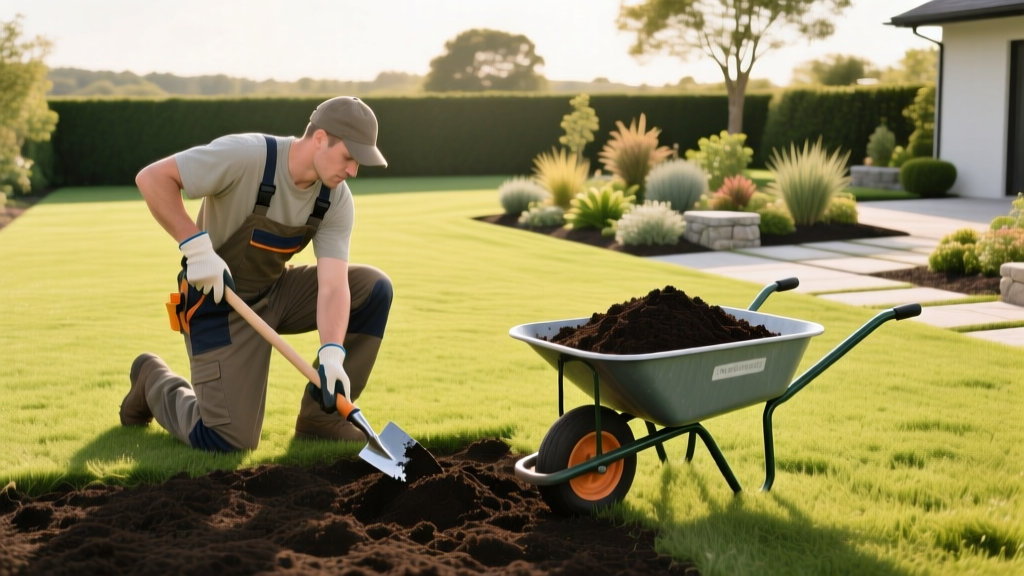
Topsoil Cost Per Yard: 2026 Pricing, Coverage & Delivery Guide
The Real Topsoil Cost Per Yard: Bulk vs. Bagged Breakdown
When budgeting for lawn establishment or garden bed construction, understanding the true topsoil cost per yard requires distinguishing between bulk delivery and bagged retail options. In 2026, the national average for bulk screened topsoil ranges from $30 to $50 per cubic yard, while premium organic blends command $50 to $85 per cubic yard. However, the unit price is only a fraction of your total project cost.
A common and expensive mistake homeowners make is purchasing bagged topsoil from big-box hardware stores for large-scale projects. A standard 1-cubic-foot bag costs between $3.50 and $5.50. Because there are 27 cubic feet in a single cubic yard, buying bagged soil equates to an effective bulk rate of $94.50 to $148.50 per cubic yard. Bulk delivery is mathematically mandatory for any project requiring more than three cubic yards.
Quick Pricing Snapshot (2026 Averages):
- Unscreened Fill Dirt: $15 - $25 per cu. yd. (Use for sub-base grading only)
- Standard Screened Topsoil: $30 - $50 per cu. yd. (Best for general lawn prep)
- Premium Organic/Compost Blend: $50 - $85 per cu. yd. (Ideal for high-performance turf and vegetable beds)
- Bagged Topsoil (1 cu. ft.): $94 - $148 per cu. yd. equivalent (Strictly for touch-ups and containers)
Coverage Calculations: How Far Does a Yard of Topsoil Go?
A 'yard' in landscaping terminology exclusively refers to a cubic yard (3 feet wide × 3 feet long × 3 feet deep = 27 cubic feet). To calculate your required volume, you must map your square footage against your target application depth. According to the University of Minnesota Extension, establishing a healthy new lawn from seed requires a minimum topsoil depth of 4 to 6 inches to support deep root penetration and drought resistance.
| Target Depth | Sq. Ft. Covered per Cu. Yd. | Primary Application |
|---|---|---|
| 1 Inch | 324 sq. ft. | Topdressing existing lawns, leveling minor bumps |
| 2 Inches | 162 sq. ft. | Overseeding preparation, garden bed refresh |
| 4 Inches | 81 sq. ft. | New lawn establishment (minimum standard) |
| 6 Inches | 54 sq. ft. | Deep grading, raised vegetable beds, sod prep |
Hidden Delivery and Spreading Costs You Must Budget For
The quoted topsoil cost per yard rarely includes logistics. Delivery fees and spreading labor can easily double your material costs if not planned correctly. Most landscape supply yards utilize single-axle dump trucks (carrying 5 to 7 cubic yards) or tri-axle trucks (carrying 12 to 15 cubic yards).
Delivery Fee Structures
- Flat-Rate Local Delivery: $50 to $125 for addresses within a 10-mile radius of the supply yard.
- Per-Mile Overage: $3.50 to $6.00 per mile beyond the base zone.
- Supersacks (1-Yard Totes): If your property lacks space for a dump truck pile, suppliers offer 1-cubic-yard woven bags. These cost $90 to $140 per sack, plus a $150 flat delivery fee. Warning: Supersacks weigh roughly 2,000 lbs each and require a forklift or skid steer to unload; they cannot be manually dragged across a lawn.
Spreading and Grading Labor
One cubic yard of topsoil weighs between 1,800 and 2,200 pounds depending on moisture content. Moving this volume manually with a standard 4-cubic-foot wheelbarrow requires roughly 7 to 8 trips per yard. Professional landscaping crews charge $65 to $95 per hour for manual spreading and grading, typically averaging $40 to $60 per cubic yard for labor. For projects exceeding 15 cubic yards, renting a compact track loader (skid steer) for $250 to $350 per day drastically reduces physical strain and time, though it risks turf damage if driven on existing grass.
Screened vs. Unscreened vs. Organic Blends: Which Do You Need?
Not all topsoil is created equal. The screening process and organic matter content dictate both the price and the biological viability of your soil.
Unscreened Topsoil (Fill Dirt)
Priced at $15 to $25 per yard, this material is pulled directly from excavation sites. It contains rocks, roots, and clay clumps. Use it exclusively for filling deep holes, building sub-base berms, or raising low-lying property grades. Never use unscreened soil for planting or seeding, as the debris prevents seed-to-soil contact and disrupts root growth.
Screened Topsoil
Passed through a 3/4-inch or 1/2-inch vibrating mesh screen, this soil is uniform and free of large debris. At $30 to $50 per yard, it is the standard choice for establishing new lawns. However, standard screened topsoil often lacks sufficient biological activity. The USDA Natural Resources Conservation Service (NRCS) recommends a soil organic matter target of at least 5% for optimal water retention and nutrient cycling. Standard screened topsoil frequently tests below 3%.
Premium Organic Blends
Costing $50 to $85 per yard, these blends mix screened topsoil with 20% to 30% composted leaf litter, aged manure, or peat. This is the mandatory choice for vegetable gardens, high-traffic turfgrass (like Kentucky Bluegrass or Bermuda), and areas with poor native clay drainage. The upfront premium eliminates the need for separate compost amendments and starter fertilizers.
Expert Soil Testing Tip: Before ordering 10+ yards of premium blend, purchase a $25-$35 comprehensive soil test from your local university extension office. If your native soil already has high phosphorus and organic matter, paying a premium for a compost-heavy topsoil blend can actually cause nutrient runoff and turf burn. Match your purchased soil profile to your native soil deficiencies.
Step-by-Step: Calculating Your Exact Order Volume
Follow this precise formula to avoid the two most common errors: ordering too little (resulting in exorbitant secondary delivery fees) or ordering too much (leaving you with a muddy pile that kills the grass beneath it).
- Measure the Area: Calculate Length (ft) × Width (ft) = Total Square Footage.
- Determine Depth in Feet: Divide your target inches by 12. (e.g., 4 inches = 0.33 feet).
- Calculate Raw Cubic Feet: Multiply Total Sq. Ft. × Depth in Feet.
- Convert to Cubic Yards: Divide the Raw Cubic Feet by 27.
- Apply the 10% Compaction Overage: Multiply your final cubic yard number by 1.10. Topsoil settles and compacts by roughly 8% to 12% after the first heavy rainfall and manual tamping.
Example Calculation: You are seeding a 50 ft × 40 ft front yard (2,000 sq. ft.) and want a 4-inch (0.33 ft) base.
2,000 × 0.33 = 660 cubic feet.
660 ÷ 27 = 24.44 cubic yards.
24.44 × 1.10 = 26.88 cubic yards.
Order exactly 27 cubic yards.
Frequently Asked Questions
Can I just dump topsoil directly over my existing weedy lawn?
No. Dumping topsoil over existing vegetation creates a decomposing organic layer that traps methane, breeds fungal pathogens, and prevents proper drainage. You must kill existing vegetation with a non-selective herbicide or solarization, scalp the dead turf with a mower, and core aerate before applying a 1-to-2-inch topsoil topdressing.
Why does my delivered topsoil smell like sulfur or ammonia?
A foul odor indicates anaerobic decomposition, meaning the soil was piled too high and too wet at the supplier's yard, cutting off oxygen to beneficial microbes. While the smell dissipates after spreading and exposure to air, anaerobic soil can temporarily tie up nitrogen and stunt seed germination. Always inspect and smell the first load before the driver dumps the entire tri-axle truck on your driveway.

