
Home & Garden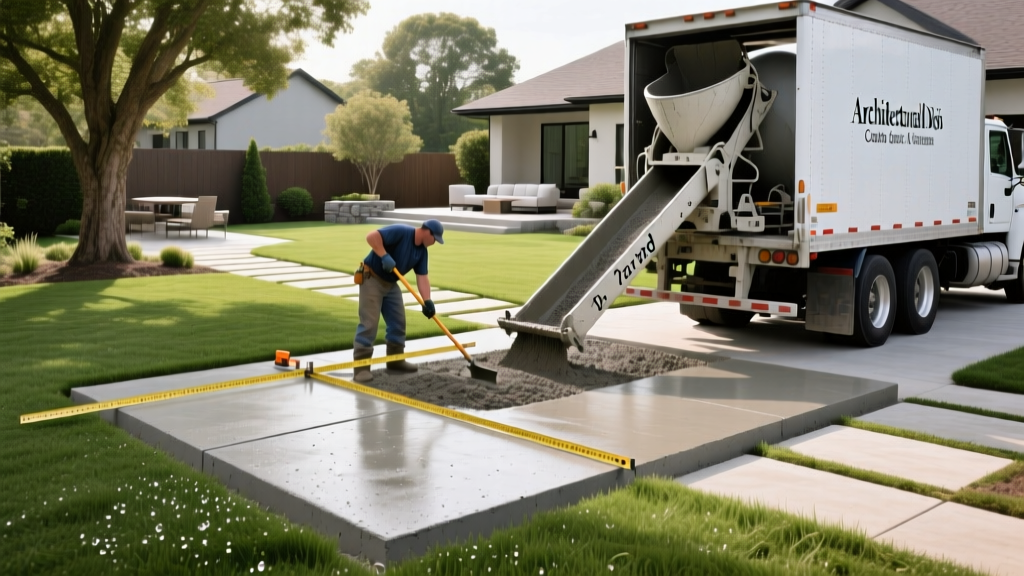
Average Weight Concrete Per Yard for Home Landscaping
The Exact Mass Behind Your Hardscape Projects
When planning a backyard patio, shed foundation, or retaining wall, volume is only half the equation. The physical mass of your materials dictates subgrade preparation, delivery logistics, and long-term structural integrity. Calculating the exact weight concrete per yard is a critical first step for any homeowner tackling outdoor hardscaping, yet it is frequently overlooked until a delivery truck cracks a residential driveway or a retaining wall begins to lean.
Standard concrete is a dense composite of cement, water, and aggregates (sand and gravel). Because aggregate composition varies by region, the mass fluctuates slightly, but industry baselines provide reliable metrics for residential planning. According to the National Ready Mixed Concrete Association, normal-weight concrete is the standard for 95% of residential flatwork and structural landscaping.
Concrete Weight Breakdown by Type
| Concrete Type | Weight Per Cubic Yard | Weight Per Cubic Foot | Common Landscaping Use |
|---|---|---|---|
| Standard Ready-Mix (3,000 - 4,000 PSI) | 4,050 lbs | 150 lbs | Patios, walkways, shed pads, fence posts |
| Lightweight Concrete | 3,000 lbs | 110 - 115 lbs | Rooftop gardens, elevated deck overlays |
| High-Density (Heavyweight) | 5,000+ lbs | 185+ lbs | Specialized heavy retaining walls, radiation shielding |
| Bagged Mix (e.g., 80lb Quikrete) | ~3,960 lbs (mixed) | ~147 lbs | Small repairs, single post-setting, bird bath bases |
Why Weight Matters: Subgrade and Soil Bearing Capacity
A common misconception among beginner landscapers is that the sheer weight of the concrete will cause it to sink into the soil. In reality, a standard 4-inch thick concrete slab exerts a dead load of approximately 20 pounds per square foot (psf). Most undisturbed soils have a bearing capacity far exceeding this. For instance, dense sandy clay can support 4,000 psf, while soft clay supports around 1,500 psf. The Portland Cement Association notes that subgrade failure is almost never caused by the concrete's dead weight, but rather by live loads (vehicles, heavy furniture) combined with poor drainage and freeze-thaw expansion.
⚠️ Subgrade Warning: If you are pouring a slab over expansive clay soil, the weight of the concrete per yard will not prevent heaving. You must excavate 4 to 6 inches of topsoil, replace it with compacted Class 5 gravel, and lay a 6-mil polyethylene vapor barrier before pouring. Failure to do so will result in severe cracking regardless of the concrete's PSI rating.
Ready-Mix Delivery vs. Bagged Concrete: Weight Logistics
Understanding the weight concrete per yard becomes a logistical necessity when ordering delivery. A standard 10-yard ready-mix truck carries up to 40,500 lbs of concrete. Add the weight of the truck itself, and the Gross Vehicle Weight Rating (GVWR) approaches 66,000 to 80,000 lbs.
The Driveway Crushing Hazard
Most residential driveways are poured at 4 inches thick over a 4-inch gravel base, engineered to support passenger vehicles (typically 4,000 to 8,000 lbs per axle). A fully loaded ready-mix truck concentrates over 30,000 lbs on its tandem rear axles. Driving this truck onto a standard residential driveway will almost certainly cause catastrophic structural cracking.
- Option A: Concrete Pump Truck. The mixer truck stays on the street while a boom pump routes the wet concrete to your backyard. As of 2026, expect to pay an additional $900 to $1,400 for a pump truck rental, but it entirely eliminates driveway weight risks.
- Option B: Mini-Mix Trucks. These smaller volumetric mixers carry 3 to 5 yards and weigh roughly 25,000 lbs fully loaded. They can safely navigate reinforced driveways and tight side-yard gates.
- Option C: Bagged Concrete. Mixing by hand. To produce one cubic yard using 80 lb bags, you will need 45 bags. That is 3,600 lbs of dry material, plus roughly 360 lbs of water. This is highly labor-intensive and only recommended for volumes under 0.5 cubic yards.
Step-by-Step: Calculating Total Load for a 10x10 Patio
To properly plan your material order and assess the total load on your landscape, follow this exact mathematical framework:
- Calculate Square Footage: A 10 ft x 10 ft patio equals 100 square feet.
- Convert Thickness to Feet: A standard 4-inch slab is 0.33 feet thick.
- Determine Cubic Feet: 100 sq ft × 0.33 ft = 33 cubic feet.
- Convert to Cubic Yards: Divide by 27. (33 ÷ 27 = 1.22 cubic yards).
- Add Waste Factor: Always add 10% for spillage, over-excavation, and formwork bowing. (1.22 × 1.10 = 1.34 cubic yards).
- Calculate Total Weight: Multiply by the standard weight of 4,050 lbs. (1.34 × 4,050 = 5,427 lbs).
You will need to order a 1.5-yard short-load from your local batch plant, and you must ensure your wheelbarrows, mixing tubs, and physical labor force are prepared to move nearly 5,500 lbs of material within a 90-minute workability window.
When to Use Lightweight Concrete in the Garden
While standard 4,050 lbs/yd³ mixes are ideal for ground-level patios, lightweight concrete (averaging 3,000 lbs per yard) is a superior choice for specific elevated or structurally sensitive landscaping projects. Lightweight mixes substitute traditional crushed stone aggregates with expanded shale, clay, or slate.
'When designing rooftop gardens, second-story balcony planters, or retaining walls built over weak, peat-heavy soils, reducing the dead load by 25% using lightweight aggregates can significantly lower the structural reinforcement costs required for the underlying framework.'
Pros and Cons of Lightweight Hardscape Mixes
- Pros: Reduces overall weight by up to 1,500 lbs per yard; provides better thermal insulation for raised garden beds protecting plant roots from frost; easier to trowel and finish for DIYers.
- Cons: Costs approximately 15% to 20% more per yard than standard mix; lower compressive strength (usually capped at 3,000 PSI), making it unsuitable for driveways or heavy vehicle pads; requires specialized curing compounds to prevent rapid moisture loss.
Frequently Asked Questions
Does wet concrete weigh more than dry, cured concrete?
Yes, but only temporarily. Freshly mixed concrete contains excess water required for the pouring process and workability. As the concrete cures over 28 days, it releases moisture through hydration and evaporation. A fully cured cubic yard of standard concrete will weigh approximately 3,800 to 3,900 lbs, roughly 150 to 250 lbs less than its wet state.
How much weight can a standard wheelbarrow hold?
A typical residential contractor-grade wheelbarrow (6 cubic foot capacity) is rated for 300 to 400 lbs of material. Because wet concrete weighs 150 lbs per cubic foot, filling a 6-cubic-foot wheelbarrow to the brim will load it with 900 lbs—far exceeding the axle and tray limits, leading to bent frames and blown tires. Always fill wheelbarrows no more than one-third full (approx. 300 lbs) when moving wet concrete.
Do I need to factor in rebar weight?
For precise structural engineering, yes. A standard grid of #4 (1/2-inch) rebar spaced at 18 inches on center adds roughly 0.15 lbs per square foot. For a 100-square-foot patio, the steel reinforcement adds only about 15 lbs to the total project weight. In residential landscaping, this steel weight is negligible and does not need to be added to your yardage weight calculations.