
Home & Garden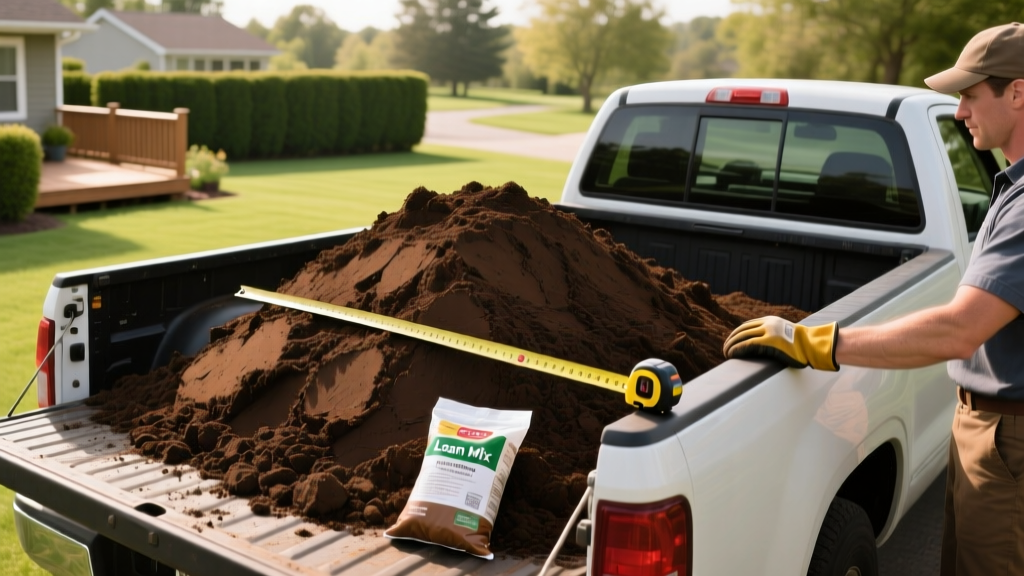
Weight of 1 Yard Topsoil: Moisture, Types, and Truck Hauling Limits
When planning a landscaping project, grading a lawn, or filling raised garden beds, ordering bulk dirt is inevitable. However, the single most miscalculated variable in hardscaping and softscaping logistics is the weight of 1 yard topsoil. Underestimating this metric leads to overloaded truck suspensions, blown tires, and severe safety hazards on the road. Conversely, overestimating it results in unnecessary delivery fees and multiple inefficient trips to the landscape supply yard.
A cubic yard is a volume measurement (3 feet wide × 3 feet long × 3 feet deep, equaling 27 cubic feet), but weight is a measure of mass. Because topsoil is a dynamic, porous medium composed of minerals, organic matter, water, and air, its weight fluctuates wildly based on environmental conditions and geological composition. This guide breaks down the exact physics of topsoil weight, provides a matrix for different soil blends, and offers a concrete framework for determining if your vehicle can safely haul it.
The Baseline: Average Weight of 1 Yard Topsoil
As a general rule of thumb in the landscaping industry, one cubic yard of topsoil weighs between 2,000 and 2,700 pounds. However, relying on a single average is dangerous when calculating vehicle payload limits. To understand the true weight, we must look at soil bulk density.
According to the USDA Natural Resources Conservation Service (NRCS), the bulk density of mineral soils typically ranges from 1.0 to 1.6 grams per cubic centimeter (g/cm³). Topsoil, which contains higher levels of organic matter and pore space, usually sits on the lower end of that spectrum (0.8 to 1.2 g/cm³). When we convert these metric densities into imperial volume weights for a 27-cubic-foot space, we get the following baseline categories:
Quick Reference: Topsoil Weight by Moisture Level
- Dry / Screened Topsoil (Summer Baked): 1,800 – 2,100 lbs per yard
- Moist / Average Topsoil (Spring/Fall): 2,200 – 2,600 lbs per yard
- Wet / Saturated Topsoil (After Heavy Rain): 2,800 – 3,200+ lbs per yard
- Frozen Topsoil (Winter): 2,900 – 3,100 lbs per yard (ice adds massive density)
Why Soil Weight Fluctuates: The Moisture and Composition Matrix
Moisture content is the primary driver of weight variance. Water weighs approximately 62.4 pounds per cubic foot. If a cubic yard of dry topsoil (which contains roughly 20% pore space) absorbs water to fill those pores, the overall weight increases dramatically. A sudden spring rainstorm can easily add 600 to 800 pounds of water weight to a single yard of topsoil sitting in a landscape supply stockpile.
Soil texture also dictates baseline density. The University of Minnesota Extension notes that soil particle size directly impacts how tightly the material packs together. Clay particles are microscopic and pack densely, trapping water and increasing mass. Sandy soils have larger particles, larger pore spaces, and drain water rapidly, making them lighter when dry but surprisingly heavy when fully saturated.
| Soil Type / Blend | Dry Weight (per Yard) | Moist Weight (per Yard) | Characteristics |
|---|---|---|---|
| Sandy Loam Topsoil | 1,900 lbs | 2,300 lbs | Drains well, lighter, ideal for turf establishment |
| Standard Screened Loam | 2,100 lbs | 2,500 lbs | Balanced sand/silt/clay mix, standard landscape grade |
| Clay-Heavy Topsoil | 2,400 lbs | 2,900 lbs | Retains water, very dense, prone to compaction |
| Organic Garden Blend (50/50) | 1,400 lbs | 1,900 lbs | High compost ratio, very light, high water retention |
Can Your Truck Haul It? Payload Limits vs. Soil Weight
The most common and costly mistake homeowners make is assuming a "half-ton" pickup truck can safely haul a cubic yard of topsoil. The term "half-ton" is a historical classification referring to a 1,000-pound payload capacity. Modern 2026 half-ton trucks (like the Ford F-150, Chevy Silverado 1500, and Ram 1500) have vastly improved engineering, but physics still apply.
⚠️ WARNING: The Half-Ton Truck Myth
Never look at a truck's towing capacity to determine how much dirt you can carry in the bed. You must look at the Payload Capacity, which is listed on the yellow sticker inside the driver's side door jamb. Payload includes the weight of the driver, passengers, fuel, aftermarket accessories (like bed liners and tonneau covers), AND the cargo.
Step-by-Step Payload Calculation Framework
Before driving to the landscape supply yard, run this exact calculation to determine if you can safely haul 1 yard of moist topsoil (estimated at 2,500 lbs):
- Find Max Payload: Check the door jamb sticker. (e.g., 2026 F-150 XLT Max Payload = 1,850 lbs).
- Subtract Human Weight: Driver (200 lbs) + Passenger (150 lbs) = 350 lbs. (Remaining: 1,500 lbs).
- Subtract Fuel & Gear: Full tank of gas (~130 lbs) + bed mat/tools (50 lbs) = 180 lbs. (Remaining: 1,320 lbs).
- The Verdict: You only have 1,320 lbs of available cargo capacity. A 2,500 lb yard of topsoil will overload your truck by 1,180 lbs, causing the rear suspension to bottom out, severely compromising braking distance and steering control.
Vehicle Class Hauling Guidelines for Topsoil
- Half-Ton Pickups (F-150, 1500 Series): Maximum safe load is 0.5 yards of moist topsoil (approx. 1,250 lbs). Do not exceed this.
- Three-Quarter-Ton Pickups (F-250, 2500 Series): Payloads range from 2,500 to 4,000 lbs. Safely hauls 1 full yard of moist topsoil with passengers and fuel.
- One-Ton Pickups (F-350, 3500 Series): Payloads often exceed 5,000 lbs. Can safely haul 1.5 to 2 yards of topsoil, provided the physical volume fits in the bed without spilling.
- Standard Utility Trailers (5x8 or 6x10): Check the axle rating. A standard 3,500 lb axle trailer can hold roughly 1.2 yards of topsoil, minus the trailer's own weight.
Bagged vs. Bulk Topsoil: The Weight Discrepancy
Many homeowners attempt to bypass bulk hauling by purchasing bagged topsoil from big-box hardware stores. It is critical to understand that bagged soil is mechanically dried, sifted, and aerated before packaging. A standard 40 lb bag of topsoil yields approximately 0.75 cubic feet. It takes exactly 36 bags to equal 1 cubic yard.
Mathematically, 36 bags × 40 lbs = 1,440 lbs per cubic yard of bagged soil. This is nearly 1,000 pounds lighter than a yard of bulk, moist topsoil. While bagged soil is easier to transport in smaller vehicles (a minivan can easily handle 20 bags / 800 lbs), the cost per cubic yard is exponentially higher. In 2026, bulk topsoil averages $30 to $50 per yard, whereas 36 bags at $3.50 each equals $126 per yard. For anything over 0.5 yards, bulk delivery is vastly more economical.
Manual Transport: Wheelbarrow Limits and Ergonomics
Once the soil is on your property, moving it requires manual labor. A standard contractor wheelbarrow holds 6 cubic feet (0.22 cubic yards). If filled to the brim with moist topsoil (2,500 lbs/yd³), the soil alone weighs 550 lbs. Add the 60 lb weight of a steel wheelbarrow, and you are attempting to push 610 lbs of dead weight on a single pneumatic tire.
Pushing 600+ lbs up even a 5% grade places over 150 lbs of downward force on your lumbar spine and wrists. Pro Tip: Never fill a wheelbarrow to capacity with topsoil. Load it to one-third or one-half volume (approx. 150-200 lbs of soil). You will move the same total volume faster, with significantly less fatigue and zero risk of tipping the load on uneven terrain.
Frequently Asked Questions
Does screened topsoil weigh less than unscreened topsoil?
Screening removes large rocks, roots, and debris, which can slightly reduce the overall weight. However, the screening process also creates a finer, more uniform particle size that packs together more densely when wet. Therefore, screened topsoil is often heavier per cubic yard than unscreened, rocky fill dirt when moisture is introduced, because the fine particles hold water more effectively in the capillary spaces.
How much does a cubic yard of topsoil cost delivered?
As of 2026, standard screened topsoil costs between $30 and $50 per cubic yard. Delivery fees are typically charged by the truckload rather than the yard, ranging from $75 to $150 depending on your distance from the supplier. A standard dump truck carries 10 to 15 yards, meaning the delivery fee per yard drops significantly if you order in bulk or split a load with a neighbor.
Will 1 yard of topsoil fit in the bed of a standard pickup truck?
Volume-wise, yes. A standard 6.5-foot truck bed holds roughly 2.5 cubic yards when filled level to the top of the bed rails. Therefore, 1 yard of topsoil will easily fit in the footprint of the bed. The limiting factor is never the physical space; it is always the vehicle's suspension and payload capacity.