
Home & Garden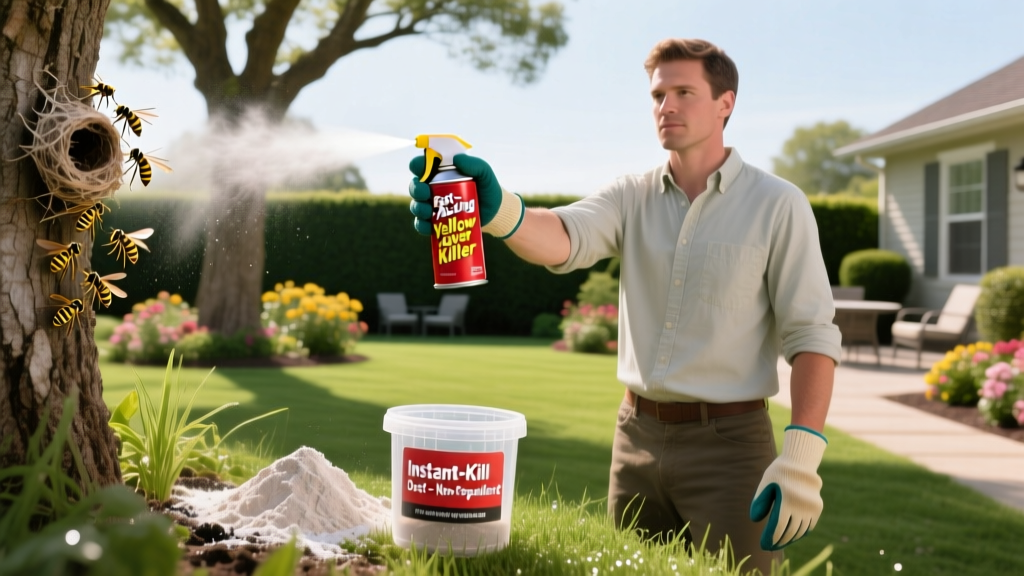
What Kills Yellow Jackets Instantly? Fast-Acting Sprays & Dusts
When a yellow jacket nest poses an immediate threat to your family or pets, you need a solution that paralyzes the colony on contact. The short answer to what kills yellow jackets instantly is pyrethroid-based aerosol sprays for aerial nests and cyfluthrin or deltamethrin insecticidal dusts for ground nests. These synthetic chemicals disrupt the insect's nervous system within seconds, causing immediate knockdown and preventing the swarm from mobilizing a defensive attack.
However, applying the wrong product to the wrong nest type is the leading cause of severe stinging incidents. Aerial nests require high-pressure, long-range liquid jets, while subterranean nests require dry dusts that workers track deep into the tunnels. This guide breaks down the exact chemistry, specific commercial products, and application protocols required to eliminate yellow jackets instantly and safely.
The Chemistry of Instant Knockdown: Pyrethroids vs. Surfactants
To understand why certain products work instantly while others fail, you must look at the active ingredients. True "instant" killers rely on pyrethroids (such as tetramethrin, cypermethrin, and prallethrin). These compounds are sodium channel modulators. When a yellow jacket is sprayed, the pyrethroid forces the nerve cell sodium channels to remain open, causing continuous nerve firing, immediate paralysis (knockdown), and rapid death.
Conversely, DIY solutions like dish soap and water act as surfactants. Soap lowers the surface tension of water and physically blocks the insect's spiracles (breathing pores), causing death by asphyxiation. While effective, asphyxiation takes 2 to 5 minutes. In a swarm scenario, a 5-minute delay allows hundreds of agitated yellow jackets to exit the nest and attack. For instant neutralization, pyrethroids are the only reliable option.
⚠️ CRITICAL SAFETY WARNING: Never use a standard white-beam flashlight to inspect or treat a nest at night. Yellow jackets are highly attracted to white light and will immediately fly toward the source, stinging the operator. Always use a red-lens flashlight or cover your light with red cellophane, as yellow jackets cannot perceive the red light spectrum.
Top Fast-Acting Aerosol Sprays for Aerial Nests
Aerial nests (built in trees, under eaves, or inside wall voids) require a pressurized aerosol that shoots a concentrated, solid stream of insecticide from a safe distance. Foggers or wide-mist sprayers are useless and dangerous here, as the wind will blow the mist back onto you and fail to penetrate the nest envelope.
According to the University of Minnesota Extension, the key to treating aerial nests is saturating the single entry/exit hole with a high-velocity jet from at least 15 feet away. Below is a comparison of the most effective instant-kill aerosols currently on the market.
| Product | Active Ingredients | Spray Range | Knockdown | Avg. Price |
|---|---|---|---|---|
| Spectracide Wasp & Hornet Killer III | Tetramethrin (0.13%), Cypermethrin (0.20%) | 20 ft | < 5 sec | $6.50 |
| Raid Wasp & Hornet Killer | Cypermethrin (0.30%), Prallethrin (0.02%) | 22 ft | < 5 sec | $5.98 |
| Hot Shot Wasp & Hornet Killer | Tetramethrin (0.13%), Prallethrin (0.02%) | 20 ft | < 8 sec | $4.50 |
Pro Tip: When spraying, do not just coat the outside of the paper nest. You must aim the solid stream directly into the visible hole. The liquid will flood the internal chambers, instantly killing the queen and the majority of the workers before they can exit.
Instant Kill Solutions for Ground Nests (Dusts & Drenches)
Treating a ground nest with an aerosol spray is a severe mistake. Subterranean yellow jacket nests consist of extensive tunnel networks that can stretch several feet underground. An aerosol spray will only kill the guards at the entrance, while the sudden influx of liquid and propellant will agitate the deep colony, causing hundreds of yellow jackets to flood out of secondary, hidden exit holes and attack.
The instant-kill solution for ground nests is insecticidal dust, specifically those containing Cyfluthrin (Tempo 1% Dust) or Deltamethrin (Delta Dust). Unlike liquids, dusts do not agitate the colony. Returning foragers walk through the treated entrance, coating their legs and bodies in the toxic powder. They track it deep into the nest, spreading it to the queen and larvae. While the total colony collapse takes 24 to 48 hours, the dust kills individual foragers instantly upon contact at the entrance, immediately reducing the threat level.
Step-by-Step Protocol for Dusting a Ground Nest
- Locate the Entrance at Daylight: Identify the exact hole(s) during the day when wasps are active. Mark it with a small rock or stick from a safe distance (at least 10 feet away).
- Wait for Optimal Conditions: Return at night, ideally between 10:00 PM and 2:00 AM, when temperatures drop below 65°F. Yellow jackets are sluggish and entirely inside the nest at this time.
- Prepare the Duster: Fill a bellows hand duster (like the JT Eaton 905 Duster) halfway with Tempo 1% Dust. Do not overfill; the duster needs air space to create a proper cloud.
- Apply the Dust: Approach the hole quietly using a red-lens light. Insert the duster nozzle near the opening and puff 2 to 3 generous clouds of dust directly into the tunnel.
- Do Not Seal the Hole: Leave the entrance open. The returning morning foragers must walk through the dust to carry it inside. Sealing it with dirt will force them to dig a new exit.
DIY "Instant" Killers: Do Soap and Water Actually Work?
A widely circulated internet hack suggests mixing 1 cup of liquid dish soap (like Dawn) with a gallon of water in a pump sprayer to kill yellow jackets. While this mixture is highly lethal, it is not instant. The soap acts as a surfactant, stripping the waxy cuticle of the insect and blocking its spiracles, causing death by suffocation.
This method is only viable for small, isolated foragers or as a secondary cleanup measure the day after a chemical treatment. If you attempt to pump soap water into a large, active ground nest or aerial nest, the 3-to-5-minute delay before asphyxiation occurs will result in a massive, aggressive swarm response. For immediate, on-contact neutralization, commercial pyrethroids remain the only scientifically viable option.
Safety Protocols and Post-Treatment Cleanup
Even after a nest has been successfully treated with an instant-kill aerosol or dust, the site remains hazardous. The University of Kentucky Entomology department notes that dead yellow jackets retain their stinging reflex for several hours, and the venom sacs can still envenomate if stepped on or handled.
Checklist for Safe Removal:
- Wait a full 48 hours after treatment before approaching the nest.
- Wear thick leather gloves and closed-toe shoes during removal.
- Knock aerial nests down with a long pole (like a broom handle) rather than a ladder to maintain distance.
- Double-bag the nest in heavy-duty contractor trash bags before disposing of it in your outdoor bin.
- Scrape away any remaining attachment material from eaves or branches to prevent secondary pest attraction.
Frequently Asked Questions
Can I use bleach to kill yellow jackets instantly?
No. Bleach is a corrosive cleaning agent, not an insecticide. It lacks the neurological knockdown agents required to paralyze a yellow jacket on contact. Spraying bleach will only agitate the swarm and expose you to toxic fumes and severe stinging.
What kills yellow jackets instantly if they are inside a wall void?
Never spray liquid aerosols into a wall void, as it can drive the colony deeper into the home or cause the liquid to damage drywall. Instead, use a bulb duster to puff Delta Dust (Deltamethrin) into the exterior entry hole. The dust is moisture-proof and will coat the insects as they enter and exit, eventually eliminating the colony inside the wall without the risk of structural damage.
Does WD-40 kill yellow jackets on contact?
While the petroleum distillates in WD-40 can suffocate an individual yellow jacket, it is not formulated as a pesticide, lacks a long-range projection nozzle, and is highly flammable. Using it near homes or on hot summer days poses a severe fire and health hazard. Stick to EPA-registered pyrethroid wasp sprays.