
Home & Garden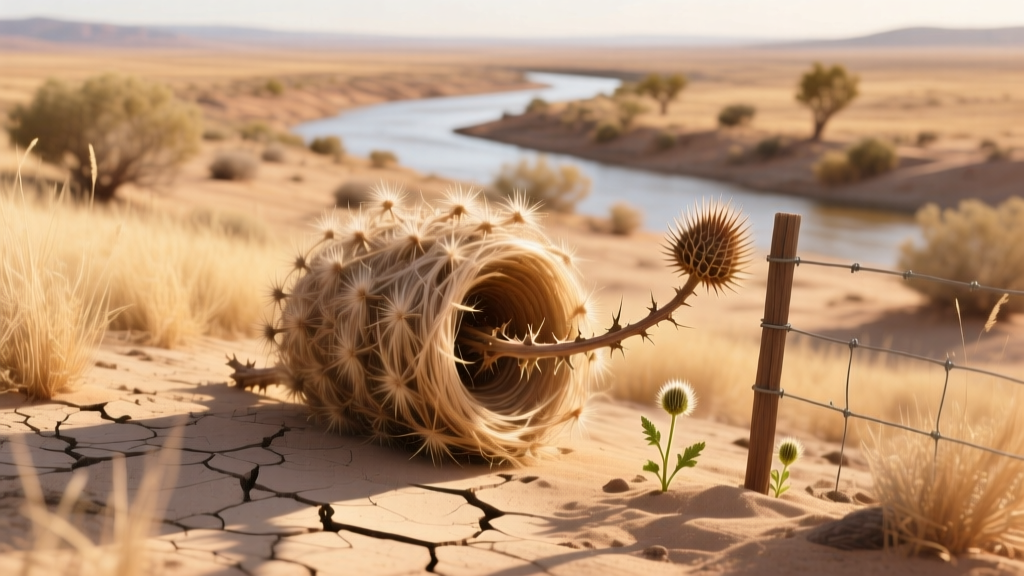
Where Do Tumbleweeds Come From? Origins & Spot-Treatment Guide
Most homeowners view tumbleweeds as a cinematic nuisance that rolls across yards in late autumn, but treating them effectively requires understanding their biology and origins. If you have ever wondered where do tumbleweeds come from, the answer lies in a highly adaptable, invasive annual weed known as Russian thistle (Salsola tragus). Unlike perennial grasses that spread via rhizomes, tumbleweeds rely entirely on a massive seed bank and a unique mechanical dispersal method. Spot-treating this weed requires precise timing, specific active ingredients, and an understanding of its rapid growth cycles.
The Botanical Origins: Where Do Tumbleweeds Come From?
Russian thistle is not native to North America. Historical agricultural records indicate that the weed was introduced to the United States in the early 1870s, specifically around 1873 or 1874, via contaminated flax seed shipments imported from Russia to South Dakota. From that single introduction point, the plant rapidly expanded across the arid and semi-arid regions of the American West and Midwest.
Historical Fact: A single mature Russian thistle plant can produce up to 250,000 seeds. When the plant dies in late summer, its stem breaks at the soil line, and the wind carries the tumbling skeleton, scattering seeds across miles of residential and agricultural land.
According to the University of California Agriculture and Natural Resources, Russian thistle thrives in disturbed soils, neglected yard edges, and drought-stressed lawns. Its deep taproot allows it to outcompete desirable turfgrass for moisture, making early spot-treatment critical before the root system fully establishes.
Tumbleweed Life Cycle & Spot-Treatment Windows
Effective spot-treatment hinges on identifying the weed's current growth stage. Herbicides that easily kill seedlings will fail on mature, woody-stemmed plants. Below is a decision matrix for spot-treating Russian thistle throughout the growing season.
| Growth Stage | Time of Year | Plant Size | Recommended Active Ingredient | Estimated Cost (Spot Treatment) |
|---|---|---|---|---|
| Rosette / Seedling | April - May | 1 to 4 inches | 2,4-D Amine or Dicamba | $0.05 per plant |
| Bolting / Branching | June - July | 6 to 18 inches | 2,4-D + Glyphosate Tank Mix | $0.12 per plant |
| Mature / Flowering | August - September | 2 to 4 feet | Mechanical Removal + Pre-emergent | $0.50+ (labor/ disposal) |
Stage 1: Rosette & Seedling (Spring)
In early spring, Russian thistle emerges as a low-growing rosette with fleshy, grass-like leaves that eventually develop spiky tips. At this stage, the plant is highly susceptible to broadleaf herbicides. For spot treatment, mix 1.5 ounces of 2,4-D amine (such as Amine 400) per gallon of water. Add a non-ionic surfactant at a rate of 0.25% v/v (roughly 1/3 teaspoon per gallon) to ensure the spray droplets penetrate the plant's naturally waxy cuticle. Spray the rosette until wet, but avoid runoff. Expect visible wilting within 48 to 72 hours.
Stage 2: Bolting & Branching (Early Summer)
As temperatures rise, the plant sends up a central stem and begins branching outward, taking on its recognizable spherical shape. The tissue becomes tougher, and the waxy coating thickens. Colorado State University Extension notes that single-active-ingredient sprays often fail at this stage due to poor translocation. To overcome this, use a tank mix combining a systemic herbicide with a contact herbicide. Mix 1 ounce of 41% glyphosate and 1 ounce of 2,4-D amine per gallon of water. The 2,4-D rapidly burns the foliage, while the glyphosate translocates down into the developing taproot. Apply during the cooler morning hours to maximize absorption before the plant closes its stomata in the midday heat.
Stage 3: The "Tumble" Phase (Late Summer/Fall)
By late summer, the plant's stem turns woody, and it begins producing seeds. Herbicide applications at this stage are largely a waste of money; the plant is already dying naturally, and its vascular system is shutting down, preventing herbicides from reaching the roots or seeds. Furthermore, spraying a mature tumbleweed with glyphosate often results in a "green but dead" plant that still breaks off and tumbles, spreading viable seeds. Do not spray mature tumbleweeds. Instead, wear heavy leather gloves, cut the plant at the soil line with loppers, and bag it immediately for municipal green waste disposal. Do not compost, as home compost piles rarely reach the 140°F required to destroy Russian thistle seeds.
⚠️ WARNING: Herbicide Volatility and Drift
When spot-treating in the summer, always check the formulation of your 2,4-D product. Avoid ester formulations (often labeled for early spring or late fall use) when temperatures exceed 85°F. Esters are highly volatile and will vaporize in the heat, drifting onto neighboring desirable plants, vegetable gardens, and shrubs, causing severe cupping and leaf distortion. Always use amine formulations for summer spot-treatments.
Pre-Emergent Strategy: Stopping the Seed Bank
Because a single missed tumbleweed can deposit thousands of seeds into your lawn's soil profile, spot-treatment must be paired with a robust pre-emergent strategy. Applying a pre-emergent in early spring (when soil temperatures at a 2-inch depth consistently reach 50°F to 55°F) creates a chemical barrier that prevents Russian thistle seeds from germinating.
- Prodiamine 65 WDG (Barricade): Apply at a rate of 0.5 to 1.0 ounces per 1,000 square feet. This provides up to 4 months of residual control and is safe for most established warm-season and cool-season turfgrasses.
- Pendimethalin (Pendulum): An excellent alternative for landscapes and ornamental beds where tumbleweeds frequently take root. Apply at 3.5 to 4.5 lbs per acre (roughly 1.5 oz per 1,000 sq ft) and water in with 0.5 inches of irrigation within 48 hours.
- Dithiopyr (Dimension): Offers early post-emergent control, meaning it will kill Russian thistle seedlings that have just germinated and are in the one- to three-leaf stage, while still providing a pre-emergent barrier.
FAQ: Tumbleweed Eradication
Can I burn tumbleweeds in my yard to destroy the seeds?
While fire will destroy the above-ground biomass and the seeds contained within the skeleton, burning is heavily restricted in most residential municipalities due to fire hazards and air quality ordinances. Furthermore, burning does nothing to address the thousands of seeds already shed into the soil. Chemical pre-emergents and manual bagging remain the safest and most effective protocols.
Will vinegar or horticultural acid kill a tumbleweed?
Organic contact herbicides like 20% or 30% horticultural vinegar (acetic acid) will burn the foliage of a young seedling, but they lack systemic action. The moment the spray hits a bolting tumbleweed, the acid destroys the leaf tissue but leaves the taproot entirely intact. The plant will simply push out new growth from the crown within a week. Reserve horticultural vinegar for crack-and-crevice driveway weeds, not deep-rooted Russian thistle.
Why do tumbleweeds turn red in the fall?
The red or purple tint that develops on the stems and branches in late summer is a stress response. As the plant matures, it stops producing chlorophyll and begins synthesizing anthocyanins and betalains to protect its remaining cellular structures from intense UV radiation while it finishes maturing its seeds. This color change is your visual cue that the plant is entering its final life stage and mechanical removal is required.