
Home & Garden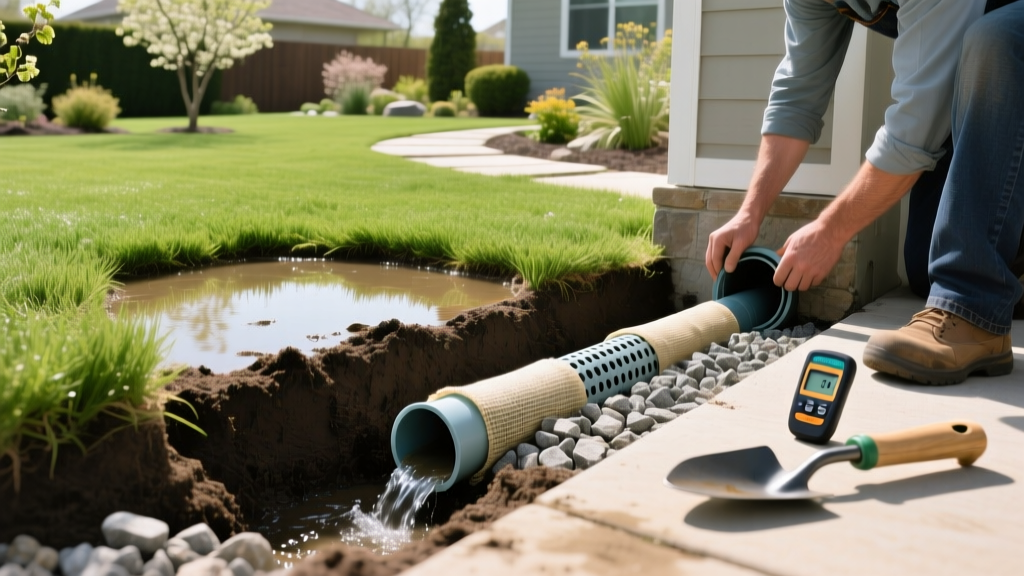
Diagnose Soggy Lawns: Which Yard Drainage System Actually Works?
The Diagnostic Framework: Identifying Your Water Failure Mode
Standing water in a lawn is rarely a single-issue problem; it is a symptom of failed hydrology. Before purchasing any pipe or gravel, you must identify exactly how water is entering the space and why it is failing to exit. Misdiagnosing the water source leads to expensive failures, such as installing a subsurface French drain to solve a surface grading issue. According to the University of Minnesota Extension, improper surface grading accounts for over 70% of residential basement moisture and lawn pooling issues, making it the critical first checkpoint in any drainage audit.
| Visual Symptom | Primary Cause | Diagnostic Test | Correct Yard Drainage System |
|---|---|---|---|
| Water pools against foundation after rain | Negative grading or settled backfill | Place a 4-foot level on soil; check for slope away from house | Surface regrading and swales |
| Lawn feels spongy; puddles form in low spots | High clay content; compacted subsurface hardpan | Dig a 12-inch test hole; fill with water and time the drainage | Subsurface French drain or deep core aeration |
| Gutter downspouts dump water that spreads across yard | High-volume point-source discharge | Calculate roof catchment area and observe flow path during a storm | Underground dry well or solid pipe daylighting |
| Water sheets across driveway or patio into the lawn | Hardscape surface runoff | Pour a 5-gallon bucket of water on the hardscape edge | Channel drains (trench drains) tied to a discharge point |
Matching the Problem to the Right Yard Drainage System
Once the failure mode is identified, select the engineered solution designed specifically for that hydraulic behavior. A yard drainage system is only effective if it intercepts the water at the correct elevation.
1. Subsurface Saturation: The French Drain
A French drain is designed to intercept the water table and relieve hydrostatic pressure in saturated soils. It does not efficiently capture surface puddles. If your soil percolation rate is slower than 1 inch per hour (heavy clay), a traditional gravel-and-pipe French drain is required.
- Materials: 4-inch Schedule 40 PVC (with drilled weep holes) or NDS EZ-Drain gravel-free pipe. Avoid single-wall corrugated ADS pipe for long-term installations; its ridges trap silt and tree roots easily penetrate the seams.
- Envelope: Wrap the pipe in 4 oz to 6 oz non-woven geotextile fabric. Never use woven landscape fabric, which clogs with fine clay particles within two seasons.
- Trench Specs: Minimum 12 inches wide and 18 inches deep. The trench must maintain a continuous 1% to 2% slope (1/8 to 1/4 inch drop per linear foot).
- Cost (2026): DIY installation runs $14 to $22 per linear foot. Professional installation averages $55 to $85 per linear foot, heavily dependent on soil type and utility obstacles.
2. High-Volume Point Source: Dry Well Systems
When a 1,500-square-foot roof section dumps 900+ gallons of water during a 1-inch rainstorm directly onto the lawn, a French drain will be overwhelmed. A dry well temporarily stores this massive volume and allows it to percolate slowly into the surrounding soil matrix.
- Product Spec: The NDS Flo-Well Dry Well System (Model #59202) holds up to 50 gallons per unit. For larger roofs, units can be daisy-chained or buried in a crushed stone bed.
- Placement Rule: Must be installed at least 10 feet away from building foundations to prevent undermining structural footings.
- Failure Mode: Dry wells fail catastrophically in heavy clay soils without a percolation test. If your soil cannot absorb the stored water within 24 hours, the dry well will overflow and create a localized swamp. In heavy clay, you must tie the dry well overflow to a solid-pipe daylighting system or a municipal storm drain.
CRITICAL SAFETY WARNING: Before digging any trench deeper than 12 inches, you are legally required to call 811 or submit an online request via Call811.com. Hitting an unmarked buried gas line, fiber optic cable, or electrical conduit can result in fatal injuries and tens of thousands of dollars in repair liabilities. Allow 2 to 3 business days for utility locators to mark your property.
3. Surface Sheet Flow: Grading and Swales
If water is flowing over the top of the soil (sheet flow), burying a pipe will not solve the problem. The EPA recommends managing surface runoff through natural grading and rain garden integration. A swale is a shallow, grass-lined depression engineered to direct surface water away from structures.
- Grading Metric: The first 10 feet of soil extending from your home's foundation must drop at least 6 inches (a 5% slope). This is the universal building code standard for foundation protection.
- Swale Construction: Minimum 2 feet wide with a gentle 1-inch drop per 10 feet of length. Line the swale with deep-rooted native grasses or riprap stone in high-velocity areas to prevent soil erosion during heavy downpours.
Hydraulic Sizing and Flow Rate Calculations
Sizing your yard drainage system requires basic hydrology math. Undersized pipes will bottleneck during peak storm events, causing water to back up and flood the lawn. Use the Rational Method formula adapted for residential catchment:
Runoff Volume (Gallons) = Catchment Area (sq. ft.) × Rainfall (inches) × 0.623
For example, a 1,200 sq. ft. roof section experiencing a 2-inch rainstorm generates 1,495 gallons of runoff. A standard 4-inch corrugated pipe flowing full can move roughly 15 gallons per minute at a 1% slope. To handle a 50-gallon-per-minute downspout discharge, a single 4-inch pipe is sufficient, but a 6-inch pipe is recommended if the run exceeds 50 linear feet to reduce friction loss.
Pipe Material Decision Matrix
| Pipe Type | Crush Rating | Best Application | Cost per 10-ft Stick |
|---|---|---|---|
| Single-Wall Corrugated (ADS) | Low (Prone to crushing) | Shallow lawn runs, no vehicle traffic | $12 - $16 |
| NDS EZ-Drain (Gravel-Free) | Medium | DIY French drains where gravel is inaccessible | $35 - $45 |
| SDR 35 PVC (Ribbed) | High (46 psi) | Deep trenches, under patios, main trunk lines | $28 - $35 |
| Schedule 40 PVC (Solid) | Very High | Under driveways, downspout extensions, daylighting | $18 - $25 |
Step-by-Step Trenching and Backfill Protocol
Proper installation prevents the system from silting in and failing within three years. Follow this exact sequence for subsurface trench drains:
- Excavation: Dig the trench to the required depth, maintaining a strict laser-level slope of 1/8 inch per foot toward the daylight point or dry well.
- Base Layer: Lay 2 inches of washed, angular drainage stone (3/4-inch crushed granite). Do not use rounded river rock, as it shifts and does not lock together, leading to pipe sagging.
- Fabric Lining: Drape the 6 oz non-woven geotextile fabric over the trench, allowing at least 12 inches of excess fabric to hang over both sides.
- Pipe Placement: Lay the perforated pipe with the holes facing down. This counterintuitive placement forces water to enter from the bottom and sides, keeping the top of the pipe clear of silt accumulation.
- Cover and Wrap: Cover the pipe with 4 inches of washed stone. Fold the excess fabric over the top of the stone, overlapping it by at least 6 inches to create a sealed envelope.
- Topsoil Cap: Add 3 to 4 inches of native topsoil and sod over the fabric to blend the trench into the lawn.
Daylighting and Terminal Discharge
A yard drainage system is useless without a verified termination point. The pipe must 'daylight' (exit the ground) at a lower elevation than the intake point. Terminate solid PVC discharge pipes with a pop-up drainage emitter (such as the NDS 4-in. Pop-Up Emitter). These devices remain flush and hidden in the lawn, only opening when water pressure pushes the lid up, which prevents rodents and lawn debris from entering and clogging the pipe from the outside.
If municipal storm drains are unavailable and daylighting topography is flat, you must transition to a subterranean dry well or an engineered rain garden planted with hydrophilic species like Joe-Pye Weed, Swamp Milkweed, and Blue Flag Iris, which can transpire up to 5 gallons of water per day per mature plant during the growing season.