
Home & Garden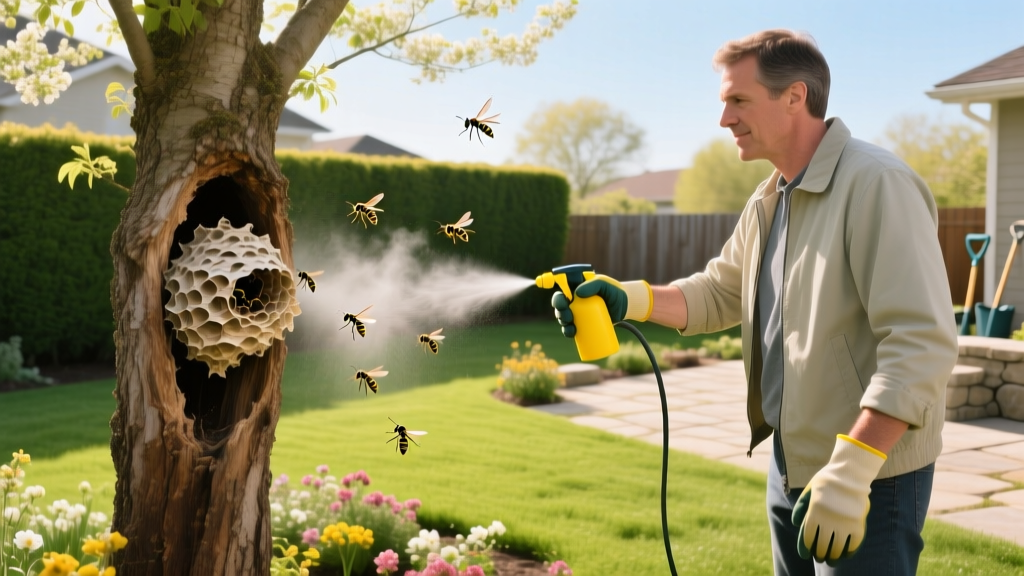
Yellowjacket Spray Guide: Diagnose Nests and Rescue Your Yard
Symptom Diagnosis: Identifying the Nest Type
Yellowjackets are highly defensive, and their nest architecture dictates the exact chemical formulation and application method required for a successful rescue fix. Spraying the wrong product into the wrong nest type is the leading cause of treatment failure and aggressive swarming. Before purchasing a yellowjacket spray, you must diagnose the nest location based on foraging flight patterns.
| Observed Symptom | Nest Diagnosis | Required Spray Type | Failure Risk if Misdiagnosed |
|---|---|---|---|
| Insects entering/exiting a bare patch of soil or rodent hole. | Subterranean Ground Nest | Insecticidal Dust or Expanding Foam | Liquid aerosols soak into soil, failing to reach deep chambers and agitating the colony. |
| Paper-like, football-shaped mass under eaves, decks, or shrubs. | Aerial / Exposed Nest | Jet-Stream Liquid Aerosol (15-27 ft range) | Foam is too heavy and may knock the nest down before the colony is neutralized. |
| Heavy traffic entering a crack in siding, soffit, or brick mortar. | Structural / Wall Void Nest | Insecticidal Dust applied via duster | Spraying liquid into the hole traps them inside, causing them to chew through drywall into living spaces. |
According to Penn State Extension, ground nests are particularly dangerous because the colony size can exceed 4,000 workers by late summer, and the nest entrance is easily obscured by grass, leading to accidental disturbance by lawnmowers.
Active Ingredient Breakdown: What to Buy
Not all yellowjacket sprays are created equal. The efficacy of a rescue fix depends entirely on the active ingredients and the delivery mechanism. Here is the technical breakdown of the top formulations available in 2026.
1. Rapid Knockdown Aerosols (Prallethrin + Cypermethrin)
For exposed aerial nests, you need immediate knockdown to prevent the guard wasps from sounding the alarm pheromone. Look for products combining Prallethrin (a fast-acting synthetic pyrethroid) and Cypermethrin (a slower-acting residual).
- Top Product: Spectracide Wasp & Hornet Killer 3 or Raid Wasp & Hornet 33.
- Cost: $5.50 - $8.00 per 14 oz can.
- Range: Up to 27 feet (jet-stream nozzle).
- Best For: Hanging eaves nests, second-story overhangs, and shrub nests.
The National Pesticide Information Center notes that Cypermethrin disrupts the insect nervous system, ensuring that any workers returning to the nest after the initial spray are eliminated by the residual coating.
2. Professional Expanding Foams (Alpine Wasp & Hornet)
Foams are critical for enclosed spaces where liquid cannot penetrate. The foam expands to fill voids, encapsulating the nest and trapping the insects inside the treated matrix.
- Top Product: Alpine Wasp & Hornet Foam Spray.
- Cost: $18.00 - $24.00 per 20 oz can.
- Range: 3 to 5 feet (extension wand required).
- Best For: Under-deck joists, attic vents, and dense shrubbery centers.
3. Insecticidal Dusts (Deltamethrin)
For ground nests and wall voids, liquid sprays are a liability. Dusts cling to the yellowjackets' legs and bodies as they enter the nest, carrying the poison deep into the colony chambers.
- Top Product: Delta Dust Insecticide (applied with a bellows hand duster).
- Cost: $25.00 - $35.00 per 1 lb container.
- Best For: Subterranean holes, weep holes, and structural cracks.
The Rescue Fix Protocol: Step-by-Step Application
Executing a rescue fix requires strict adherence to environmental timing and personal protective equipment (PPE). Yellowjackets rely heavily on visual cues to target threats; altering the conditions removes their tactical advantage.
⚠️ CRITICAL WARNING: Never seal a wall void or ground hole immediately after spraying. Yellowjackets need time to die off. Sealing the entrance prematurely will force the surviving colony to chew through interior drywall or find alternative exits into your home.
- Time the Attack: Apply treatments only between 9:00 PM and 11:00 PM, or just before dawn. At night, all foraging workers are inside the nest, and their metabolism and reaction times are severely diminished.
- Temperature Check: Ideal application occurs when ambient temperatures are below 55°F. Cold weather makes yellowjackets sluggish and less likely to swarm.
- Lighting Discipline: Do not shine a standard white LED flashlight directly at the nest. Yellowjackets are attracted to and agitated by white light. Use a red-lens filter or a headlamp with a red-light setting.
- PPE Requirements: Wear a bee veil, thick canvas jacket, leather gloves, and tuck your pants into your boots. Tape the gap between your gloves and sleeves.
- The Application Technique:
- For Aerosols: Stand at the maximum range (15+ feet). Aim for the bottom center of the nest where the primary entrance hole is located. Spray continuously for 5-8 seconds to saturate the entry point, then sweep the rest of the paper envelope.
- For Ground Nests: Puff the insecticidal dust directly into the hole using a hand duster. Do not pack the hole with dirt immediately. Leave it open for 48 hours.
- The Retreat: Back away slowly. Do not turn your back and run, as rapid movement triggers a pursuit response.
Troubleshooting: Why the Spray Failed
If you are still seeing heavy yellowjacket traffic 24 hours after your rescue fix, one of the following failure modes occurred:
Failure Mode 1: The Wind Drift
Symptom: The colony is highly agitated, and the nest is still active. Cause: You sprayed when wind speeds exceeded 5 mph. The jet-stream aerosol atomized in the air, coating the outside of the nest but failing to penetrate the interior chambers where the queen and brood reside. Fix: Wait 48 hours for the colony to calm down, check the wind forecast, and re-apply at dusk with zero wind.
Failure Mode 2: The Satellite Nest
Symptom: The treated nest is dead, but yellowjackets are still swarming the same general area. Cause: According to University of Minnesota Extension, yellowjackets often establish satellite nests within 20 to 50 feet of the primary colony, especially in favorable microclimates like under sheds or inside retaining walls. Fix: Conduct a daytime visual survey from a safe distance (50+ feet) to track flight paths and locate the secondary entrance. Treat the satellite nest using the same diagnostic matrix.
Failure Mode 3: The Scavenger Confusion
Symptom: Yellowjackets are swarming your patio or trash cans, but you cannot find a nest nearby. Cause: You are dealing with foraging scavengers, not a local nest defense. Spraying the air or the patio furniture is useless and leaves toxic residue on human surfaces. Fix: Abandon the spray. Deploy a commercial bait trap (like the Rescue! Yellowjacket Trap) baited with heptyl butyrate, placed at least 20 feet away from your seating area to draw the foragers away from your living space.
Post-Treatment Cleanup and Safety
Once 72 hours have passed and no activity is observed, it is safe to remove the nest. For aerial nests, use a long pole to knock the paper structure down. Submerge the nest in a bucket of soapy water for 24 hours before disposing of it in the trash to ensure any surviving pupae are drowned. For ground nests, fill the void with topsoil and overseed the bare patch to prevent future rodent or insect colonization. By matching the exact yellowjacket spray formulation to the specific nest architecture, you eliminate the threat safely without resorting to expensive professional extermination fees.