
Landscaping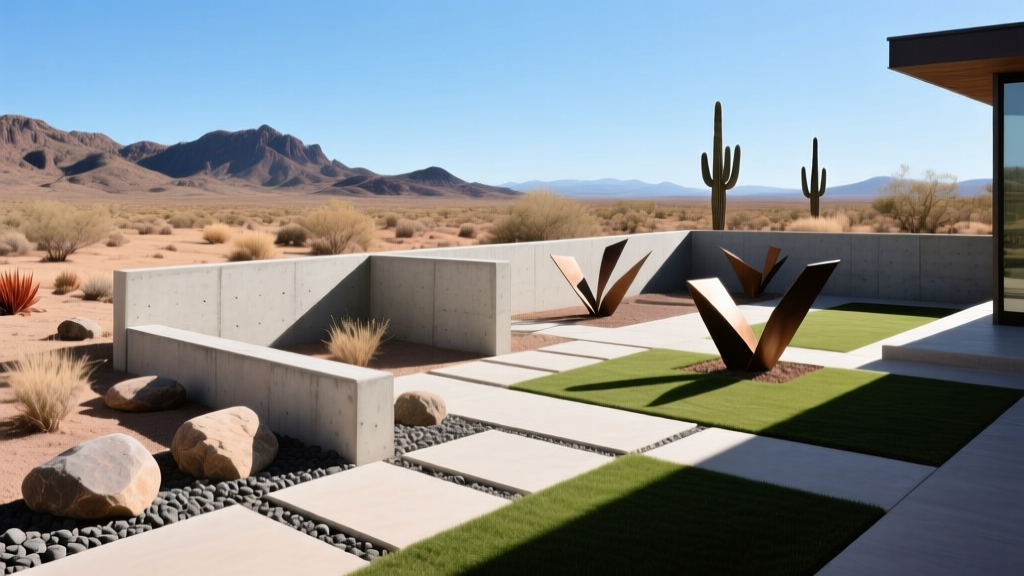
Firewise Landscaping Ideas With No Plants in Arizona
The Problem: Why 'Fire-Resistant' Plants Fail in Arizona's WUI
Homeowners in Arizona’s Wildland-Urban Interface (WUI)—from the ponderosa pine forests of Prescott to the chaparral zones of Sedona—are often sold a dangerous myth: that planting 'fire-resistant' vegetation creates a safe defensible space. Under extreme wind-driven ember storms, which can transport burning debris over a mile ahead of a fire front, these plants routinely fail. Species commonly marketed as drought-tolerant or fire-wise, such as juniper, rosemary, and coyote brush, contain high concentrations of volatile terpenes and resins. When subjected to direct ember impingement, these oils vaporize and ignite explosively.
The only foolproof solution for the immediate perimeter of your home is a zero-plant hardscape design. By eliminating organic fuel sources entirely and relying on non-combustible materials, you remove the ignition vectors that cause 90% of structure losses in wildfires. According to the Insurance Institute for Business & Home Safety (IBHS), the critical 0-to-5-foot zone around a structure must be completely free of combustible vegetation and mulch to survive modern megafires.
⚠️ Diagnosis Alert: The Mulch Wick Effect
Many Arizona homeowners replace plants with organic wood chips or rubber mulch. Rubber mulch melts at 350°F and burns at 500°F, creating a toxic, high-heat liquid fuel that flows directly against home foundations. Wood chips act as a wick, holding embers and smoldering for hours before igniting adjacent siding.
Zero-Plant Hardscape Solutions for Zone 0 and Zone 1
Designing a yard with no plants does not mean pouring a sterile concrete slab. Modern firewise landscaping utilizes varied textures, permeable surfaces, and topographical changes to create visual interest while maintaining a Class A fire rating.
1. Compacted Decomposed Granite (DG)
Decomposed granite is the cornerstone of Arizona zero-plant landscaping. However, specification matters. You must order '3/4-inch minus' DG, which includes the fine rock dust (fines) necessary for mechanical interlocking. If you use '3/4-inch clean' (washed rock without fines), the stones will remain loose. Loose gravel creates micro-depressions where wind-blown pine needles and dry grass accumulate, inadvertently creating localized fuel beds.
- Installation Depth: 3 inches compacted over a 1-inch base of crushed road base.
- Compaction Requirement: Must be vibratory-plate compacted at optimum moisture content (usually 8-10%) to achieve a hard, concrete-like surface that repels water and resists wind-scouring.
- 2026 Cost Estimate: $75 to $95 per ton for material; $2.50 to $4.00 per square foot installed.
2. Permeable Interlocking Concrete Pavers (PICP)
For patios and walkways where a solid surface is desired, PICP systems offer superior drainage and a non-combustible footprint. Look for pavers rated under ASTM C936. Unlike poured concrete, which cracks under Arizona’s expansive clay soils and extreme thermal expansion, pavers flex. The joints should be filled with ASTM C33 concrete sand rather than polymeric sand, which can degrade under UV exposure and harbor weed seeds that introduce organic fuel into the hardscape.
3. Mortared Flagstone and Cobble Swales
To manage water runoff without plants, incorporate dry creek beds lined with 3-to-5-inch river cobble set in mortar. Mortaring the cobbles prevents them from shifting and stops organic debris from wedging between the rocks. Pair this with large, standalone limestone or basalt boulders (minimum 24-inch diameter) to provide the vertical mass and architectural anchoring that shrubs would normally supply.
Material Comparison & Decision Matrix
Selecting the right non-combustible material depends on your budget, drainage needs, and aesthetic preferences. Use this matrix to evaluate options for your Arizona property.
| Material | Fire Rating | Installed Cost (2026) | Permeability | Debris Trap Risk | Best Application |
|---|---|---|---|---|---|
| 3/4' Minus DG (Compacted) | Class A | $2.50 - $4.00 / sq ft | Low (when sealed) | Low | Primary ground cover, wide pathways |
| PICP Pavers | Class A | $14.00 - $19.00 / sq ft | High | Medium (joints) | Patios, driveways, entertainment zones |
| 3/4' Crushed Red Lava Rock | Class A | $3.50 - $5.50 / sq ft | High | High (porous surface) | Accent borders, deep drainage swales |
| Mortared Flagstone | Class A | $22.00 - $30.00 / sq ft | None | Very Low | High-traffic walkways, immediate foundation |
| River Cobble (Mortared) | Class A | $18.00 - $25.00 / sq ft | Low | Low | Dry creek beds, erosion control channels |
Step-by-Step Installation: Building the Non-Combustible Perimeter
A zero-plant landscape will fail if the underlying preparation introduces hidden combustibles. Follow this exact sequence to ensure structural integrity and fire safety.
- Excavation and Grading: Excavate the top 4 inches of soil. Grade the soil away from the foundation at a minimum 2% slope (1/4 inch per foot) to direct water away from the structure.
- Geotextile Selection (Critical Step): Lay a 4 oz non-woven polyester geotextile fabric. Do NOT use standard woven polypropylene weed barrier. Polypropylene melts at 320°F; if an ember lands on exposed fabric edges, it will melt, shrink, and create a wick that pulls fire under the gravel. Polyester has a much higher melting point and will not wick flame.
- Steel Edging Installation: Install 14-gauge Cor-Ten steel landscape edging to contain the DG and rock. Cor-Ten steel develops a protective rust patina and will not combust, warp, or melt like plastic or aluminum edging. Secure with 18-inch steel pins driven every 4 feet. Expect to pay $8 to $12 per linear foot for professional installation.
- Base and Surface Layering: Apply a 1-inch layer of crushed road base, compact it, then apply 2 inches of 3/4-inch minus DG. Wet the DG lightly and run a vibratory plate compactor over the surface in two perpendicular passes.
Solving the Aesthetic Deficit: Designing Without Flora
The primary objection to zero-plant landscaping is the 'barren' or 'commercial' aesthetic. You can solve this by introducing non-combustible architectural elements and topographical variance.
- Topographical Berming: Instead of planting tall shrubs for privacy, build structural berms using compacted DG and retain them with stacked, dry-laid basalt retaining walls. This creates vertical interest and breaks up the flat plane of the yard.
- Corten Steel Water Features: Incorporate standalone Corten steel water bowls or sheer descent waterfalls. The moving water provides ambient noise and local humidity, while the steel housing remains entirely fireproof.
- Hardscape Lighting: Use low-voltage LED hardscape lights housed in solid brass or copper fixtures. Avoid plastic or composite light housings, which can melt under direct ember exposure and ignite the wiring insulation. Mount brass well-lights directly into the flagstone or DG to illuminate the boulders at night.
'The goal of Firewise landscaping in the WUI is not just to choose plants that burn slower, but to eliminate the continuous fuel bed that allows fire to reach the structure. Hardscaping the immediate 5-foot zone is the single most cost-effective retrofit a homeowner can undertake.' — National Fire Protection Association (NFPA) Firewise Guidelines
Troubleshooting: The Hidden Flaw of Gravel Landscapes
Zero-plant landscapes introduce a specific maintenance vulnerability: the gravel trap. Wind-blown debris (pine needles, oak leaves, tumbleweeds) will inevitably settle into the interstitial spaces of crushed rock and lava stone. If left unmanaged, this debris dries out and becomes highly receptive to ember ignition.
The Maintenance Protocol
You cannot rely on raking to clean crushed rock; rakes will displace the stones and expose the geotextile fabric. Instead, implement a pneumatic maintenance protocol:
- Equipment: Invest in a commercial-grade backpack blower (e.g., Stihl BR 800 X Magnum or Echo PB-9010) with a minimum of 40 Newtons of blowing force. Handheld blowers lack the torque to dislodge debris wedged in 3/4-inch rock.
- Frequency: During peak fire season (May through July in Arizona), blow the entire hardscape perimeter weekly. After heavy monsoon winds, perform an immediate inspection and clearing.
- Edge Clearing: Pay special attention to the intersection where the hardscape meets the home's siding or stucco. Debris naturally accumulates in these 90-degree corners. Use a crevice tool or a stiff-bristled nylon brush to manually clear these zones if the blower cannot dislodge compacted needles.
By diagnosing the failure points of traditional 'fire-resistant' planting and executing a rigorously specified zero-plant hardscape, Arizona homeowners can create a defensible space that is both architecturally striking and fundamentally immune to ember ignition. For further reading on establishing defensible space zones beyond the hardscape perimeter, consult the USDA Forest Service wildfire management resources.

