
Landscaping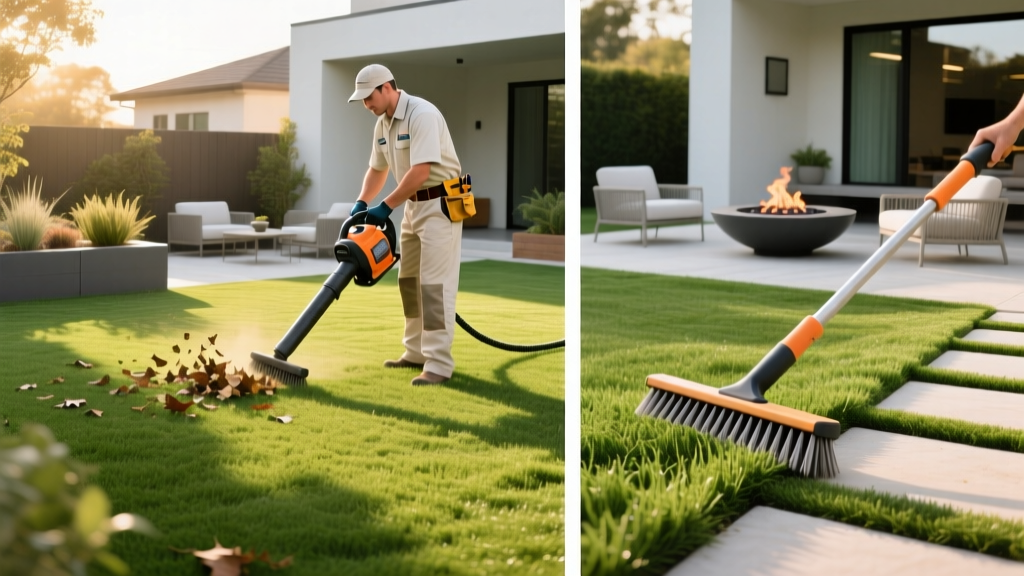
Step-by-Step Maintenance for an Artificial Grass Backyard
Synthetic turf eliminates mowing, edging, and irrigation, but it is fundamentally incorrect to classify it as maintenance-free. Without a structured, proactive regimen, UV degradation, fiber matting, and bacterial buildup will compromise a $12,000 to $18,000 installation within three to five years. Proper upkeep preserves the 60-ounce face weight of the yarn, ensures the backing continues to drain at rates exceeding 30 inches per hour, and keeps the infill properly distributed.
The following procedures outline the exact mechanical and chemical steps required to maintain an artificial grass backyard in peak condition, based on current industry standards and manufacturer warranties.
The Core Maintenance Calendar
Maintenance frequency scales directly with foot traffic, pet usage, and regional foliage. Use this baseline matrix to schedule your annual upkeep.
| Frequency | Procedure | Primary Equipment | Time Required (per 500 sq ft) |
|---|---|---|---|
| Weekly | Debris removal and surface rinsing | Leaf blower, poly-fan rake | 10–15 minutes |
| Monthly | Fiber revitalization and brushing | Power brush, stiff nylon broom | 30–45 minutes |
| Bi-Annually | Weed prevention and edge treatment | Pre-emergent herbicide, edge trimmer | 20 minutes |
| Annually | Infill top-up and drainage inspection | Drop spreader, zeolite/silica sand | 1–2 hours |
Step 1: Surface Debris Removal and Rinsing
Organic debris—leaves, pine needles, and twigs—traps moisture against the turf backing. Over time, this decomposes into a sludge layer that blocks the perforated drainage holes and creates a breeding ground for anaerobic bacteria.
Execution Protocol
- Blowing: Use a backpack or handheld leaf blower (e.g., STIHL BG 56 producing 400 CFM) to clear loose debris. Always blow in a single direction, working from the center of the yard toward the perimeter.
- Raking: If debris is matted down, use a turf-specific poly-fan rake. Never use metal tines or wire rakes. Metal will slice the polyethylene yarn and tear the primary backing, voiding most manufacturer warranties.
- Rinsing: Once a month, hose down the surface with a standard garden nozzle set to a 'flat' or 'shower' spray. Avoid high-pressure power washers (above 1,500 PSI), as the concentrated stream will blast the infill out of the turf pile and displace the base aggregate.
Step 2: Fiber Revitalization and Brushing
Synthetic grass blades will naturally lean and mat down in high-traffic zones, particularly along walkways and near patio furniture. Brushing stands the fibers back up and redistributes the infill, which is critical for keeping the blades upright and protecting them from direct UV radiation.
Manual vs. Power Brushing
For small areas under 200 square feet, a stiff-bristled nylon push broom works adequately. Brush against the natural grain of the turf installation. For larger spaces, a mechanical power brush is mandatory for effective penetration.
Expert Specification: Use a dedicated turf power brush like the Billy Goat LB351 or a rotary brush attachment for a weed whacker. Set the brush depth so the bristles penetrate the infill layer by exactly 0.5 inches. Going deeper will drag the aggregate base to the surface; going shallower will fail to lift the root-level matting.
Step 3: Weed Prevention and Edge Management
While the woven backing of high-quality artificial turf blocks most weed growth, the perimeter edges and the occasional gap between seams are highly vulnerable. Wind-blown seeds can also germinate in the organic dust that settles on top of the infill.
To manage this without damaging the synthetic fibers, apply a granular pre-emergent herbicide containing dithiopyr (such as Dimension 2EW) in early spring and late fall. This prevents weed seeds from germinating without harming the turf. For existing weeds pushing through the edges, manual extraction is required. Pull the weed from the root, and apply a targeted spot-treatment of a post-emergent herbicide, taking care to follow EPA guidelines for safe pest and weed control to prevent chemical runoff into adjacent soil beds.
Step 4: Pet Waste Management and Enzyme Treatment
If dogs use the artificial grass backyard, urine will seep through the backing into the crushed rock base. As the liquid evaporates, it leaves behind uric acid crystals that emit a strong ammonia odor, especially when heated by the sun. Standard water rinsing will not dissolve these crystals.
The Enzymatic Neutralization Process
- Solid Waste: Remove solid waste immediately using a standard pooper-scooper. Rinse the spot with water.
- Enzyme Application: Use a live-enzyme turf deodorizer (e.g., Turfresh Bio-O or Simple Green Outdoor Odor Eliminator). These products contain bacteria that literally consume the uric acid crystals.
- Dilution and Soaking: Dilute the concentrate at a 10:1 ratio (water to enzyme) in a pump sprayer. Apply heavily to the affected zones, ensuring the liquid penetrates through the turf and into the base layer. Allow it to soak for 15 minutes before lightly rinsing.
Step 5: Infill Replenishment and Drainage Checks
Infill is the unsung hero of synthetic turf. It weighs down the backing, protects the primary latex/polyurethane coating from UV rays, and provides cushioning. Over time, infill migrates due to rain, foot traffic, and pet digging.
Inspect the infill levels annually. The top of the infill should sit roughly 0.5 to 0.75 inches below the tip of the grass blades. If the backing is visible, you must top it up.
Choosing the Right Top-Up Material
- Rounded Silica Sand (30-50 mesh): The most cost-effective option ($12–$18 per 50lb bag). It provides excellent ballast but offers no odor control.
- Zeolite: A natural volcanic ash mineral ($35–$45 per 50lb bag). Zeolite has a massive porous surface area that traps ammonia molecules, making it the mandatory choice for artificial grass backyards with heavy pet usage.
- Antimicrobial Acrylic (e.g., Envirofill): Premium option ($50+ per 50lb bag). Best for playgrounds and high-impact zones due to its shock-absorption properties.
Apply the new infill using a standard drop spreader, followed immediately by a power brushing session to work the granules down to the backing.
Troubleshooting Common Artificial Turf Issues
| Symptom | Root Cause | Corrective Action |
|---|---|---|
| Water pooling in specific zones | Base aggregate (Class II road base) has settled or compacted unevenly, or drainage holes are clogged with organic sludge. | Lift the turf in the affected area, re-grade the base with crushed drain rock, and tamp to a 95% compaction rate before re-laying. |
| Seams separating or lifting | Adhesive failure due to moisture during installation, or thermal expansion/contraction without adequate seaming tape. | Clean the backing with isopropyl alcohol, apply a two-part polyurethane turf adhesive to a 12-inch seaming tape, and weigh down with 50lb sandbags for 24 hours. |
| Fibers look flat despite brushing | Severe infill depletion or UV degradation of the polyethylene yarn (common in cheap, non-UV-stabilized imports). | Top up infill immediately. If fibers crumble when bent, the turf has reached end-of-life and requires replacement. |
Estimated Annual Maintenance Costs (2026 Pricing)
While the water conservation benefits of synthetic turf are well documented, homeowners must budget for mechanical upkeep. Below is the average annual cost to maintain a 500-square-foot artificial grass backyard.
DIY Maintenance Budget: $85 – $140 per year
(Includes: 4 bags of silica sand/zeolite, 1 gallon of enzyme cleaner, pre-emergent herbicide, and fuel for equipment).
Professional Service Budget: $450 – $750 per year
(Includes: 4 quarterly visits for power brushing, deep rinsing, infill leveling, and antimicrobial treatments by a licensed turf specialist).
(Includes: 4 bags of silica sand/zeolite, 1 gallon of enzyme cleaner, pre-emergent herbicide, and fuel for equipment).
Professional Service Budget: $450 – $750 per year
(Includes: 4 quarterly visits for power brushing, deep rinsing, infill leveling, and antimicrobial treatments by a licensed turf specialist).
Adhering to these specific mechanical and chemical protocols ensures the structural integrity of the turf system. For comprehensive warranty compliance and advanced testing metrics, always cross-reference your specific product's documentation with the Synthetic Turf Council's official maintenance standards.

