
Landscaping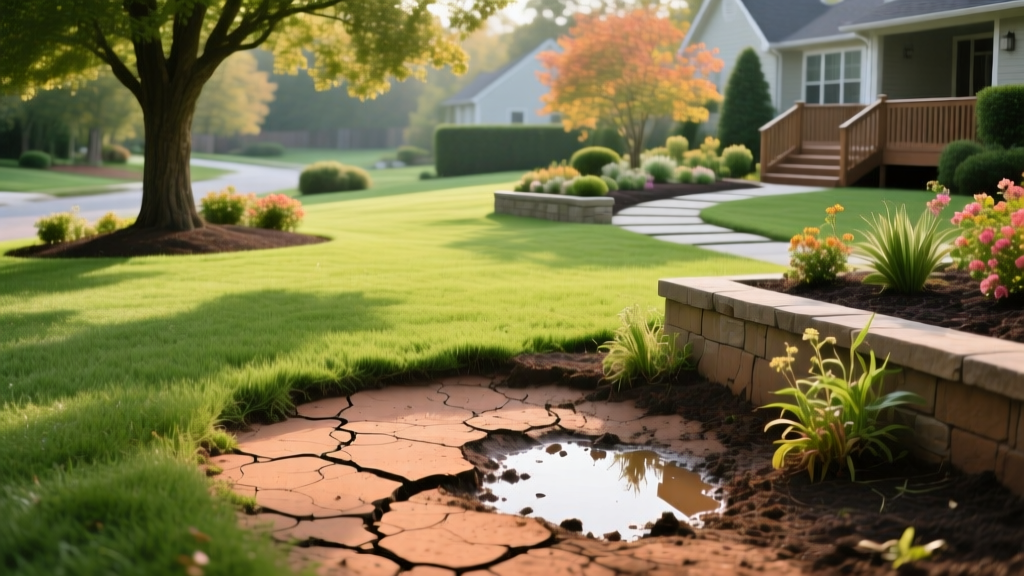
Atlanta GA Landscape Troubleshooting: Fixing Clay Soil and Drainage
The Diagnostic Matrix: Symptom to Solution
Landscaping in the Atlanta metropolitan area requires navigating the unique constraints of the Piedmont region. The combination of Cecil and Appling soil series (dense red clay), high summer humidity, and sudden torrential microbursts creates a specific set of failure modes that generic landscaping advice cannot solve. Below is a rapid diagnostic matrix to identify your yard's primary stressors before investing in amendments or hardscapes.
| Observed Symptom | Root Cause in Atlanta Soil/Climate | Targeted Protocol |
|---|---|---|
| Water pooling >24 hours after rain | Hardpan clay layer blocking percolation | Deep-tine aeration + expanded shale amendment |
| Mulch washing into street or gullies forming | Insufficient swale grading & high runoff velocity | Install NDS 12-inch catch basin + SDR 35 PVC pipe |
| Tall Fescue browning in July/August | Rhizoctonia solani (Brown Patch) fueled by humidity | Apply Azoxystrobin + shift irrigation to 4:00 AM |
| Hydrangeas and Dogwoods showing chlorosis (yellowing) | Iron lockout due to alkaline shifts or compacted roots | Chelated iron drench + vertical mulching |
Problem 1: Piedmont Red Clay Compaction & Nutrient Lockout
Why Atlanta Clay Fails Standard Plantings
The native red clay in Atlanta is predominantly part of the Cecil soil series. While it possesses a high Cation Exchange Capacity (CEC)—meaning it can theoretically hold abundant nutrients—the microscopic clay particles bind tightly together, creating an anaerobic environment that suffocates roots and locks out vital micronutrients. Furthermore, native Atlanta soil typically rests at a pH of 5.0 to 5.5, which is too acidic for optimal turfgrass and many ornamental shrubs.
The 2026 Protocol for Clay Amendment
According to soil management guidelines from the University of Georgia Extension, simply tilling the soil is insufficient and often worsens compaction by creating a 'cloddy' hardpan layer beneath the tilled zone. The correct rehabilitation sequence requires chemical and structural intervention:
- Soil Testing: Pull 10 core samples at a 4-inch depth. Send to the UGA Soil, Plant, and Water Lab to determine exact lime requirements.
- pH Correction: Apply pelletized dolomitic lime (which adds both calcium and magnesium) at the prescribed rate, typically 25-50 lbs per 1,000 sq ft.
- Structural Fracturing: Use a deep-tine aerator to pull 3-inch to 4-inch cores. Leave the cores on the lawn to break down.
- Porosity Amendment: Topdress with expanded shale (often sold under the brand name Permatill) and screened pine bark compost. Expanded shale permanently fractures clay density without breaking down over time.
⚠️ CRITICAL WARNING: The Sand Myth
Never add masonry sand or play sand to Atlanta red clay in an attempt to improve drainage. The Clemson Home & Garden Information Center explicitly warns that mixing sand into heavy clay without achieving a minimum 75% sand-to-clay ratio will create a concrete-like matrix that is entirely impermeable to water and roots.
Problem 2: Erosion from Sudden Torrential Downpours
Atlanta averages roughly 50 inches of rainfall annually, but the distribution is highly erratic. Summer thunderstorms can drop 2 inches of rain in 45 minutes. If your yard has even a 2% slope, this volume of water will strip topsoil, wash out mulch beds, and undermine retaining walls.
Sizing and Specifying a French Drain for Atlanta Storms
Standard hardware store corrugated black pipe is a primary failure point in Atlanta landscapes. The ridges inside corrugated pipe trap red clay silt, leading to total occlusion within 24 to 36 months. For a permanent solution, specify the following materials:
- Pipe: 4-inch SDR 35 smooth-wall PVC. The smooth interior allows clay silt to flush through during high-flow events.
- Catch Basins: NDS 12-inch x 12-inch square catch basins with atrium grates placed at the lowest topographical points of the yard.
- Envelope: Wrap the perforated pipe sections in non-woven geotextile fabric (minimum 4 oz per square yard). Do not use woven landscape fabric, which clogs instantly with fine clay particles.
- Backfill: Use washed 3/4-inch crushed stone. Never use 'crusher run' or gravel with fines, as the dust will wash into the pipe and cement itself inside the PVC.
- Gradient: Maintain a minimum slope of 1/8 inch per foot (1% grade) to ensure self-cleaning water velocity.
Problem 3: Humidity-Driven Fungal Pathogens
Atlanta's summer microclimate features nighttime temperatures that rarely drop below 72°F, combined with 80%+ humidity. This creates an incubator for Rhizoctonia solani (Brown Patch) in Tall Fescue lawns, and Powdery Mildew on flowering Dogwoods and Crape Myrtles.
Targeted Fungicide Rotation Strategy
Over-reliance on a single chemical class leads to rapid pathogen resistance. Professional landscape managers in the Southeast utilize a strict rotation protocol during the high-risk months of June through August:
| Active Ingredient | Product Example | Application Rate (per 1,000 sq ft) | FRAC Group |
|---|---|---|---|
| Azoxystrobin | Heritage TL / Scotts DiseaseEx | 0.4 oz (preventative) / 0.77 oz (curative) | Group 11 |
| Propiconazole | Banner Maxx / Honor Guard | 0.5 to 0.7 oz | Group 3 |
| Fluoxastrobin | Disarm | 0.15 to 0.36 oz | Group 11 |
Expert Insight: Fungicides will fail if your irrigation schedule contradicts the chemistry. Watering Tall Fescue in the evening leaves the leaf blade wet for 10+ hours, guaranteeing fungal germination. Program your smart controller to water between 4:00 AM and 6:00 AM, allowing the grass canopy to dry completely by mid-morning.
2026 Atlanta Landscape Repair Cost Guide
Budgeting for landscape remediation requires accurate, localized pricing. The costs below reflect current 2026 rates for licensed and insured landscape contractors operating within the I-285 perimeter and immediate northern suburbs (Sandy Springs, Alpharetta, Marietta).
| Remediation Service | 2026 Average Cost | Critical Specifications to Verify |
|---|---|---|
| Core Aeration (per 5,000 sq ft) | $180 - $250 | Must pull 3-inch minimum plugs; hollow tines only. |
| SDR 35 French Drain Install | $45 - $65 per linear ft | Includes trenching, SDR 35 PVC, washed stone, and geotextile. |
| Segmental Retaining Wall | $55 - $85 per sq ft of face | Requires 6-inch compacted base, geogrid for walls >3ft, and clean stone backfill. |
| Compost Topdressing | $350 - $500 per 5,000 sq ft | Compost must be screened to 3/8 inch and tested for heavy metals/salts. |
| Smart Irrigation Controller Upgrade | $250 - $400 (installed) | Includes Rachio 3 or Hunter Hydrawise with local weather API integration. |
Final Verification Steps
Before signing a landscape contract in Atlanta, require the contractor to provide a soil test report and a drainage plan that explicitly lists SDR 35 PVC rather than generic 'drain pipe'. Addressing the subterranean clay and water management issues first ensures that any subsequent investments in patios, pergolas, or premium plantings will not be destroyed by shifting soil or hydrostatic pressure.

