
Landscaping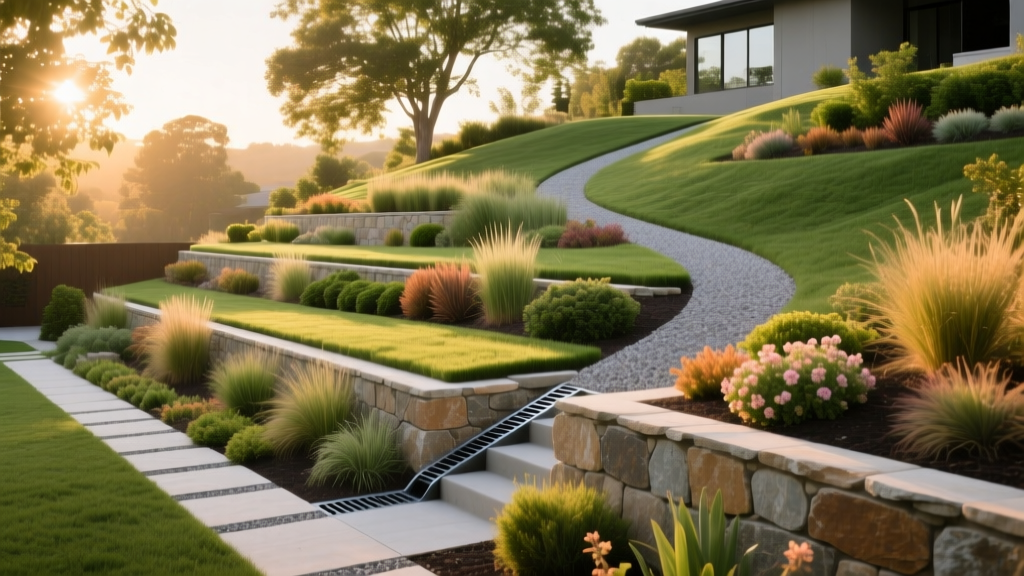
Backyard Slope Landscaping Ideas to Fix Erosion and Drainage
Sloped backyards present two distinct engineering challenges: rapid soil erosion and unmanaged hydrostatic pressure. When left unmitigated, a 15% grade can lose up to 5 tons of topsoil per acre annually, stripping nutrients and destabilizing foundations. Effective slope management requires moving beyond superficial aesthetic fixes to implement structural and botanical interventions. By analyzing the specific gradient, soil composition, and water table of your property, you can deploy targeted backyard slope landscaping ideas that permanently stabilize the terrain while creating usable outdoor living space.
The Slope Severity Matrix: Choosing Your Strategy
Not all slopes require the same intervention. The correct landscaping approach depends entirely on the gradient percentage, which you can calculate by dividing the vertical rise by the horizontal run, then multiplying by 100. Use the matrix below to determine the structural requirements for your specific site conditions.
| Slope Gradient | Primary Challenge | Recommended Landscaping Solution | Est. Cost (2026) |
|---|---|---|---|
| < 10% | Surface runoff, minor sheet erosion | Deep-rooted groundcovers, dry creek beds | $2 - $8 / sq. ft. |
| 10% - 33% | Soil slippage, unusable yard space | Terracing, segmental retaining walls, swales | $15 - $35 / sq. ft. |
| > 33% | Severe erosion, structural collapse risk | Engineered riprap, gabion walls, structural piles | $40 - $85+ / sq. ft. |
Terracing and Retaining Walls: Engineering Usable Space
For slopes between 10% and 33%, terracing is the most effective method to convert unusable inclines into flat, functional zones. While treated timber was historically popular for budget retaining walls, it degrades within 15 to 20 years and is no longer recommended for permanent slope stabilization. Modern landscaping relies on Segmental Retaining Wall (SRW) blocks or natural stone.
Material Selection and Installation Specs
- Segmental Concrete Blocks (e.g., Allan Block Classic, Versa-Lok): Costing $15 to $25 per square foot installed, SRWs feature a pinning system or lip that locks courses together. They require a compacted base of 6 to 8 inches of 3/4-inch aggregate.
- Natural Stone (Limestone, Granite): Priced at $30 to $45 per square foot. Stone requires a concrete footing or a heavily compacted gravel base and skilled masonry to ensure level coursing.
- Corten Steel Planters: For modern designs, 3/16-inch thick Corten steel edging can be staked into slopes to create raised terraces. It costs $20 to $30 per linear foot and develops a protective rust patina that prevents structural degradation.
CRITICAL WARNING: Hydrostatic Pressure
The number one cause of retaining wall failure is hydrostatic pressure—water trapped in the soil behind the wall pushing outward. A wall holding back saturated soil experiences up to 10 times more lateral pressure than one holding back dry soil. You must install a minimum 12-inch layer of washed drain rock directly behind the wall blocks and incorporate weep holes every 4 to 6 feet to allow water to escape.
The number one cause of retaining wall failure is hydrostatic pressure—water trapped in the soil behind the wall pushing outward. A wall holding back saturated soil experiences up to 10 times more lateral pressure than one holding back dry soil. You must install a minimum 12-inch layer of washed drain rock directly behind the wall blocks and incorporate weep holes every 4 to 6 feet to allow water to escape.
For any retaining wall exceeding 4 feet in height (measured from the bottom of the base course to the top of the wall), local building codes universally require geogrid reinforcement and a stamped engineering plan. Geogrids, such as Tensar or Mirafi synthetic meshes, are layered between block courses and extended back into the compacted soil to tie the wall face to the earth mass.
Plant-Based Erosion Control: Deep-Rooted Groundcovers
For gentle slopes under 10%, or the faces of terraced retaining walls, botanical stabilization is highly effective. According to the USDA Natural Resources Conservation Service, specific plant root architectures act as living rebar, binding soil particles together. Avoid shallow-rooted turfgrass like Kentucky Bluegrass, which offers minimal slope stabilization.
Top Botanical Choices for Slopes
- Vetiver Grass (Chrysopogon zizanioides): The gold standard for steep slope stabilization. Vetiver roots grow straight down, reaching depths of 10 to 12 feet within the first year. Plant in staggered rows spaced 12 to 18 inches apart.
- Creeping Juniper (Juniperus horizontalis 'Blue Rug'): Ideal for full-sun slopes. It forms a dense, weed-choking mat with roots penetrating 2 to 3 feet deep. Space plants 3 to 4 feet apart; they will merge into a solid carpet within two growing seasons.
- Japanese Spurge (Pachysandra terminalis): The premier choice for heavily shaded slopes where juniper will fail. Plant 6 inches apart in a staggered grid. Requires consistent moisture during the first 12 months to establish.
As noted by the Arbor Day Foundation, integrating deep-rooted native shrubs like Red Osier Dogwood (Cornus sericea) at the base of a slope can further intercept groundwater and prevent basal erosion.
French Drains and Swales: Managing the Water Table
Landscaping a slope without addressing water routing is a temporary fix. If water pools at the top of your slope or cascades unchecked down the middle, you must install interception drains or swales.
Step-by-Step Sloped French Drain Installation
- Trench Excavation: Dig a trench 18 to 24 inches deep and 12 inches wide. Ensure the trench follows a minimum 1% slope (a 1-inch drop for every 8 feet of run) toward a safe discharge point like a municipal storm drain or dry well.
- Pipe Selection: Use rigid 4-inch SDR 35 perforated PVC pipe. Never use flexible black corrugated pipe on slopes; the ridges trap sediment, and the flexible walls easily crush under the weight of saturated clay backfill.
- Fabric Wrapping: Wrap the pipe in non-woven geotextile fabric (minimum 4 oz per square yard). Do not use woven landscape fabric, which clogs with fine silt and restricts water flow.
- Backfill: Surround the pipe with 3/4-inch washed clear stone (no fines or stone dust). Fill to 2 inches below the surface grade, then cap with a layer of topsoil or decorative river rock.
Pro-Tip: Swale Integration
If your slope suffers from high-velocity surface runoff, pair your French drain with a shallow, grass-lined swale (a gently sloped ditch). Line the swale with erosion control blankets (ECBs) made of biodegradable coconut coir until the turf or groundcover establishes.
If your slope suffers from high-velocity surface runoff, pair your French drain with a shallow, grass-lined swale (a gently sloped ditch). Line the swale with erosion control blankets (ECBs) made of biodegradable coconut coir until the turf or groundcover establishes.
Common Slope Landscaping Failures (And How to Avoid Them)
Even well-funded projects fail when contractors ignore soil mechanics. Avoid these frequent edge-case mistakes:
- Using Native Clay as Backfill: Expansive clay soils absorb water and swell, exerting massive pressure on retaining walls. Always excavate native clay and replace the backfill zone immediately behind a wall with free-draining gravel or sandy loam.
- Oversaturating the Slope with Irrigation: Installing standard rotary sprinklers on a steep grade causes rapid runoff before the soil can absorb the moisture. Use low-volume drip irrigation (0.5 to 1.0 GPH emitters) placed directly at the root zone of slope plantings to prevent surface washing.
- Ignoring the 'Toe' of the Slope: Erosion often starts at the bottom (the toe) of the slope and works its way up. If the toe is not armored with riprap, a retaining wall, or deep-rooted shrubs, the entire slope can unravel from the bottom up.
According to the Environmental Protection Agency (EPA), soil degradation from unchecked erosion severely impacts local watersheds by introducing sediment and attached fertilizers into municipal water systems. By implementing structural terracing, rigid drainage piping, and deep-rooted botanical anchors, you not only reclaim your backyard space but also contribute to localized environmental stability.

