
Landscaping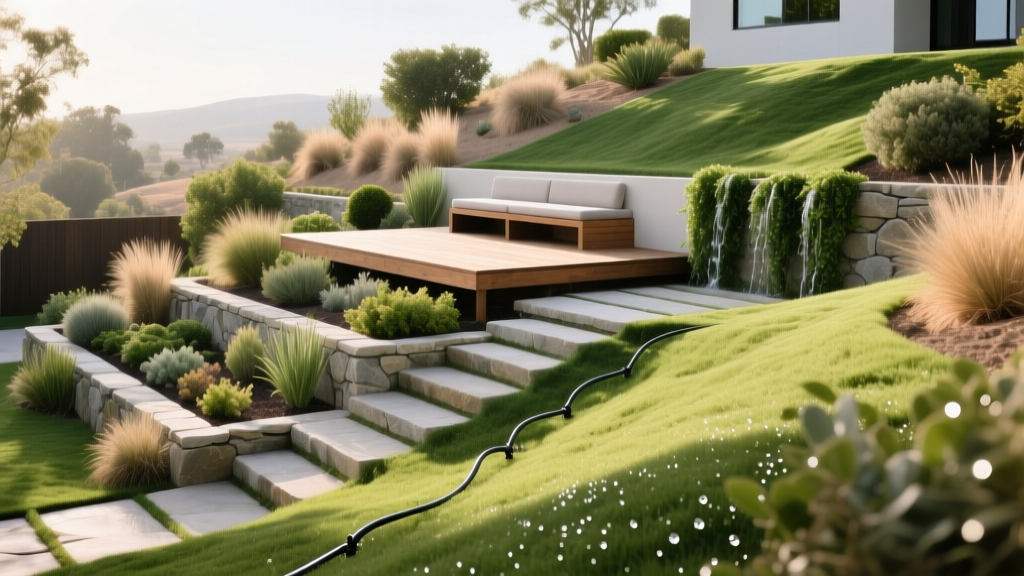
Top Backyard Landscaping Ideas for Sloped Yards: A Beginner Guide
Assessing Your Slope Gradient
When evaluating backyard landscaping ideas for sloped yards, the first step is calculating your exact gradient. Slope percentage dictates which engineering and planting strategies will actually hold up against gravity and water runoff. To calculate this, measure the vertical rise and the horizontal run, then divide the rise by the run and multiply by 100.
| Slope Gradient | Erosion Risk | Recommended Strategy |
|---|---|---|
| Under 10% | Low | Deep-rooted groundcovers, mulch, gentle grading |
| 10% to 30% | Moderate | Terracing, retaining walls, winding pathways, dry creek beds |
| Over 30% | Severe | Engineered segmental retaining walls, structural steps, riprap |
According to the USDA Natural Resources Conservation Service, slopes exceeding 15% begin to experience significant topsoil displacement during heavy rainfall if left unprotected. Choosing the right intervention based on your specific gradient prevents costly washouts and foundation damage.
Terracing with Segmental Retaining Walls
For slopes between 15% and 40%, terracing converts unusable inclines into flat, functional planting zones or patio spaces. Segmental retaining wall (SRW) blocks are the industry standard for DIY and professional terracing because they interlock without mortar, allowing for slight ground movement and natural drainage.
Material Selection and Installation Specs
Opt for high-density concrete blocks like the Allan Block Europa Collection or Versa-Lok Standard. As of 2026, these SRW units typically cost between $4.50 and $7.00 per block. Avoid lightweight timber or railroad ties for slopes over 20%; timber degrades and the spikes used to secure them frequently fail under lateral soil pressure.
- Excavate a Level Trench: Dig a trench 6 inches deep and twice the width of your block. Fill with 4 inches of compacted 3/4-inch crushed gravel to create a frost-heave-resistant base.
- Lay the First Course: Ensure the base blocks are perfectly level side-to-side and front-to-back. This first course dictates the structural integrity of the entire wall.
- Install Drainage: Place a 4-inch perforated PVC pipe wrapped in filter fabric directly behind the base course. Daylight the pipe at the ends of the wall to allow hydrostatic pressure to escape.
- Backfill Properly: Fill the space behind the wall with clean, washed 3/4-inch drainage gravel, not native soil. Native soil retains water and expands, pushing the wall outward.
Building Code Warning: In most municipalities, any retaining wall exceeding 4 feet in height (measured from the bottom of the footing to the top of the wall) requires a stamped engineering plan and a building permit. Always call 811 before digging to locate underground utilities.
Erosion Control via Deep-Rooted Groundcovers
If your slope is under 15%, or if you are planting the faces of your terraced berms, traditional turf grass is a poor choice. Mowing on an incline is dangerous, and grass roots rarely penetrate deeper than 3 inches, offering minimal soil stabilization. Instead, utilize deep-rooted, spreading groundcovers.
Top Plant Selections for Slopes
- Creeping Juniper (Juniperus horizontalis): Ideal for full sun. Roots spread 4 to 8 feet wide, creating a dense mat that chokes out weeds and holds soil. Space plants 4 feet apart.
- Pachysandra (Pachysandra terminalis): Best for shaded slopes. Grows 8-12 inches tall and forms a thick evergreen carpet. Requires consistent moisture during the first year of establishment.
- Daylilies (Hemerocallis): Excellent for moderate sun. Their fibrous, tuberous root systems act like a net in the soil. The 'Stella de Oro' variety offers continuous blooming and high drought tolerance once established.
To secure these plants and the surrounding soil during their first year, pin down biodegradable erosion control blankets made of jute or Curlex wood excelsior. Standard plastic bird netting is ineffective and poses a severe entanglement hazard to local wildlife, a point frequently highlighted by University of Minnesota Extension conservation guides.
Navigating the Grade: Stairs and Winding Paths
A steep yard is unusable if you cannot safely walk through it. Winding paths reduce the perceived steepness by cutting across the contour lines of the slope, while stairs provide direct vertical access.
Calculating Stair Dimensions
Outdoor stairs must adhere to ergonomic safety ratios to prevent tripping. The golden rule for landscape stairs is a 7-inch riser (vertical height) and an 11-inch tread (horizontal depth). If your total vertical rise is 42 inches, you will need exactly 6 steps (42 ÷ 7 = 6).
For the treads, use 2-inch thick flagstone or poured concrete caps. Avoid loose materials like gravel for stair treads on slopes, as they migrate downhill over time. Secure stair stringers using 4x4 pressure-treated timber or steel landscape spikes driven at least 18 inches into undisturbed subsoil.
Managing Runoff with Dry Creek Beds
Sloped yards naturally funnel rainwater toward the lowest point, often causing localized flooding or trenching. A dry creek bed is a highly effective, aesthetically pleasing way to manage this runoff without installing hidden, easily clogged PVC drain pipes.
To build a functional dry creek bed, dig a swale (a shallow, wide ditch) with a gentle 1% to 2% downward slope. Line the entire trench with 6 oz non-woven geotextile fabric. Do not use standard woven weed barrier; woven fabrics restrict water percolation and degrade rapidly under UV exposure. Fill the center of the bed with 3-inch to 5-inch river cobble, and line the edges with smaller 1-inch crushed gravel to create a natural, tapering look. The National Concrete Masonry Association recommends utilizing varied stone sizes to dissipate water energy, preventing the stones themselves from washing away during heavy downpours.
Project Cost & ROI Matrix
Budgeting for slope remediation requires understanding both material costs and long-term property value impacts. Below is a 2026 cost breakdown for common slope landscaping interventions.
| Intervention Type | DIY Material Cost | Professional Installed Cost | Maintenance Level |
|---|---|---|---|
| Segmental Retaining Wall (per sq. ft.) | $12 - $18 | $45 - $75 | Low |
| Dry Creek Bed (per linear ft.) | $8 - $14 | $25 - $40 | Low |
| Groundcover Planting (per sq. ft.) | $2 - $4 | $6 - $12 | Moderate (Year 1) |
| Timber/Stone Stairs (per step) | $40 - $85 | $150 - $300 | Low |
Frequently Asked Questions
Can I use mulch on a steep slope?
Standard hardwood or bark mulch will wash away on any slope exceeding 10%. If you must use organic mulch, opt for shredded cedar or cypress, which interlock and mat together better than chunky bark. Alternatively, use heavy inorganic mulch like 2-inch river rock, always laid over geotextile fabric.
How do I water plants on a hill without the water running off?
Use a soaker hose or drip irrigation system pinned directly to the soil at the base of each plant. If using sprinklers, apply water in short, 5-minute cycles with 15-minute breaks in between to allow the soil to absorb the moisture before the next cycle begins.
Do I need a French drain behind a 2-foot retaining wall?
Yes. Even low walls experience hydrostatic pressure if the soil behind them becomes saturated. A 3-inch perforated pipe wrapped in landscape fabric, placed at the base of the wall and covered with gravel, is mandatory for the wall's long-term survival, regardless of height.

