
Landscaping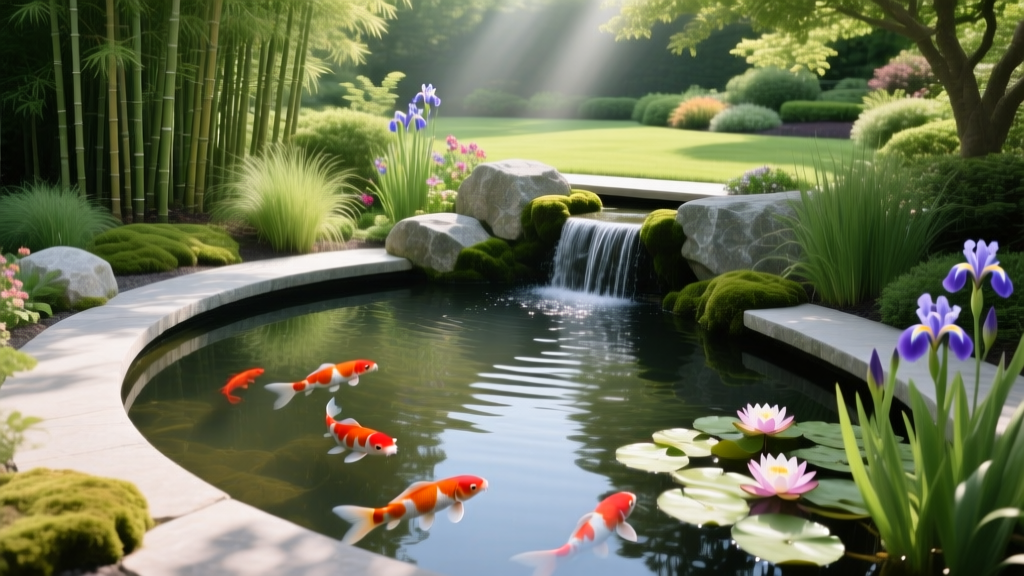
Beginner-Friendly Koi Pond Design Ideas & Layout Guide
The Golden Rules of Koi Pond Sizing and Depth
Japanese koi (Cyprinus rubrofuscus) are massive, active fish that can reach 36 inches in length and live for decades. Designing a habitat for them requires strict adherence to volume and depth parameters. The absolute minimum volume for a dedicated koi pond is 1,000 gallons. Anything smaller restricts their growth, degrades water quality rapidly, and makes temperature fluctuations lethal.
Critical Depth Requirement: Your pond must have a minimum depth of 3 feet, with at least one zone reaching 4 feet. This depth prevents the water from freezing solid in winter, deters wading predators like herons, and provides a cool thermal refuge during summer heatwaves.
When calculating your excavation footprint, remember that 1 cubic foot of water equals roughly 7.48 gallons. A pond measuring 10 feet long by 8 feet wide with an average depth of 3.5 feet holds approximately 2,094 gallons. Always account for displacement caused by large boulders and filtration equipment.
3 Beginner-Friendly Koi Pond Design Ideas
1. The Formal Rectangular Pond with Raised Coping
Ideal for small, structured yards or patio extensions. This design utilizes clean, geometric lines with a raised perimeter built from cinder blocks and capped with limestone or bluestone coping. The raised edge (18-24 inches above grade) serves a dual purpose: it prevents lawn runoff—loaded with fertilizers and pesticides—from entering the water, and it provides built-in seating. Filtration is typically hidden behind a formal waterfall wall or a faux stone skimmer box.
2. The Natural Bog-Edge Ecosystem
This design mimics a natural wetland edge by incorporating a shallow plant shelf (12 to 18 inches deep) that wraps around 50% of the pond perimeter. Marginal plants like Horsetail reed (Equisetum hyemale) and Canna lilies are planted in aquatic gravel beds. According to the University of Minnesota Extension, these marginal plants act as a massive biological filter, absorbing nitrates and phosphates directly from the water column, which starves out string algae. The transition from the shallow shelf to the 4-foot deep zone should feature a steep 45-degree slope to prevent soil collapse.
3. The Patio-Integrated Spillover
Perfect for homes with existing retaining walls or terraced landscapes. The pond is built directly into the base of a retaining wall, utilizing the wall's height to house a gravity-fed filtration system. Water is pumped from the pond up to a header pool behind the wall, then spills back down through a wide, sheer-descent waterfall. This design maximizes vertical space and masks the sound of neighborhood traffic with continuous white noise.
Essential Equipment: Filtration and Pump Sizing Matrix
Koi produce a heavy bioload. You cannot rely on standard garden pond pumps; you need dedicated koi-grade filtration. The general rule is to turn over the total pond volume 1.5 times per hour. Below is a sizing matrix for common beginner pond volumes.
| Pond Volume | Target Flow Rate | Recommended Pump Type | Filter System | UV Clarifier |
|---|---|---|---|---|
| 1,000 Gallons | 1,500 - 2,000 GPH | Submersible (e.g., Laguna Max-Flo 2100) | Oase BioTec ScreenMatic 12 | 18-Watt UV |
| 2,500 Gallons | 3,500 - 4,500 GPH | External (e.g., Sequence 4200) | Oase BioTec ScreenMatic 30 | 36-Watt UV |
| 5,000 Gallons | 7,500 - 8,500 GPH | External (e.g., Sequence 7500) | Helix Life Support 5000 | 2x 36-Watt UV |
External pumps are vastly more energy-efficient and easier to maintain than submersible pumps for ponds over 2,000 gallons, as they sit dry outside the pond and do not add heat to the water during summer.
Real-World 2026 Cost Breakdown for a 1,500-Gallon DIY Build
Building a koi pond is a significant capital investment. While professional contractors typically charge between $15,000 and $35,000 for a 1,500-gallon ecosystem, a DIY approach using premium materials will cost significantly less. Here is an accurate material breakdown for a DIY build:
- Liner: 45-mil EPDM rubber (Firestone PondGard) or RPE (Reinforced Polyethylene). EPDM costs roughly $1.50 per square foot. For a 15x12 footprint, budget $450.
- Underlayment: Non-woven geotextile fabric ($0.40/sq ft). Budget $120. Never use old carpet or sand alone; roots and sharp stones will puncture the liner.
- Bottom Drain: A 3-inch anti-vortex bottom drain (e.g., Oase ProfiClear) is mandatory for koi ponds to pull solid waste from the deepest point. Budget $180.
- Filtration & Pump: Oase BioTec ScreenMatic 18 ($950) and Sequence 4200 external pump ($650).
- Plumbing: Flexible PVC pipe (1.5 inch or 2 inch), O-rings, and PVC cement. Budget $250.
- Hardscaping: 2 to 3 tons of fieldstone and limestone coping. Budget $800 - $1,200 depending on local quarry delivery fees.
Pro-Tip on Liners: While 45-mil EPDM has been the industry standard for decades, Reinforced Polyethylene (RPE) is increasingly preferred by professionals. RPE is lighter, more puncture-resistant, and does not require a separate underlayment layer, which can offset its slightly higher per-square-foot cost.
Water Loss, Evaporation, and Top-Off Systems
Beginners often underestimate water loss. According to the EPA WaterSense program, outdoor water features can lose significant volume to evaporation, especially in arid climates or during peak summer. A 100-square-foot pond surface area can lose up to 10 gallons a day in high heat. Relying on a garden hose to top off the pond introduces chlorine and heavy metals, which can burn koi gills.
The Fix: Install an automatic float valve connected to a dedicated irrigation line equipped with a dechlorinator dosing pump, or use a mechanical auto-fill valve (like the AquaFill system) paired with a carbon filter inline. This ensures water levels remain constant, protecting your skimmer's ability to function.
Common Beginner Mistakes and Edge Cases
- Overstocking: The golden ratio is one adult koi per 250 gallons of water. A 1,000-gallon pond supports a maximum of four adult koi. Adding more will overwhelm the biological filter, leading to ammonia spikes and lethal nitrite poisoning.
- Shallow Edges: Raccoons and Great Blue Herons will wade into ponds with gradual, sloping edges. Design your pond with sheer, vertical drop-offs immediately below the water surface (at least 18 inches straight down) to make wading impossible for predators.
- Skipping the Bottom Drain: Submersible pumps placed on the pond floor only clean the immediate vicinity. Without a gravity-fed bottom drain piping waste to a settlement chamber, fish feces and decaying leaves will accumulate in the center, creating toxic hydrogen sulfide gas pockets.
- Ignoring Head Loss: When buying a pump, the GPH rating on the box is measured at zero head (no elevation). If you are pumping water 4 feet up a waterfall through 15 feet of pipe, you lose roughly 30% of the flow. Always oversize your pump by 30% to compensate for friction and elevation head loss.
'A koi pond is not just a water feature; it is a living, breathing biological machine. The design of the hardscape is secondary to the engineering of the hydraulics and filtration.' — Professional Aquatic Ecosystem Builders Guild

