
Landscaping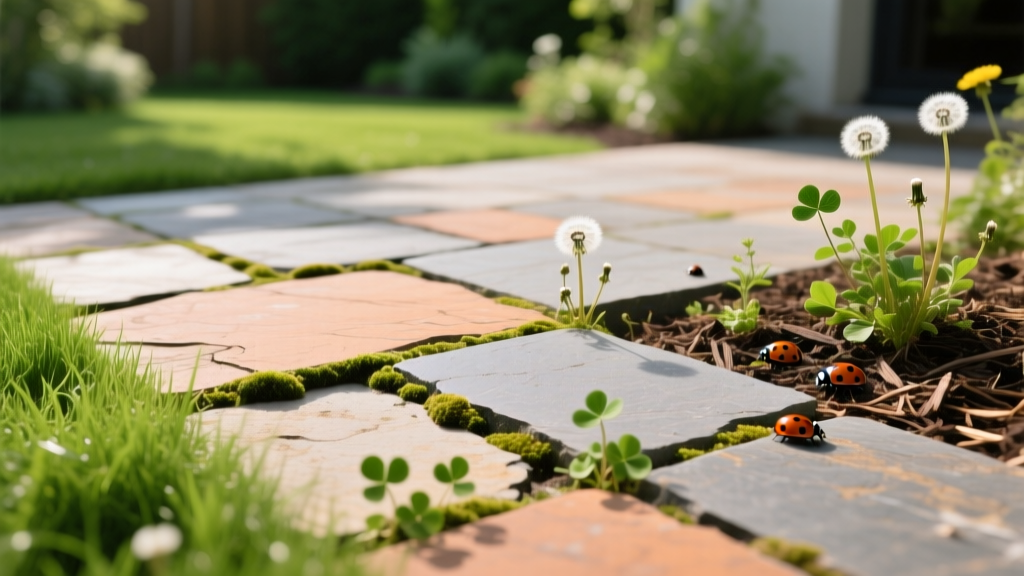
Natural Flagstone Patio Care: Organic Weed and Pest Control Guide
The Hidden Cost of Synthetic Herbicides on Porous Stone
A natural flagstone patio anchors your landscape with rustic elegance, but the irregular joints between stones are notorious magnets for weed seeds. While reaching for a synthetic glyphosate-based herbicide might seem like the fastest solution, it introduces severe long-term risks to both your hardscape and the surrounding soil ecology. Systemic chemical herbicides leave behind salt residues that, when combined with freeze-thaw cycles, accelerate spalling (the flaking and peeling of the stone surface) in highly porous sedimentary rocks like sandstone and limestone.
Furthermore, chemical runoff alters the soil pH in adjacent garden beds, disrupting the mycorrhizal fungi networks essential for the health of nearby trees and shrubs. Maintaining a pristine natural flagstone patio requires a shift toward organic, bio-based controls and physical jointing strategies that outcompete weeds without introducing toxic residues into your yard.
Eco-Friendly Jointing Strategies: The First Line of Defense
The most effective chemical-free weed control begins beneath the surface. If your flagstone joints are filled with loose masonry sand, weeds will inevitably take root. Upgrading your jointing material creates a physical barrier that blocks light and restricts root expansion.
| Jointing Material | Weed Resistance | Permeability | Best Stone Type |
|---|---|---|---|
| Crushed Decomposed Granite (DG) | Moderate (Requires compaction) | High (Excellent drainage) | Arizona Buff / Sandstone |
| Organic Resin-Bound Sand | High (Binds without cement) | Moderate | Pennsylvania Bluestone |
| Living Joints (Moss/Thyme) | High (Outcompetes weeds) | Very High | Irregular Fieldstone |
| Standard Polymeric Sand | Very High (Hardens like concrete) | Low (Can cause pooling) | Cut/Rectangular Flagstone |
For homeowners strictly avoiding synthetic polymers, plant-based resin-bound sands offer a 100% natural alternative to traditional polymeric sand, utilizing pine rosin and plant starches to lock joint sand in place while maintaining water permeability.
Organic Post-Emergent Eradication Tactics
When weeds inevitably breach your jointing material, organic post-emergent treatments provide rapid burn-down without soil toxicity. However, stone composition dictates which organic acid you can safely use.
d-Limonene (Citrus Oil Extracts)
Products like Avenger Organics Weed Killer utilize d-limonene, a compound extracted from citrus peels. According to the National Pesticide Information Center, d-limonene works by stripping the protective waxy cuticle from broadleaf weeds, causing rapid cellular dehydration. Priced around $42 per gallon, it is highly effective on a sunny day when temperatures exceed 70°F. Because it breaks down rapidly in sunlight and soil, it leaves zero toxic footprint near your patio edges.
Horticultural Vinegar (20% Acetic Acid)
While standard 5% household vinegar is ineffective on mature weeds, 20% horticultural acetic acid provides a aggressive burn-down. Critical Warning: Never apply acetic acid to calcareous stones like limestone, travertine, or certain sandstones. The acid reacts violently with calcium carbonate ($CaCO_3$), causing permanent pitting, etching, and structural weakening. Reserve vinegar treatments exclusively for siliceous stones like quartzite or granite-based flagstones.
Thermal Infrared Weeding
For deep-rooted perennials like bindweed or thistle growing in deep flagstone crevices, thermal weeding is the ultimate chemical-free tool. Infrared weeders, such as the Dragon Flame YD-2S ($165), connect to a standard propane tank and emit targeted 2,000°F heat. You do not incinerate the weed to ash; instead, you pass the emitter over the foliage for two seconds. This boils the water inside the plant cells, rupturing them and causing the weed to wilt and die within 24 hours, safely avoiding any chemical contact with the stone.
Pre-Emergent Biological Controls
Stopping weeds before they germinate is the cornerstone of organic landscaping. Corn Gluten Meal (CGM) is a natural byproduct of the corn milling process that acts as a potent pre-emergent herbicide. It works by inhibiting root formation during the seed germination phase. The EPA Safer Choice program recognizes such bio-based controls as low-risk alternatives to synthetic pre-emergents like pendimethalin.
Application Protocol for Corn Gluten Meal:
- Rate: Apply exactly 20 lbs per 1,000 square feet of patio and adjacent bed area.
- Timing: Apply when soil temperatures consistently hit 55°F at a 2-inch depth (typically early spring for crabgrass, and late summer for fall weeds).
- Activation: Requires a light watering (about 1/4 inch) immediately after application to activate the proteins, followed by 48 hours of dry weather to dehydrate the germinating seedlings.
- Limitation: CGM will not harm established weeds or desirable plants; it only affects seeds. Do not use if you are intentionally seeding a living joint with creeping thyme or clover.
Embracing the "Living Joint"
Rather than fighting nature to keep joints bare, many landscape architects are designing natural flagstone patios with "living joints" intentionally planted with low-growing, drought-tolerant groundcovers. This approach completely eliminates the need for weed control by occupying the ecological niche weeds would otherwise exploit.
- Creeping Thyme (Thymus serpyllum): Ideal for full-sun patios. It tolerates light foot traffic, grows only 2-3 inches tall, and emits a pleasant fragrance when stepped on. Its dense root mat physically chokes out dandelion and clover seeds.
- Irish Moss (Sagina subulata): Best for partially shaded flagstone areas. It forms a lush, emerald-green carpet that thrives in the micro-climate created by the thermal mass of the surrounding stone.
- Blue Star Creeper (Isotoma fluviatilis): Excellent for wide joints (1+ inches). It produces tiny pale blue flowers and handles heavy moisture runoff from the patio surface better than thyme.
Troubleshooting Matrix: Organic Responses to Common Patio Weeds
| Weed Species | Growth Habit | Organic Treatment Strategy | Optimal Application Window |
|---|---|---|---|
| Annual Bluegrass (Poa annua) | Shallow annual grass | Corn Gluten Meal pre-emergent | Early Fall (Soil cooling to 70°F) |
| Dandelion (Taraxacum) | Deep taproot perennial | Hand-pull tool + d-limonene spot spray | Spring/Early Summer (Active growth) |
| Field Bindweed | Vining perennial | Infrared thermal weeder (repeated passes) | Pre-flowering vining stage |
| Spotted Spurge | Low, matting annual | Horticultural vinegar (20%) on siliceous stone only | Mid-summer heat spikes |
Routine Chemical-Free Maintenance Schedule
Consistency is the key to a chemical-free hardscape. Follow this seasonal rhythm to maintain your natural flagstone patio:
- Early Spring: Sweep joints thoroughly with a stiff-bristled broom to remove winter debris and weed seeds. Apply Corn Gluten Meal before soil temperatures reach 55°F. Inspect jointing sand for washouts and top-dress with crushed DG or resin-bound sand where necessary.
- Early Summer: Spot-treat any breached broadleaf weeds with d-limonene on a hot, windless morning. If utilizing living joints, shear creeping thyme back by 30% after its first bloom to encourage dense, lateral growth that shades out weed seeds.
- Late Fall: Remove fallen leaves immediately; decaying organic matter in joints creates a nutrient-rich seedbed for spring weeds. Apply a second round of Corn Gluten Meal to target fall-germinating weeds like annual bluegrass.
Pro-Tip on Power Washing: Avoid high-pressure power washing on natural flagstone. Pressures above 1,500 PSI will scour the soft matrix of sedimentary stones and blast out your organic jointing materials, creating deep voids that guarantee future weed infestations. Use a surface cleaner attachment at low pressure, or rely on stiff-bristled mechanical sweeping and organic enzyme-based stone cleaners to remove algae and stains.

